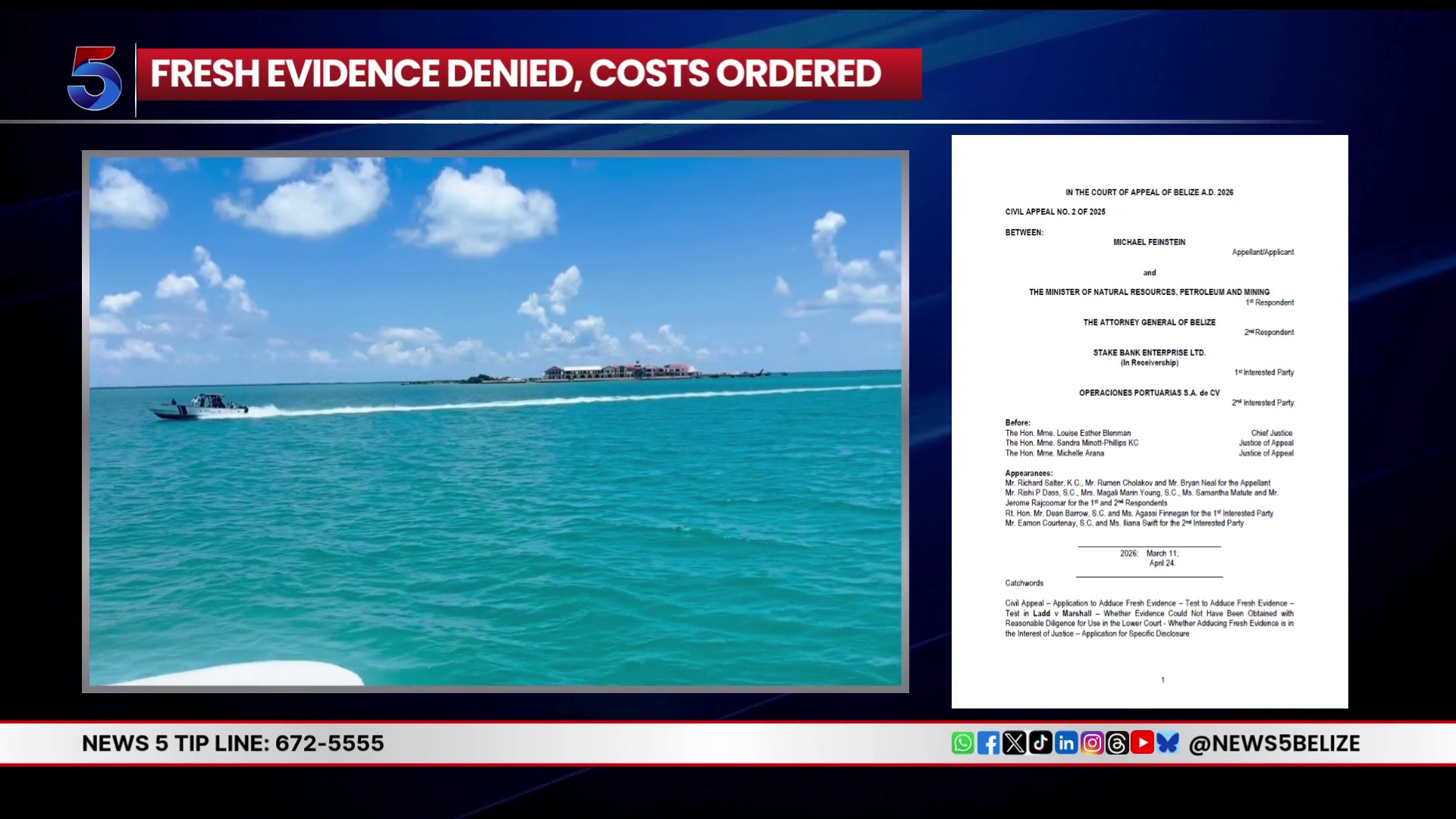
A key legal battle over Belize’s high-profile Stake Bank Extension cruise port project took a decisive turn last week, when the Court of Appeal ruled against local businessman Michael Feinstein’s bid to reopen his appeal case with newly submitted evidence.
Feinstein has been challenging the compulsory acquisition of his land for the infrastructure development, arguing that the government’s justification for seizing the property was legally flawed. To bolster his appeal, he sought court permission to introduce a fresh analysis from an independent tourism consultant that compares competing cruise port development options across Belize. He claimed the report would provide new context to prove the government’s original reasoning for the land acquisition was unfounded.
However, the appellate judges delivered a clear rejection of both his request to submit the new evidence and his separate demand for additional internal document disclosure from the government. In their written ruling, the court outlined that Feinstein could have secured and submitted the consultant’s report during the original trial if he had exercised reasonable professional diligence. Judges further emphasized that even if the report had been considered, it would not have altered the final outcome of the initial case.
The ruling also reinforced a core principle of appellate procedure: appeals are not intended to give litigants a second opportunity to construct an entirely new case using evidence that was omitted from the original trial proceedings. On the matter of document disclosure, the court labeled Feinstein’s request for additional government records as unnecessary at this late procedural stage, noting that granting the order would not serve the public interest of justice.
The outcome of this procedural hearing clears a major path for the government, removing a key barrier that threatened to delay the ongoing appeal process. As a consequence of the ruling, Feinstein was also ordered to cover the legal costs incurred by the government and all other parties involved in responding to his application. Moving forward, the substantive appeal will proceed to a full hearing based solely on the evidence that was already entered into the court record during the original trial, with the core question remaining whether the initial judgment upholding the compulsory land acquisition was legally valid.
Legal and development observers note that this ruling sets a clear precedent for procedural conduct in appellate land dispute cases in Belize, while the final outcome of the substantive appeal will have long-lasting implications for the future of the Stake Bank cruise port project, a major development initiative expected to boost the country’s tourism sector. News outlets will continue to cover the case as it moves toward its full substantive hearing.