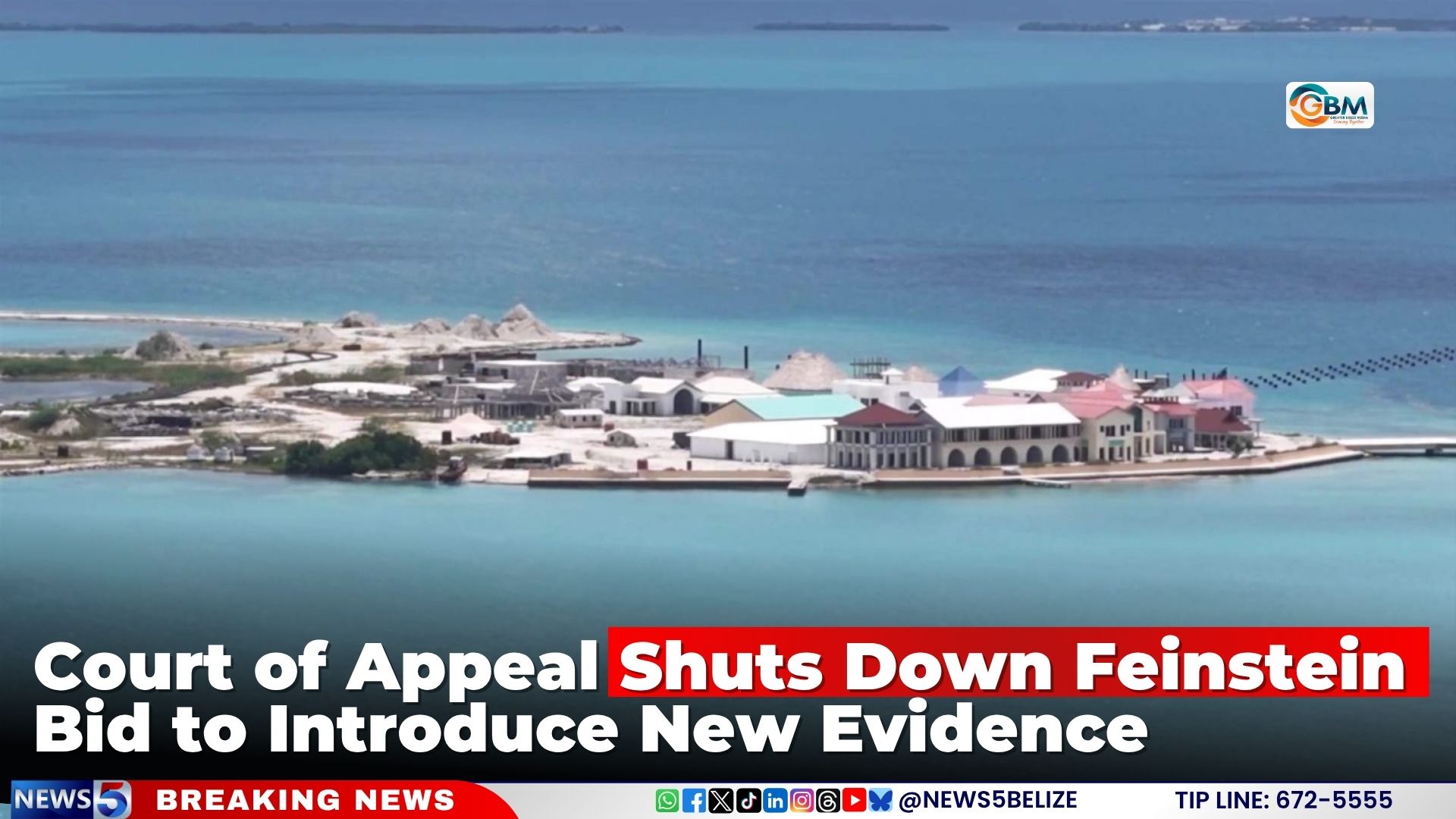
A key legal battle over the compulsory acquisition of private land for a major Caribbean cruise port development hit a major procedural hurdle this week, as an appellate court has turned away landowner Michael Feinstein’s bid to include a critical previously undisclosed government report in his ongoing appeal. The ruling marks a significant setback for Feinstein, who has challenged the government’s seizure of his 23.4-acre plot adjacent to Belize’s Stake Bank Island, but it does not bring the broader constitutional challenge to an end.
At the heart of the rejected application was a 2024 consulting report commissioned by Belize’s Ministry of Tourism, completed just two months before the government formally announced its intent to seize Feinstein’s land for the Stake Bank cruise port project. Prepared by independent consultants Osric Forrest and Orlando Hewitt, the report compared the Stake Bank site against two competing potential locations: the Port of Magical Belize and the existing Port of Belize. In its assessment, the consultants labeled the Stake Bank development itself as “defunct”, a finding Feinstein argues undermines the entire legal basis for the land seizure.
Feinstein, whose legal team is led by London-based King’s Counsel Richard Salter, argues the report exposes a fatal flaw in the government’s justification for the acquisition. The government has maintained seizing the land is a legitimate public interest project to grow Belize’s tourism economy through a new cruise port. But Feinstein contends that if the government’s own consultants were already calling the Stake Bank project nonviable and recommending alternative sites months before the seizure declaration, the government’s public interest claim is built on false pretenses. He further alleges the seizure is not actually for public benefit at all, but rather is a move to resolve a tangled private ownership dispute in favor of connected commercial investors.
Alongside seeking to admit the 2024 consulting report, Feinstein also asked the Court of Appeal to compel the government to release six categories of internal documents, including full Cabinet records and all communications between the Ministry of Tourism and Ministry of Natural Resources in the months leading up to the acquisition declaration.
The three-judge appellate panel, led by Chief Justice Blenman, issued a unanimous ruling rejecting both of Feinstein’s applications. Blenman based the decision on the long-established Ladd v Marshall legal standard, which sets three strict conditions for any party seeking to introduce new evidence during an appeal: first, the evidence could not have been obtained through reasonable diligence before the original trial concluded; second, the evidence would likely have had a material impact on the original trial’s outcome; and third, the evidence is clearly credible.
Addressing the first condition, Chief Justice Blenman was unambiguous in the court’s finding: Feinstein already had full knowledge that alternative cruise port sites were under government consideration when the original trial was underway. Feinstein’s own trial affidavit explicitly referenced the competing proposals, his own witnesses raised the issue during proceedings, and Prime Minister John Briceño had even made public comments about the alternative port plans. Given this existing information, the court ruled, Feinstein could have requested disclosure of the 2024 report and related internal documents during the original trial, but he chose not to do so.
“This was a clear litigation choice by Mr. Feinstein to frame his case in the way he did,” Chief Justice Blenman wrote in the ruling. The court emphasized that the Ladd v Marshall standard is not designed to give parties that have already argued their case “a second bite at the proverbial cherry” by introducing new evidence they chose not to pursue earlier in the proceedings.
The court also rejected Feinstein’s argument that the report would have changed the original trial’s outcome. Even if the report had been included in the original analysis, judges noted, the core finding of the lower court would still stand: at the time of the acquisition, the Stake Bank project was the only proposal with all required regulatory approvals in place, construction equipment already on site, and full financing secured. The Port of Magical Belize, while it had completed an environmental assessment and secured a preliminary agreement with cruise line Royal Caribbean, remained only a conceptual project with no formal approvals. The court further ruled that the consultants’ use of the word “defunct” to describe the Stake Bank project could not be taken as an official statement of the government’s own position on the development.
Having failed to meet two of the three required conditions under the Ladd v Marshall standard, Feinstein’s application for new evidence was dismissed in full. The broader substantive appeal, which will ultimately rule on whether the government’s compulsory acquisition of Feinstein’s land violates constitutional protections for private property, is still scheduled to be heard at a future date.