A simmering territorial dispute between Guyana and Venezuela has erupted into a full-blown diplomatic controversy across the Caribbean Community (CARICOM), after Venezuelan President Delcy Rodriguez appeared in official meetings with multiple Caribbean leaders wearing a brooch that displays Venezuela’s map claiming Guyana’s resource-rich Essequibo Region as Venezuelan territory. The incident has sparked sharp criticism from a senior Guyanese official, internal political pushback within Guyana, and calls for regional accountability just weeks before the International Court of Justice (ICJ) hears formal arguments on the decades-long dispute.
In a blunt, public statement shared via Facebook late Monday, Guyana’s Minister of Local Government Priya Manickchand slammed CARICOM leaders who hosted Rodriguez and allowed the provocative display to go unchallenged during official engagements. Just hours before Manickchand’s post, Rodriguez had appeared alongside Barbados Prime Minister Mia Mottley at official events in Bridgetown while wearing the map brooch, which explicitly lays claim to the 159,000-square-kilometer Essequibo Region that makes up roughly two-thirds of Guyana’s total territory. This was not an isolated incident: earlier in April 2026, Rodriguez wore an identical brooch during meetings with Grenada Prime Minister Dickon Mitchell.
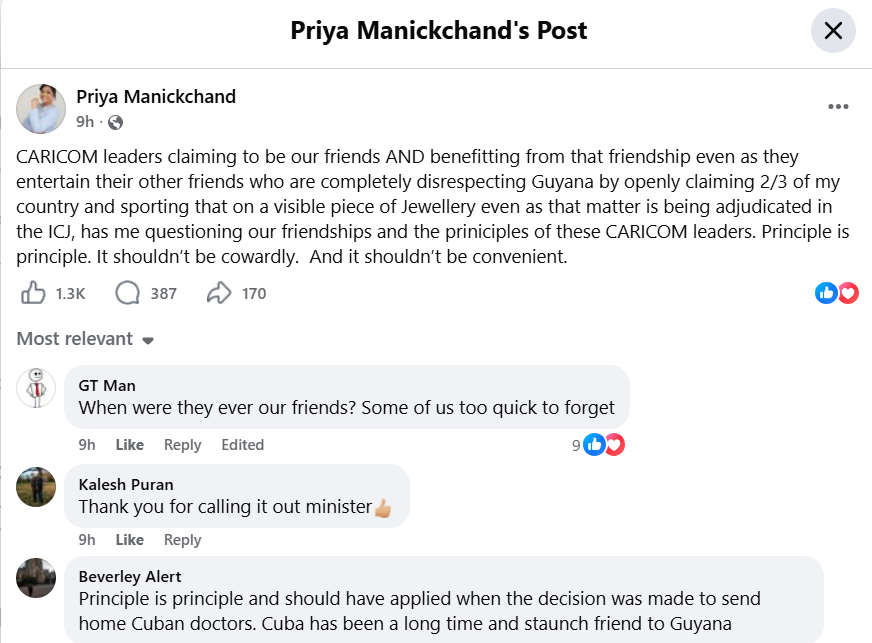
Manickchand questioned the integrity of alliances between Guyana and other CARICOM members, noting that the territorial dispute is currently under active adjudication at the ICJ. “CARICOM leaders claiming to be our friends and benefitting from that friendship even as they entertain their other friends who are completely disrespecting Guyana by openly claiming two-thirds of my country and sporting that claim on a visible piece of jewellery has me questioning our friendships and the principles of these CARICOM leaders,” she wrote. The long-serving cabinet minister emphasized that commitments to sovereignty and territorial integrity should not be set aside for political convenience, adding “Principle is principle. It shouldn’t be cowardly. And it shouldn’t be convenient.”
The criticism quickly sparked a domestic political backlash within Guyana. Beverly Alert, an executive member of the opposition Alliance For Change (AFC) and a former parliamentarian, hit back at Manickchand, accusing the Guyanese government of applying a double standard to questions of principle. Alert argued that the government itself abandoned principle when it terminated the country’s Cuban Medical Brigade programme, a move that came after the United States threatened to revoke visas for Guyanese officials and their immediate families over unsubstantiated claims that Cuban medical workers were exploited by the Cuban government. “Principle is principle and should have applied when the decision was made to send home Cuban doctors. Cuba has been a long time and staunch friend to Guyana,” Alert noted. Guyana was one of several CARICOM nations that ended the popular medical programme under U.S. pressure.
To date, the Guyanese government has not released an official public statement on the controversy, which has been labeled “brooch gate” by regional political commentators. However, key private sector groups with close ties to the Guyanese administration have publicly condemned Rodriguez’s action and called for regional pushback. The Private Sector Commission (PSC), Guyana’s leading private sector umbrella organization, did not name Grenada in its statement but explicitly called on Barbados, CARICOM, and the broader international community to denounce the provocative move.
“We call on the Government of Barbados, a valued CARICOM partner and long-standing friend of Guyana to stand firmly in defence of Guyana’s sovereignty and territorial integrity. Further, we call on CARICOM and all regional and international partners to remain vigilant and unequivocal in their support for the rule of law. Silence or inaction in the face of such deliberate provocation risks emboldening further escalation,” the PSC said.
The controversy comes at a critical juncture for the territorial dispute. Next month, the ICJ will hold multiple days of public hearings where both Guyana and Venezuela will present the full merits of their arguments over the validity of the 1899 Arbitral Tribunal Award, which originally granted Essequibo to Guyana. The ICJ is expected to issue a final ruling on the case, which was brought to the court by Guyana, in the first quarter of 2027.
While CARICOM as a bloc has repeatedly formally affirmed Guyana’s sovereignty over the Essequibo Region, many small CARICOM island states have maintained close bilateral ties with successive Venezuelan governments led by Hugo Chávez and Nicolás Maduro. These relations have been supported by decades of concessionary oil pricing and other forms of economic assistance from Caracas, creating a split in regional commitments that has been laid bare by the brooch controversy.