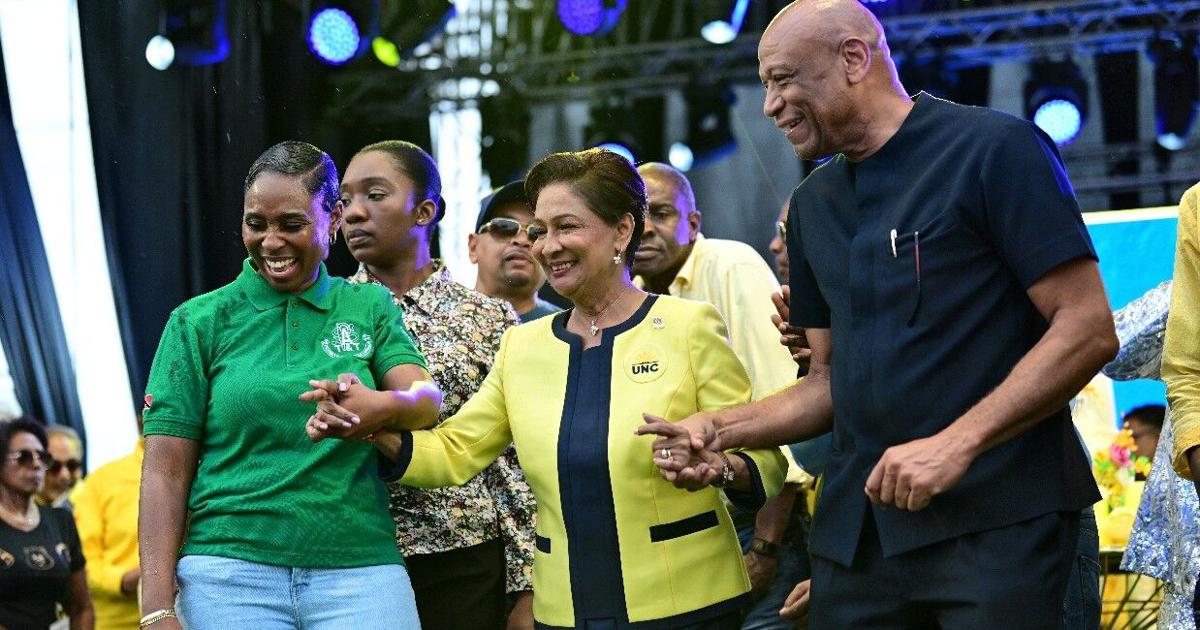
When the United National Congress (UNC) took power in Trinidad and Tobago in April 2025, it inherited a national treasury drained of resources and a decade of systemic mismanagement left by the previous People’s National Movement (PNM) administration. Prime Minister Kamla Persad-Bissessar laid out this challenging starting point and detailed her government’s early policy wins during a keynote address at the UNC’s 37th annual national congress, held Saturday in Couva.
Persad-Bissessar painted a stark picture of the economic damage the new administration inherited, telling assembled supporters that meaningful national recovery will require years of targeted effort to reverse a decade of damage. During the PNM’s 10-year tenure, she said, the country’s total national debt surged from $75.4 billion in 2015 to $144.7 billion in 2025 – a near-doubling of the national obligations. At the same time, overall economic output shrank by 20%, the country’s foreign reserve holdings were cut in half, and billions in public savings were withdrawn from state accounts.
Despite this weak starting position, Persad-Bissessar emphasized that the UNC has already delivered on core campaign promises within its first months in office. The administration quickly released a people-first national budget that cut the price of super gasoline by $1 per unit and eliminated value-added tax on all essential food items, policies designed to reduce cost-of-living burdens for working households.
“We restored fairness to a system where, for too long, ordinary citizens carried the weight of elite mismanagement,” the prime minister said. “Your UNC Government put more money back into your pockets.”
One of the administration’s most high-profile early achievements is a 10% wage increase for public sector workers, a policy the prime minister highlighted as a top campaign pledge fulfilled. An agreement between the Chief Personnel Officer and the Public Services Association (PSA) has already locked in the raise, delivering pay increases to more than 51,000 public workers: 17,000 PSA members, 20,000 National Union of Government and Federated Workers members, and 14,000 public school teachers. Persad-Bissessar confirmed that negotiations and planning are already underway to extend similar wage adjustments to other public sector employee groups. The government has also fulfilled its pledge to eliminate taxes on private pensions, a win for retired citizens across the country.
Beyond domestic policy gains, the UNC has successfully restored international investor and institutional confidence in Trinidad and Tobago’s economy, the prime minister said. Within its first year in office, the administration successfully issued a US$1 billion sovereign bond that drew 2.5 times oversubscription, with participation from more than 140 institutional investors across the globe. “That is a clear signal – the world believes in Trinidad and Tobago again,” Persad-Bissessar said. The government has also secured the country’s removal from both the European Union’s tax blacklist and the Financial Action Task Force’s (FATF) anti-money laundering blacklist, reversing diplomatic and economic damage from the previous administration and rebuilding the country’s global credibility.
As it works to resuscitate long-stagnant economic growth, the UNC government has placed a high priority on targeted social support for vulnerable and marginalized citizens, the prime minister added. The government has already disbursed $1 million in ex gratia compensation to families impacted by the 2022 Paria diving tragedy, a long-unresolved issue the previous administration failed to address. A wide range of ongoing social programs are delivering tangible support: more than 117,000 elderly citizens have received $3.8 billion in pension payments; 25,602 people living with disabilities have accessed $520.3 million in disability grants; 13,869 low-income vulnerable families have received $216 million in direct cash support; 12,614 people have accessed $75.7 million in targeted food assistance; and 2,808 people impacted by disasters have benefited from 1,232 individual disaster relief grants.
### Progress in Healthcare and Diplomatic Outreach
Beyond economic and social policy, Persad-Bissessar highlighted meaningful improvements to the country’s public healthcare system, long plagued by underfunding and access gaps. The Couva Children’s Hospital, shuttered for years under the previous administration, has been fully reopened and has already completed more than 600 same-day surgical procedures. Regional health authorities have expanded access to care across the country, doubling the number of operational public healthcare clinics and adding hundreds of new doctors, nurses and frontline medical staff to the understaffed public system.
On the diplomatic front, the UNC government has reengaged with global and regional partners at the highest levels to rebuild bilateral and multilateral ties, the prime minister said. She pointed to her own high-level meeting with United States President Donald Trump during the recent Summit of the Americas as a key step in repairing bilateral relations, as well as a meeting between Foreign and Caricom Affairs Minister Sean Sobers and King Charles III during an official visit to the United Kingdom. Persad-Bissessar came to Sobers’ defense amid recent controversy over Trinidad and Tobago’s objection to the reappointment of Caricom Secretary-General Dr. Carla Barnett, dismissing unsubstantiated claims that Sobers missed a key negotiating meeting due to seasickness as baseless rumor. The prime minister also highlighted a successful official visit by Indian Prime Minister Narendra Modi, which deepened long-standing cultural and economic bilateral ties between the two nations.
For the island of Tobago, Persad-Bissessar reaffirmed that equitable development remains a top priority for the UNC administration. The 2025 national budget included the largest ever allocation for Tobago, totaling $3.725 billion earmarked for local infrastructure and social programs. The long-standing airfare subsidy for the domestic inter-island airbridge remains in place, and the cabinet has not yet made a final decision on a proposal to add two new unsubsidized flights to the route. The national government is also working closely with the Tobago House of Assembly (THA) to advance a full slate of legislative and administrative reforms: addressing long-standing legal anomalies in the THA Act, exploring the creation of a dedicated Tobago Local Police Service, reforming the outdated alien landholding licensing system, maintaining the existing export licence for the Studley Park quarry, advancing planning for a new desalination plant in Charlotteville to address chronic water shortages, and resolving decades-long unresolved land tenure disputes for local residents.