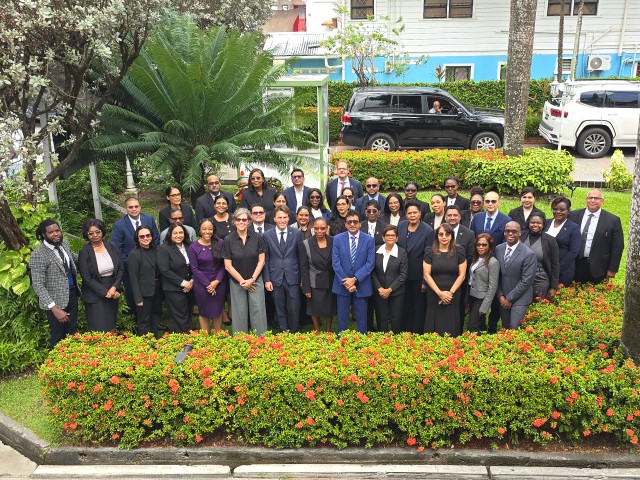
GEORGETOWN, Guyana – April 27, 2026 – Guyana has launched a full overhaul of its 17-year-old Anti-Money Laundering and Countering Financing of Terrorism (AML/CFT) regulatory framework, with plans to introduce a modern, consolidated bill ahead of a 2027 international compliance assessment, Attorney General Anil Nandlall announced Monday.
Nandlall made the announcement during the opening ceremony of a four-day justice sector training workshop hosted under the Partnership of the Caribbean and European Union on Justice (PACE) initiative, a program co-funded by the European Union (EU) and the United Nations Development Programme (UNDP). The event brought together senior judicial officers, including judges, magistrates, registrars and appellate justices, to build capacity for handling complex criminal cases.
The current AML/CFT law, first enacted in 2009 and patched with repeated amendments over more than a decade, has developed disjointed, inconsistent language that creates risks of misinterpretation in court, Nandlall explained. Beyond fixing structural issues, the new legislation will incorporate updated global standards that have emerged since the original bill passed. “Not that the one that we have is bad, but we have cut and paste over the years so many things that it reads in a disjuncted way, and it can cause problems in terms of interpretation. In addition to that, there have been changes that have been made in the world, and we have to incorporate that,” he told attendees.
A third-party consultant is already drafting the replacement bill, which will introduce a key procedural shift: a major transfer of the burden of proof to defendants accused of financial crimes. Nandlall acknowledged that the new law will include unusual, far-reaching provisions that may require judicial caution during implementation. He also noted the inherently broad and invasive nature of AML/CFT regulation, which includes powers of pre-conviction detention and asset forfeiture that can complicate traditional fairness frameworks. These requirements are not arbitrary, he added; they reflect mandatory international standards set by global regulatory bodies that monitor anti-financial crime frameworks worldwide.
Guyana is a member of three key global and regional anti-financial crime bodies: the Caribbean Financial Action Task Force (CFATF), the Paris-headquartered Financial Action Task Force (FATF) – the global standard-setting watchdog for money laundering and terrorist financing – and the Canada-based Egmont Group of Financial Intelligence Units, which facilitates cross-border intelligence sharing to combat illicit financial activity.
The new legislation must be passed quickly, Nandlall emphasized, because Guyana will undergo a mandatory mutual evaluation by the CFATF next year, for which preparations are already underway. He noted that Guyana earned the highest compliance score among independent Caribbean nations in the CFATF’s last assessment, putting the country on strong footing, but a full regulatory update is still required to maintain that standing. “We are on good footing there, but we have to revamp the legislation and get a new one,” he said.
Monday’s event launched the PACE project training, which will cover a wide range of topics to modernize Guyana’s criminal justice system, including jury selection and orientation, pre-arraignment procedures, handling of complex criminal trials, no-case submissions, support protocols for vulnerable witnesses and defendants, pre-trial publicity management, and summation best practices. UNDP Resident Representative Katy Thompson noted that the training prioritizes both effective trial outcomes and protection of the fundamental rights of all parties involved in criminal proceedings.
Chancellor of the Judiciary Roxane George-Wiltshire added that the curriculum will also address emerging legal issues including pre-trial voir dire processes, the handling of DNA and digital evidence, the integration of artificial intelligence in judicial work, streamlined concurrent case tracks for appellate and high court judges, and an introduction to judge-alone trials – a procedural reform that Guyana is preparing to adopt. “Which is really timely, as it is my understanding that Guyana will be moving in this direction,” she said.
The training is designed to help the judiciary meet its constitutional mandate: delivering fair hearings within a reasonable timeframe before an independent, impartial tribunal, as outlined in Article 144 of Guyana’s Constitution. “The training will therefore further enhance our capacity and capability to better address the criminal cases that will come before us so as to ensure that which Article 144 of the Constitution of Guyana mandates,” George-Wiltshire added.
EU Ambassador to Guyana Luca Pierantoni highlighted the tangible progress the justice sector has already made through the PACE initiative, including expanded human resource capacity via new judicial appointments and the distribution of updated official law reports. “Certainly, we can see a justice system which is more responding to certain challenges,” he said.