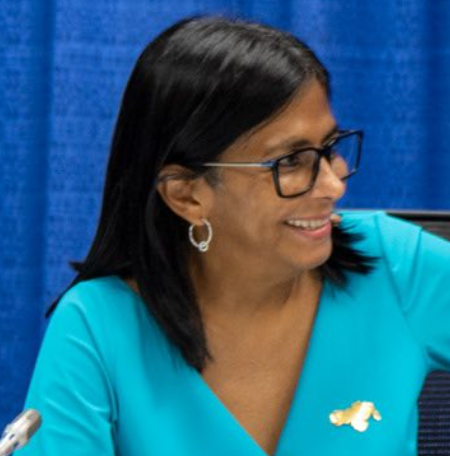
A diplomatic dispute over the contested Essequibo Region has flared up again after Venezuelan President Delcy Rodriguez wore a controversial map brooch during back-to-back official visits to Caribbean Community (CARICOM) member states, drawing sharp condemnation from a leading Guyanese industry group.
The incident unfolded on April 27, 2026, during Rodriguez’s second visit to a CARICOM nation in less than three months. Meeting with Barbadian Prime Minister Mia Mottley in Bridgetown, the Venezuelan leader was spotted wearing a lapel brooch that re-draws Venezuela’s map to incorporate the 159,000-square-kilometer Essequibo Region – a territory long recognized by international law as part of Guyana. This was not an isolated choice: Rodriguez wore the exact same brooch during an April visit to Grenada for talks with Prime Minister Dickon Mitchell, photographs of the encounter confirm.
Within hours of the Barbados meeting, the Aviation Operators Association of Guyana (AOAG), a trade body representing the country’s privately-owned domestic aviation carriers, issued a strongly worded statement condemning the gesture as deliberate, provocative aggression. The group labeled the brooch an “offensive emblem” and framed Rodriguez’s repeated use of the symbol during high-level diplomatic engagements as “continued provocative conduct” that undermines regional norms of peaceful dispute resolution.
“This calculated act is not diplomacy. It is theatrical aggression, wrapped in symbolism and intended to offend, intimidate, and destabilize,” the AOAG statement read. “It is especially insulting when displayed before the leaders and peoples of CARICOM, a community founded on mutual respect, sovereignty, and the peaceful settlement of disputes.”
The association called on all CARICOM member states to stand in solidarity with Guyana, urging regional governments to remain vigilant and reject any attempt – whether symbolic or practical – to legitimize what it calls Venezuela’s unlawful territorial claim. “The Caribbean must never provide a stage for territorial adventurism,” the statement added.
The long-running territorial dispute over Essequibo is currently working its way through the International Court of Justice (ICJ), the United Nations’ highest court for state-to-state disputes. Next month, the court will open multiple days of public hearings to hear arguments from both sides on the merits of the case, which centers on the legal validity of the 1899 Arbitral Tribunal Award that established the current border between Venezuela and what was then British Guiana. The ICJ is expected to issue a binding ruling on the dispute in the first quarter of 2027.
The AOAG emphasized that for more than 125 years, Guyana has maintained uninterrupted, peaceful, and internationally recognized sovereign administration over the entire Essequibo Region. The group argued that Rodriguez’s reliance on symbolic cartographic claims does not alter established international law, nor does it weaken Guyana’s commitment to defending its territorial integrity.
“Indeed, such conduct diminishes Venezuela far more than it threatens Guyana,” the statement continued. “It reflects a government more interested in manufacturing external disputes than addressing internal crises. A badge does not confer sovereignty. A lapel pin cannot erase treaties, arbitral awards, or the will of a free people.”
The AOAG reaffirmed the group’s unwavering position that the Essequibo Region has always been, and will forever remain, an inseparable part of Guyana’s sovereign territory.
Regional dynamics add a layer of complexity to the dispute: while all CARICOM member states have formally backed Guyana’s territorial claim, many small Caribbean island nations have maintained close fraternal ties with successive Venezuelan governments, dating back to the Hugo Chavez administration. In exchange for these warm relations, Venezuela has long provided the bloc with concessionary oil prices and other forms of development assistance, creating divisions in regional responses to Caracas’ ongoing claims.