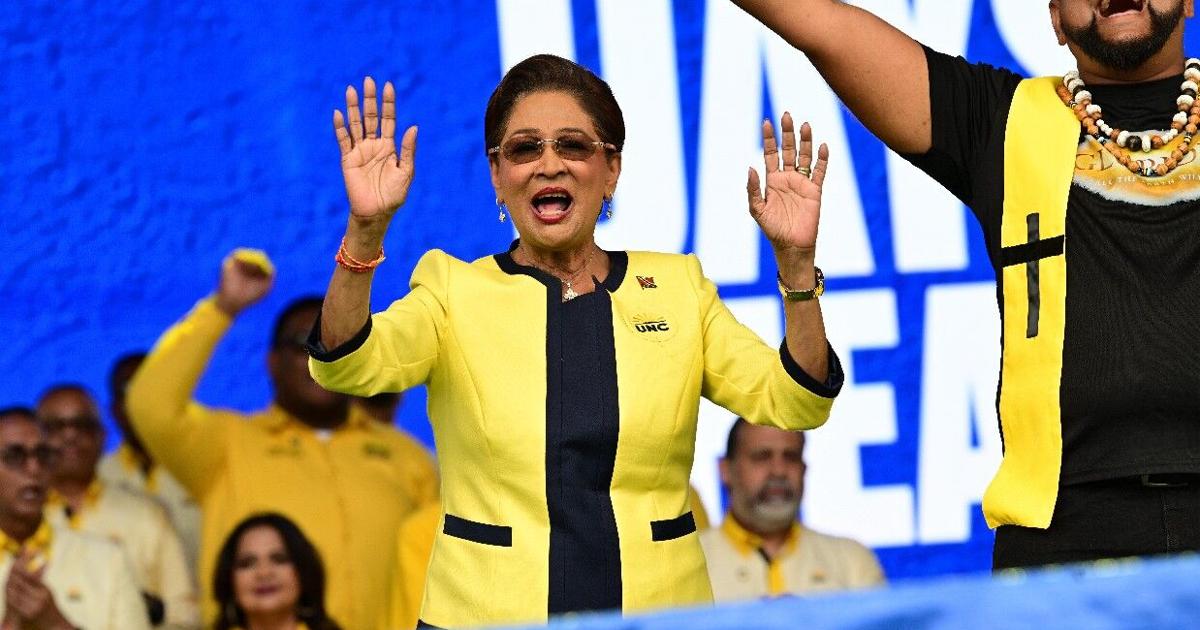
After one year at the helm of Trinidad and Tobago’s government under Prime Minister Kamla Persad-Bissessar, the United National Congress (UNC) administration has earned high marks from two leading political analysts, who point to the Prime Minister’s bold, decisive leadership as the driving force behind its early policy wins. In an exclusive interview with the Sunday Express, Professor Hamid Ghany and Dr Maukesh Basdeo both agreed that if a general election were called today, the incumbent UNC would defeat the opposition People’s National Movement (PNM) by a clear margin.
Professor Ghany, who awarded the UNC’s first-year performance an A grade, specifically highlighted Persad-Bissessar’s willingness to spend political capital on tough, transformative policy changes aligned with the party’s election manifesto, rather than opting for business-as-usual governance that prioritizes holding power over progress. “They had every opportunity to coast through their first year, enjoy the perks of office and delay hard choices. Instead, they moved immediately to deliver the fundamental societal changes they campaigned on,” Ghany explained.
When addressing the country’s most pressing challenge of violent crime, Ghany praised the Prime Minister’s uncompromising approach. He noted that Persad-Bissessar activated the previously signed SOFA security agreement with the United States to strengthen cross-border cooperation against narco-trafficking and illegal gun smuggling, a move he framed as a reflection of her fearless stance on national security. He also defended her decision to deploy a state of emergency (SoE) to target systemic violent crime, arguing that the policy was a continuation of efforts started by the previous administration, which never got the chance to extend the measure after dissolving parliament early. Without these hardline measures—including partnerships with the U.S. and new stand-your-ground legislation—ordinary citizens would remain vulnerable to criminal activity, Ghany added.
Ghany also called out what he labeled clear bias in traditional media coverage of the country’s crime trends. He noted that when crime and murder statistics dropped across all categories under the UNC administration, media outlets shifted their measurement framework from quantitative data to a qualitative narrative focused on public fear of crime, moving the goalposts to undermine the government’s progress.
On broader governance, Ghany argued that Persad-Bissessar’s leadership style has reshaped Trinidad and Tobago’s political landscape for the better. He pointed out that she has purged the party of the internal cabals, cliques and dynasties that undermined her first term, delivering the kind of decisive, purpose-driven leadership many voters have long wanted. “Detractors have long tried to stereotype her as an unfit leader, dismissing her as a ‘little country girl from Siparia’ who does not belong at the highest tables of government in Trinidad and Tobago or even Caricom. But she has turned their criticism into strength, and proven she will not tolerate underperformance from her administration,” Ghany said.
He added that the PNM’s current state of disarray, clearly demonstrated by its recent wipeout in the Tobago House of Assembly elections, cements the UNC’s likely election victory if a vote were held today. Looking to the future, Ghany expressed confidence that the UNC will successfully turn around the country’s economy, noting that the administration defied widespread doom-and-gloom predictions that its cross-border Venezuelan natural gas project would spark conflict and fail. “Critics said aligning with the U.S. administration would lead to war and the destruction of offshore infrastructure. Persad-Bissessar was right, and they were wrong. The economy will recover despite all the negative talk,” he said.
Dr. Basdeo offered a slightly more reserved but still positive assessment, grading the UNC’s first year a B+. He echoed Ghany’s prediction that the government would win an immediate general election, and outlined four core challenges the administration must address in the coming term, led by economic recovery and growth. Basdeo noted positive early signs for the energy sector, including ExxonMobil’s deepwater exploration and expanded exploration activities by BP and Shell, but said the government still needs to reverse broader economic decline and boost overall oil and gas output. He also highlighted the need to increase U.S. dollar availability through the domestic banking sector, pointing to the recent return of dividend payments for Trinidad and Tobago NGL Ltd shareholders after a three-year pause—including the option to receive payments in USD—as a promising first step.
Basdeo confirmed that crime remains a top ongoing challenge, noting that while the administration introduced the ZOSO bill to address the post-2025 crime surge after taking office on May 1, 2025, the legislation failed to win Senate approval. He said future progress will depend on the government advancing new effective legislative measures to tackle crime head-on. He also added that reversing long-term decline in public utilities, the public health sector and social services remains a critical unmet goal.
On leadership, Basdeo recalled Persad-Bissessar’s opening remarks when she took office, which underscored her firm resolve: “Never, ever mistake my physical appearance or my kindness for weakness. I think you all know there is nothing more dangerous than a mother who believes her children are in danger. Everyone will be wise to remember that for the next five years.” Like Ghany, Basdeo expressed long-term optimism about the country’s economic trajectory under the UNC, framing growing private investment as a key indicator of future success.