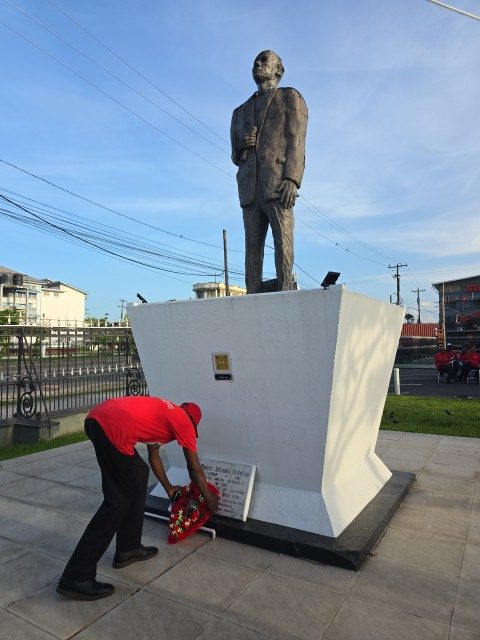
As Guyana kicked off its annual Labour Week celebrations on Sunday, April 26, 2026, the country’s leading trade union chief has amplified pressure on the ruling administration to roll out broad new consumer subsidies, blaming cascading global conflicts for driving up everyday costs for working Guyanese.
Norris Witter, president of the Guyana Trades Union Congress (GTUC), made the appeal immediately after he joined fellow union representatives in laying a ceremonial wreath at the Hubert Nathaniel Critchlow monument, located on the grounds of Georgetown’s Parliament Building. The annual tribute opens the country’s Labour Week, which honors the legacy of Critchlow, widely recognized as the founding father of Guyana’s trade union movement.
Speaking to reporters after the ceremony, Witter traced the current cost-of-living crisis in Guyana back to two overlapping global conflicts: the ongoing war between Russia and Ukraine, and the escalating tensions in the Persian Gulf. According to Witter, these dual crises have severely disrupted global supply chains, exacerbated fossil fuel shortages, and driven up prices for a wide range of essential goods nationwide.
To counteract these inflationary pressures, Witter argued that targeted government subsidies — what he called the “invisible hand of the State” — are the most effective immediate tool to stabilize prices for basic commodities. The call comes as transportation providers across the country have already implemented fare hikes: public buses, private taxis, and domestic airlines have all raised ticket prices in response to sharp spikes in global fuel costs.
Witter criticized the incumbent People’s Progressive Party Civic (PPPC) administration, arguing that the broad subsidy package the GTUC demands would require political will that the current government has so far failed to demonstrate. He accused the PPPC of overly aligning with Western geopolitical interests instead of prioritizing the economic needs of Guyanese workers, and called on the government to adopt a more inclusive approach that accommodates diverse perspectives from across Guyanese society.
Currently, the government already implements limited energy-related subsidies: it covers extra fuel costs for the state-owned Guyana Power and Light utility and Guyana Water Incorporated to prevent them from passing higher fuel expenses on to residential and commercial customers. The administration has also eliminated all taxes on gasoline and diesel, and state-owned petroleum firm Guyana Oil Company (GUYOIL) sells fuel at below-market rates to act as a price anchor for private fuel importers and distributors.
Witter acknowledged that many union members expect private and public sector employers to raise wages and salaries to help workers keep up with rising costs. However, he emphasized that the ultimate responsibility for taming inflation falls on national policymakers. “Even though the unions will have a right to engage the employers for meaningful increases, we must not lose sight of the fact that it is political managers who manage the national economy, who have that foremost responsibility to ensure that the kinds of policies and programmes are put in place to arrest the increase in the cost of living,” Witter said.
Witter’s comments echo recent criticism from former Guyanese Finance Minister Winston Jordan, who has also called on the PPPC government to take stronger action to address the cost of living. Jordan recently recommended that the government distribute an interim salary increase to public workers using funds already allocated in the 2026 national budget, then revise the entire budget to cut non-essential spending on low-priority infrastructure projects. He has also faulted the administration for failing to roll out a public fuel conservation education campaign and implement formal policies to crack down on predatory price gouging by retailers and suppliers.