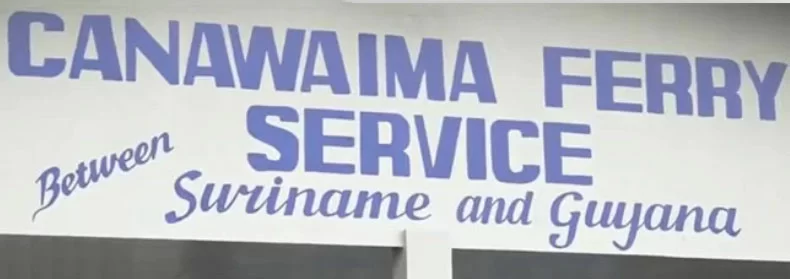
For investigative journalists, there are moments when observation gives way to deep unease — a gut feeling that something is fundamentally off in the narrative unfolding before them. In recent days, that uncomfortable sensation has grown stronger and stronger amid the cascade of revelations surrounding Suriname’s Canawaima Management Company, the state-owned operator of the key ferry link between Suriname and Guyana. Loose ends outnumber confirmed facts, questions pile up far faster than answers, and the entire affair leaves the public with more uncertainty than clarity.
The chaos began when politician Newara took to Facebook Live, waving a set of documents he claimed were invoices from local repair firm Sardha. These invoices, Newara alleged, were for massive sums of work carried out on the ferry’s faulty engine — work that had left the vessel relying on a pushboat to stay operational for months. Newara directly tied the invoices and the alleged contract to two members of Canawaima’s supervisory board (Raad van Commissarissen): president-commissioner Richenel Vrieze and board member Edgar van Genderen.
The accused board members have pushed back with a consistent account: they confirm the documents were taken from their possession during an official work visit, but stress the invoices in question had never even been submitted to Canawaima’s management for processing. For its part, Sardha has issued a blanket denial of any connection to the invoices. The firm says it never drafted or submitted the documents, has never received any payment for the work described, and flatly rejects all suggestions of familial or business ties to the Canawaima supervisory board. Sardha does confirm it carried out repair work on the ferry’s engine, but has explicitly distanced itself from the invoices now circulating publicly.
Even with these denials on the record, gaping holes remain in the official narrative. If the invoices did not come from Sardha, who created them? How did they end up in Vrieze’s possession in the first place? If they were never submitted to management, how did they leak into the public sphere? Compounding these questions is the long-running crisis of the ferry itself, which has operated with a broken main engine for months, relying on auxiliary support to stay in service.
Once the allegations became public, the situation escalated rapidly. Canawaima’s trade union withdrew its confidence in the supervisory board and threatened to launch a full strike. Transport, Communication and Tourism Minister Raymond Landveld moved quickly to reassure staff that intervention would come, and delivered on that promise within 48 hours: the entire supervisory board was dismissed and replaced. The shake-up came after the terminal manager, who had repeatedly clashed with the outgoing board, filed a complaint with the minister alleging the board was overstepping its mandate and carrying out duties reserved for executive management.
But the rapid dismissal has spawned a new, uncomfortable set of questions. Was this a justified administrative correction of failing governance, or a naked political intervention? The outgoing board had deep ties to the ruling coalition, with key internal connections to the National Democratic Party. The newly appointed board also draws its membership from coalition ranks. That has left many asking whether this was a genuine fix for mismanagement, or simply an internal power shift within the ruling political faction. This question is not just academic: it goes to the heart of whether state-owned enterprises are being run for public benefit, or are becoming pawns in internal political power plays. If the question is left unanswered, that risk will only grow.
One of the most striking coincidences of the entire affair has drawn additional scrutiny: on the exact same day the supervisory board was replaced, the long-delayed engine repairs were suddenly declared complete, and the ferry was able to resume independent operation. Coincidence? It is possible, but it is not a question that can be ignored. The truth of what happened must be brought to light, and replacing the board — where wrongdoing may well have occurred — is not enough on its own to resolve the crisis of public trust.
Minister Landveld has announced an official inquiry into the affair, a step that is welcome. But for that inquiry to mean anything, it must be independent, thorough, and fully transparent. It must answer a set of fundamental questions that go to the core of the controversy: was there ever any conflict of interest involved in the affair? Who actually created the disputed invoices if Sardha did not? How did the documents end up in Vrieze’s possession and how did they leak to the public? Is there any personal, familial, or business relationship between Sardha and Vrieze? Why did Canawaima operate the way it did through the months of the ferry crisis? And ultimately, who bears responsibility for the chaos, and where did governance fail?
Without clear answers to these questions, the entire affair will remain stuck between unproven insinuations and categorical denials — a state of affairs that is fatal to public trust in state institutions. Sardha has already filed a criminal complaint against Newara for defamation, and the resulting police investigation will be critical to determining the origin of the disputed invoices.
In the end, the Canawaima controversy is about far more than just one state-owned company. It touches the very core of good governance, especially for public sector enterprises. Transparency, accountability, and integrity are all on the line. That is why this affair cannot be wrapped up with a quick, cosmetic change of leadership. The public is owed clear, definitive answers from an independent, unbiased investigation.