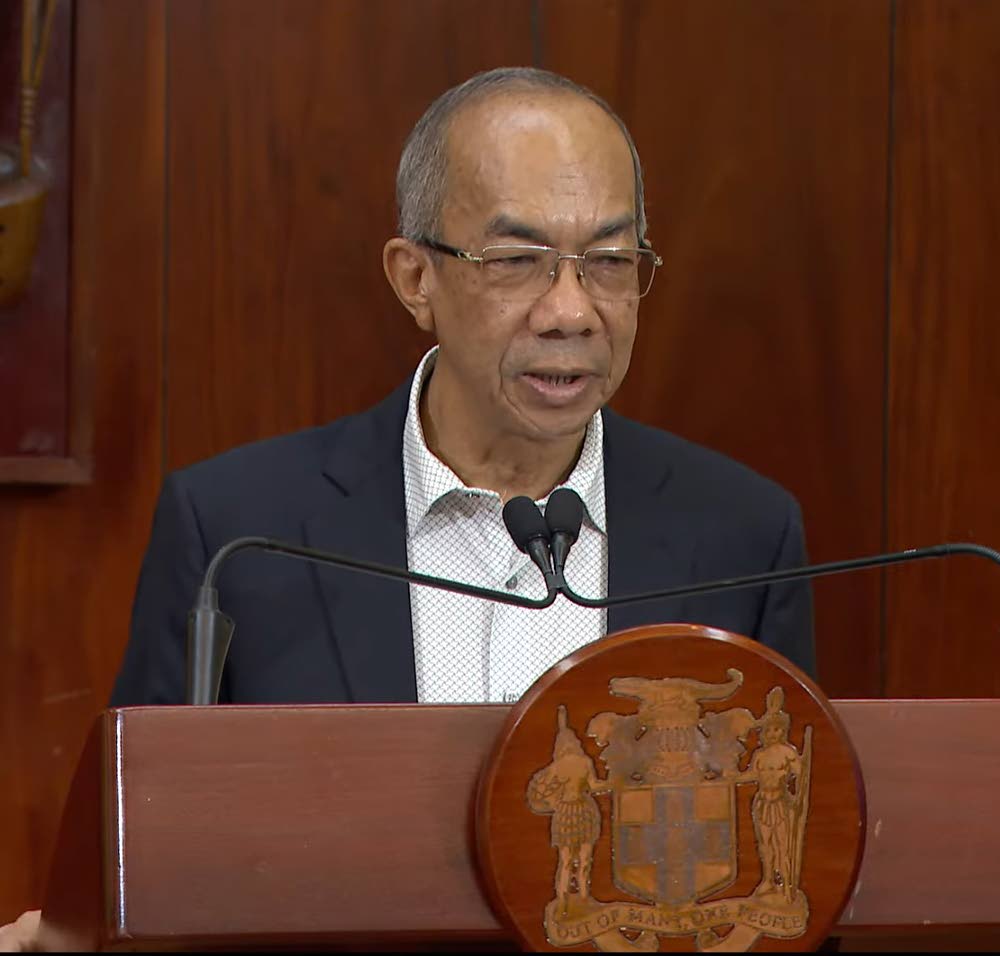
Jamaica’s Minister of National Security and Peace, Deputy Prime Minister Dr. Horace Chang, has drawn a firm line in the ongoing debate over police body camera use, stating unequivocally that officers will not be required to wear the devices during high-risk operations targeting armed criminals. He has publicly dismissed growing demands from civil society advocates for universal body camera use as an ill-conceived and dangerous proposal that puts law enforcement lives at unnecessary risk.
The debate has intensified in recent months amid a sharp uptick in fatal police shootings across Jamaica, with civil society group Jamaicans For Justice leading repeated calls for mandatory camera deployment during all planned police operations to increase accountability. Chang, who has been locked in public disagreement with the advocacy group over the policy, laid out his full position during Wednesday’s weekly post-Cabinet press briefing at Jamaica House, leaving no ambiguity about his stance.
“This thing that you must wear a camera when you going to look for a man who has a M16 that’s firing 60 rounds per second is a crazy idea,” Chang stated during the briefing. He walked through the practical realities of high-stakes counter-gunman operations, explaining that when gunfire breaks out, officers prioritize taking cover before returning fire, and mandatory body cameras would create avoidable additional hazards. For early morning planned raids targeting dangerous wanted suspects, Chang said cameras are simply off the table.
Noting that fugitive armed criminals often move more quickly than responding officers, Chang emphasized that stealth and surprise are critical to successful operations. “Cameras make them a target,” he explained, adding that officers entering these high-risk scenarios already face extreme danger, and any requirement that compromises their safety cannot be implemented. Unlike routine public interactions, these covert operations cannot afford elements that reveal officers’ positions or identities before they can engage suspects, he argued.
Contrary to claims that the government opposes body camera use entirely, Chang clarified that the Jamaica Constabulary Force (JCF) already has access to body-worn cameras, with 1,000 additional units on order to expand the program, and all officers receive training on how to use the devices. Deployment decisions, he reiterated, rest solely with Commissioner of Police Dr. Kevin Blake, a position he first laid out during his sectoral debate address to Parliament Tuesday. Civil society groups have no authority to dictate how police equipment is deployed in the field, he added.
Chang pointed out that body cameras are already in regular use for appropriate types of operations across Jamaica. For example, at least one officer involved in the national coordinated road check initiative — a program designed to disrupt gang activity and recover illegal firearms — wears a camera during these interactions. This use case aligns with how body cameras are deployed in the United States, where the technology was first adopted broadly to address racial profiling in routine traffic stops and public interactions, not for high-risk tactical SWAT operations. That model is comparable to the work of the JCF’s Public Safety and Traffic Enforcement Branch, which already uses cameras when engaging with the public, he noted.
Currently, most local body camera use is for routine public-facing work: road checks and crowd management at entertainment events. Chang highlighted tangible public safety benefits from this existing deployment: since cameras were introduced for traffic stops, confrontations between police and taxi operators have dropped dramatically. “When last have you seen a video — because they used to go viral — of a policeman and a taximan fighting, or a policeman has to beat up a taximan? They don’t, because when the taximan or any driver sees a policeman with a camera and he stops a car, they behave themselves,” he said.
The minister pushed back against what he described as a harmful colonial-era legacy of widespread public assumption that Jamaican authorities and elected officials are inherently corrupt. He argued that repeated calls for universal body camera use for all operations reinforces this false narrative, which he called an unfair misrepresentation of the JCF. “It assumes that those who have authority are corrupt, so the idea that the police is a corrupt body out there to extort people is a wrong legacy. It’s incorrect and I cannot support anything that seeks to reinforce that and that’s what the call for cameras to be used all the time does,” Chang said.
He emphasized that while the government welcomes constructive criticism of law enforcement policy, it is long past time for the public to trust Jamaican police professionals and respect their expertise in operational planning. Acknowledging that the 14,000-strong JCF is not a perfect institution, and that a small number of officers have engaged in criminal misconduct, Chang noted that official data backs up the claim that bad actors are a tiny minority. Statistics from the Independent Commission of Investigations (Indecom), Jamaica’s police oversight body, show that only 3.4 per cent of police officers charged with offenses in recent years have been convicted.
Chang closed by repeating his call for civil society organizations to allow established oversight processes to run their course before issuing public statements or passing judgement on police operations. He said Indecom, as the independent investigative body, should be allowed to complete its work and release its findings before any public conclusions are drawn about officer conduct.