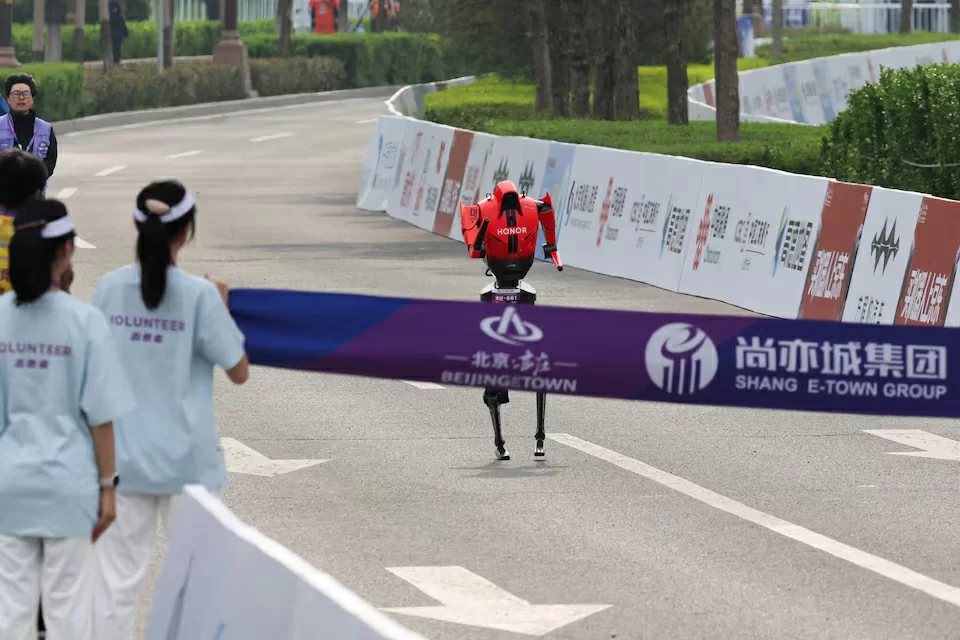
On a race day in Beijing, the second edition of the Beijing E-Town Half Marathon made global headlines, not just for the thousands of human runners competing, but for a groundbreaking companion event that showcased how far humanoid robotics have advanced in just 12 months. When the special humanoid robot half-marathon debuted last year, most of the competing machines failed to even reach the finish line, and the fastest entry logged a time far slower than the average human competitor. This year, that narrative shifted dramatically, with dozens of China-developed humanoid robots delivering staggering improvements in speed, autonomy, and endurance over the 21-kilometer course.
The event saw explosive growth in participation, with the number of competing robotics teams jumping from just 20 in 2024 to more than 100 in 2025. To eliminate collision risks between human and robotic runners, the two groups competed on separate parallel courses, allowing each group to push their limits without interference. When the checkered flag fell, the top spot went to the Honor Lightning humanoid, developed by Chinese smartphone manufacturer Honor — a spin-off of tech giant Huawei. Honor’s winning machine crossed the finish line in 50 minutes and 26 seconds, a time that beats the current official men’s half-marathon world record set by Jacob Kiplimo just one month prior in Lisbon. In a dominant showing, Honor claimed all three podium positions with three separate teams.
According to Du Xiaodi, an engineer leading the project at Honor, the competing robot took one full year of targeted development to reach this performance level. Standing out for its design, the machine features 90 to 95 centimeter legs, a proportion matching that of elite human long-distance runners, and leverages advanced liquid cooling technology adapted from Honor’s smartphone designs to prevent overheating during sustained high-speed operation, a common technical challenge for bipedal robots.
The rapid improvement in robotic performance, from widespread failure to finishing faster than the world’s best human runners, underscores the dramatic progress China has made in the robotics and artificial intelligence sectors. For spectators in attendance, including large numbers of engineering students and young software developers, the event was a clear sign that the widespread AI and robotics era is rapidly approaching. A 23-year-old engineering student at the race summed up the prevailing sentiment among young tech professionals, noting that those who fail to adapt to working with AI now will be left behind as the sector transforms global industries.
While the successful race demonstrates huge potential for humanoid robotics, experts note that practical widespread commercial application remains in the experimental stage for most use cases. The capabilities demonstrated on the running course do not directly translate to many commercial roles, which require fine motor control, precise manual manipulation, and complex adaptive interaction with unpredictable environments, they cautioned. Even so, the technology opens the door to future use cases including replacing human workers in high-risk occupations and even potential applications in defense operations, the event organizers noted.
China has prioritized the development of humanoid robotics and AI in recent years, rolling out generous government subsidies and large-scale infrastructure projects to support domestic technology companies advancing the sector. The national ambition for the industry was even highlighted at this year’s CCTV Spring Festival Gala, the country’s most-watched annual television event, which featured a viral martial arts demonstration performed by Unitree humanoid robots that drew hundreds of millions of views.
With this landmark half-marathon event, China’s leading technology firms have put their progress on full display, making clear that humanoid robots are on track to become a core part of the future of global industry and everyday society.