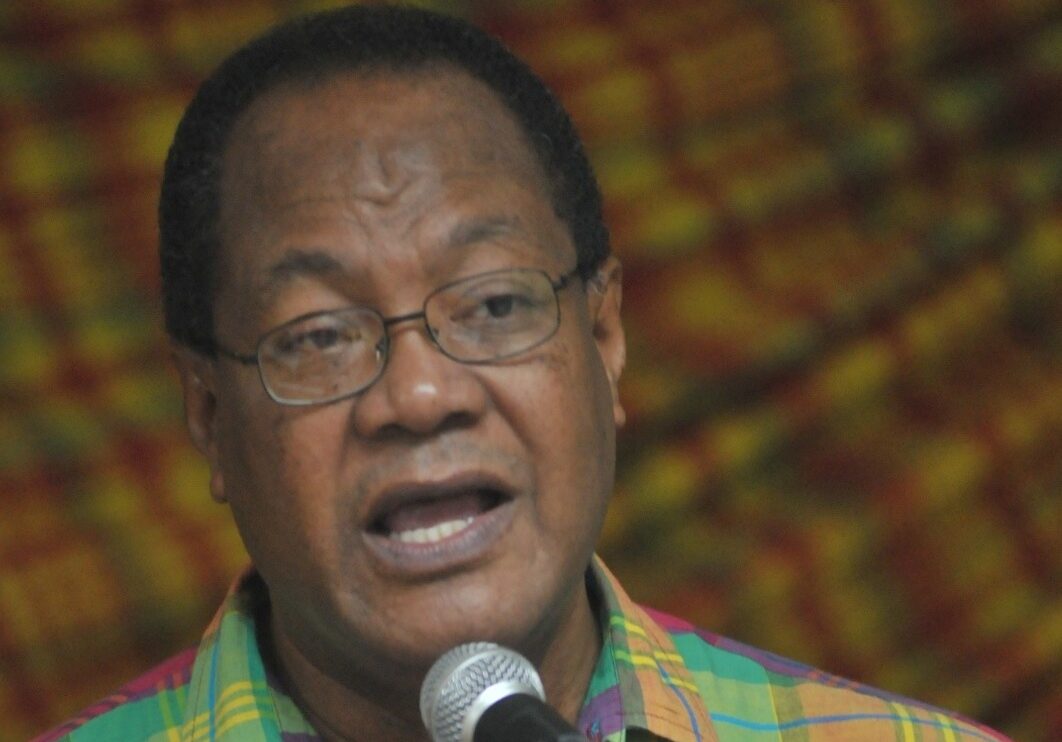
A new biographical profile of former Dominican Chief Cultural Officer Raymond Lawrence, produced from an in-depth interview held in late March 2026, is being released as part of a critical cultural preservation initiative led by Gabriel J. Christian, a Dominican attorney, author and publisher. This project forms the core mission of Pont Casse Press, the independent publishing house founded in 1992 by Christian and his late collaborator Dr. Irving W. André, a former Canadian Superior Court Judge. Through oral histories, video biographies, and written documentation, the initiative works to capture and preserve the legacies of prominent Dominican figures whose contributions laid the foundation for the modern nation, ensuring these stories remain accessible for future generations as part of the island’s living historical record.
Born in Roseau, Dominica, in January 1954, Lawrence grew up in a household that prioritized education, entrepreneurial spirit, and artistic achievement. His parents Hugh Lawrence and Doris Durand Lawrence ran a successful local soft drink factory and retail shop at a time when small-scale Dominican entrepreneurship was a core expression of national economic self-determination. The Lawrence home was also steeped in musical tradition: his older sister Jean Lawrence emerged as one of Dominica’s most influential cultural leaders, shaping the island’s choral music scene through her direction of the Siffleur Montagne Chorale, which raised national standards for musical performance and built widespread cultural pride across the country.
Lawrence’s early academic journey took him through Convent Preparatory School for primary education, followed by the elite Dominica Grammar School, where he honed his academic focus and early sense of civic duty. He completed his sixth-form studies at St. Mary’s Academy between 1970 and 1972, and complemented his classroom learning with service in the Cadet Corps, an experience that instilled lifelong habits of leadership, discipline, and national responsibility. His musical training began early under the tutelage of Lemuel McPherson Christian OBE, the legendary composer who wrote Dominica’s national anthem, grounding Lawrence in the artistic traditions that would define his lifelong career.
He later expanded his academic training in the United States, earning a bachelor’s degree from the University of Steubenville in Ohio and a master’s degree from the University of North Texas. These international experiences deepened his expertise in communications, performing arts, and cultural administration, equipping him with the skills to lead national cultural policy and development work back home.
Lawrence’s professional career began in broadcasting, where he worked from 1972 to 1982 at both Radio Dominica and Radio Antilles. The role gave him a national platform to connect with Dominican communities and helped him recognize media’s unique power to strengthen collective national identity. Parallel to his media work, he launched his cultural organizing career in 1971 by co-founding the Waitu Kubuli Dance Troupe alongside fellow cultural practitioners Gwyneth Joseph and Arlington James. Under his early leadership, the group transformed traditional Dominican folk dance into a rigorous, respected national performance art, and brought Dominican culture to regional audiences through tours across Antigua and other Caribbean neighbors.
Lawrence’s work grew from the foundation laid by an earlier generation of Dominican cultural nation-builders. He joined the ranks of icons like Dr. Alwin Bully, the late playwright, artist, educator and former Chief Cultural Officer who institutionalized theater arts and strengthened Dominica’s national festival traditions; Pearle Christian, the beloved grassroots cultural leader who worked to keep national culture rooted in community life; and Mable Cissy Cauderion, a pioneer who preserved Creole musical traditions that form the backbone of Dominican cultural identity.
Over his decades of public service, Lawrence would go on to serve with distinction as Dominica’s Chief Cultural Officer, holding the post for 24 years across two tenures: from 1990 to 2014, and again from 2017 to 2021. In this role, he rejected the framing of culture as a narrow category of isolated performance, instead defining it as the complete way of life of the Dominican people. Working alongside fellow cultural administrators Rosalind Paul and Matthew Olivace, he centered his leadership on a clear mission: preserve Dominica’s unique ancestral traditions while nurturing new artistic excellence and innovation.
One of Lawrence’s most historically significant contributions was his leadership of the revitalization of the Dominica Cultural Centre at the Old Mill, a site with deep, layered historical meaning. The center is built within the surviving stone walls of a 19th-century sugar mill plantation, a relic of the slavery era where enslaved Africans were forced to labor to generate wealth for European colonial powers. Lawrence recognized the critical importance of reclaiming this fraught space as a site of cultural affirmation, rather than leaving it shrouded in historical silence.
Under his direction, major restoration and preservation work transformed the site. Lawrence organized the transfer and conservation of a historic steam locomotive from the former Bath Estate plantation, implemented specialized conservation techniques to protect the site’s aging historic structures, led the conversion of unused buildings into functional cultural spaces including dance studios, and secured partnership funding for improvements from organizations including UNESCO and the U.S. Embassy. Through this years-long effort, he turned a site born of colonial exploitation into a thriving hub for artistic expression and public historical education.
Throughout his career, Lawrence consistently argued that culture must serve to strengthen national character. He voiced public concern about eroding social values, and pushed for cultural policy that reinforces dignity, discipline, and mutual respect among younger generations. For Lawrence, culture was never separate from nation-building: it shapes how a people understand their own identity and their collective responsibility to one another.
Lawrence’s life and career represent far more than a tenure in public administration. It is the story of a cultural patriot who recognized that a nation’s strength depends not only on physical infrastructure and economic growth, but on shared identity, collective memory, and national pride. As a broadcaster, educator, organizer, preservationist, and administrator, he spent decades working to ensure that Dominica’s rich cultural inheritance would remain a living, active force in national life, rather than a forgotten relic of the past.
In documenting Lawrence’s story, Pont Casse Press advances its core mission to honor the figures who built modern Dominican civilization. Lawrence’s life stands as a testament to the truth that the most enduring nation-builders are those who preserve the spirit of their people. After more than 50 years of relentless service, he has secured his place among the most respected cultural guardians in Dominica’s history. A full biographical video of Lawrence’s story is available for public viewing.