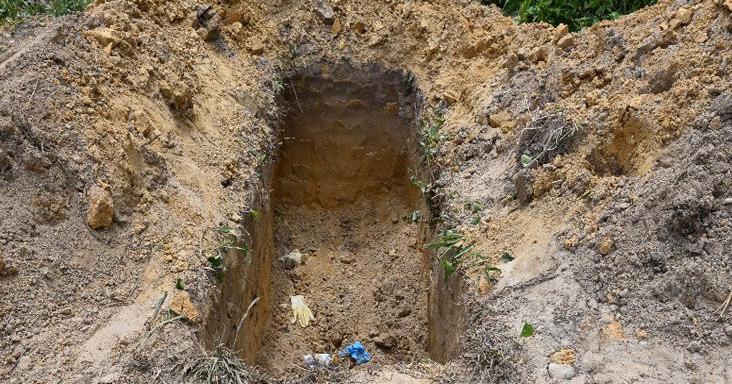
A grim discovery at a public cemetery in Trinidad has triggered a top-priority criminal investigation, after local law enforcement confirmed 56 bodies – 50 of which were infants – were found dumped in an unauthorised mass grave yesterday morning.
The find was first reported to police shortly after 10 a.m. by a local resident who was testing an air rifle at his private garden adjacent to Cumuto Cemetery, according to official statements from the Trinidad and Tobago Police Service (TTPS). The witness told investigators he spotted a group of men digging a pit, and when he approached to ask what work they were carrying out, the men admitted they were disposing of children’s remains. As the man neared the site, the workers fled in a silver vehicle, the witness added. Shortly after making his report, the informant accompanied two detained suspects back to the local Cumuto Police Station.
Police quickly identified the two detained men as employees of a local private funeral home. Investigations so far indicate the pair were acting on instructions from their employer, who told them to dig the grave for what was described as a pauper’s burial. The men dug a pit roughly 1.8 metres by 0.9 metres on the cemetery’s northern perimeter, and dumped dozens of remains including the 50 infants, law enforcement confirmed.
TTPS Commissioner Allister Guevarro, who formally announced the launch of the investigation, emphasised the case has been assigned the highest possible priority. “This discovery is deeply disturbing, and we fully recognise what profound emotional shock this will cause to affected families and the entire nation,” Guevarro said in an official address. “The TTPS is pursuing this case with urgency, profound sensitivity, and an unwavering commitment to uncover every detail of the truth. Every set of remains must be treated with dignity and handled in full accordance with the law. Any individual or institution found to have violated that fundamental duty will be held fully accountable for their actions.”
Following the initial report, responding officers immediately secured the discovery site, where specialist crime scene investigators have begun detailed forensic examinations to gather evidence. Police confirmed the breakdown of remains: 50 infants, four adult men, and two adult women. Preliminary on-site assessments found that most adult remains carried official identification tags, with only one adult male’s remains untagged. Two remains – one adult male and one adult female – showed clear evidence of having already undergone post-mortem examinations before being dumped at the site.
Investigators told reporters that preliminary lines of inquiry point to this being a case of unlawful disposal of unclaimed corpses, though examinations are still ongoing to confirm the full circumstances of the discovery. The TTPS stressed in an official media release that this is an active, evolving investigation, and further forensic testing is currently underway to trace the origin of all remains and identify any violations of law or official burial procedures. Specialised TTPS units including the Homicide Bureau and Northern North Division are leading the ongoing probe.
Speaking to media on the background of unclaimed body procedures in the country, former health minister Dr Fuad Khan confirmed that the burial of unclaimed remains follows established, formal protocols in Trinidad, even though the practice is rarely discussed publicly due to its sensitive nature. Khan explained that under standard rules, unclaimed bodies are first publicly advertised for multiple cycles in major local newspapers. If no family member or party comes forward to claim the remains, they are either buried by funeral homes or made available for anatomical research at medical schools.
Khan noted that mass burials for unclaimed paupers are a standard, cost-saving practice, and that without this process, public morgues would quickly run out of storage space for newly deceased people, overwhelming the entire end-of-life care system. “This is a deeply sensitive topic, so details of these burial processes are not normally publicised – it is just carried out as a necessary part of the system,” Khan said. “It reflects the harsh reality that some people face at the end of life, when they have no family or money to cover an individual burial.”
As of press time, the TTPS has not announced any formal charges, and investigations into how the remains came to be disposed of in an unauthorised mass grave are continuing.