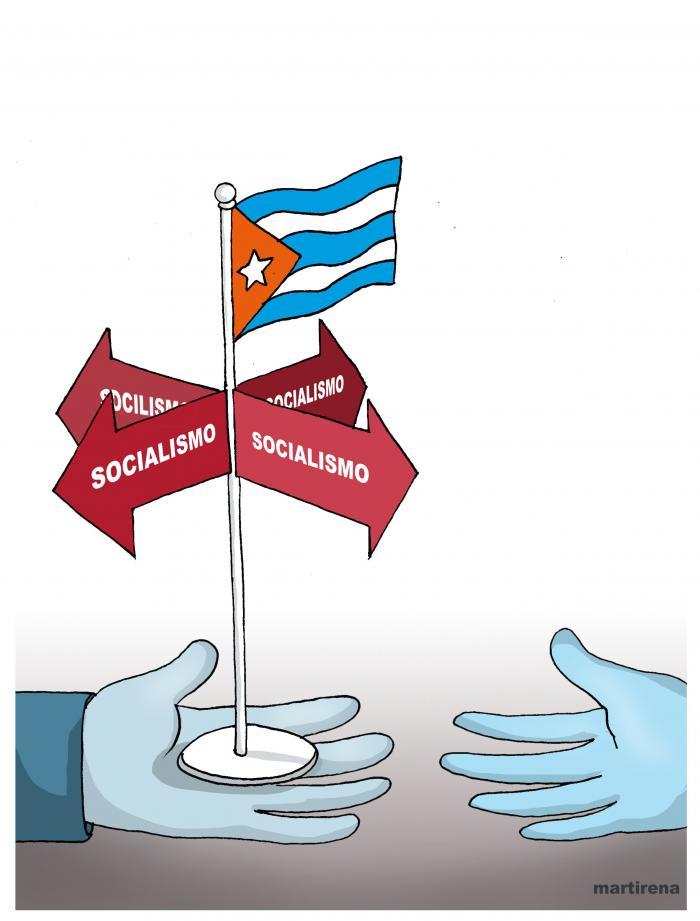
April 16 returns once more, bringing with it the annual gathering that decades have not been able to erase, held at the iconic intersection of 23rd and 12th Streets in Havana. It is a moment etched deep into the collective memory of the Cuban people, for it was on this site that Fidel Castro publicly confirmed what many already felt in their hearts: the revolution born at Moncada, forged during the Granma expedition and nurtured in the Sierra Maestra and lowland campaign had always been a socialist revolution. This was no empty rhetorical flourish; it was a declaration of fact: Cubans were building something new, something entirely their own, a system that fit no pre-written foreign manual and answered to no outside political slogan.
A false narrative peddled by critics who refuse to accept that a small, heavily blockaded sovereign nation has the right to chart its own independent course claims that Cuban socialism was imposed from outside. But this claim could not be further from the truth. Cuban socialism is the product of the organic, endogenous evolution of Cuban national consciousness, born on this island out of a urgent need to build a political and social order diametrically opposed to the decades of exploitation and foreign domination that defined colonial rule.
Today, as Cuba navigates the deepest economic crisis it has faced in decades, compounded by a tightened U.S. blockade that has strained household budgets and tested national morale, some have questioned whether the choice to pursue an independent socialist path was a mistake. The author pushes back against this doubt, arguing that global capitalism’s current model of endless overconsumption is ecologically and socially unsustainable on a planetary scale. How many additional Earths would be required to sustain the reckless wastefulness of a system that measures human worth by how much an individual consumes? Even amid decades of blockade and hardship, Cuba stands as a living proof that another path is possible. This path is not perfect, nor is it a miracle cure for every challenge, but it is the only system that guarantees that every resource the nation has—whether little or much—is shared equitably across the entire population. It proves that a new global order built on cooperation and collective solidarity rather than exploitation is achievable.
One of the core challenges facing contemporary Cuban socialism, the author argues, is reinterpreting Marxist thought to fit the daily lived experience of ordinary Cubans—translating its core principles into the language people use while waiting in bread lines, riding public buses, walking down neighborhood streets, and gathering with friends. If Cuba’s socialist model were truly a failure, it would never have survived decades of unrelenting, increasingly harsh pressure from a hostile foreign empire. While external enemies are a very real threat, the author stresses that Cubans must also be willing to look inward and acknowledge the internal weaknesses that have held the project back.
From the revolutionary camp, which remains unwavering in its commitment to building a more just and prosperous Cuba, there are many internal ills that demand open confrontation. Suffocating bureaucratic bloat, widespread indolence, and a persistent tendency to prioritize low-effort shortcuts over long-term collective good are dangerous weaknesses that must be discussed openly. This is not an exercise in self-flagellation; it is a necessary correction: a socialism that refuses to engage in honest self-criticism is a socialism that stagnates, stops progressing, and in the face of aggressive global capitalism, stagnation is fatal.
Currently, Cuba faces a sustained campaign of cultural hegemony aimed at pushing the nation toward restoring a dependent, predatory form of capitalism—one that turns popular need into a profit opportunity for elites and frames collective solidarity as a weakness. Yet despite this pressure, Cuba remains firm in its commitment to continue building an independent, distinctly Cuban form of socialism, one that does not reject the goals of shared prosperity and long-term environmental sustainability.
Entrenching the irreversibility of the socialist project is not just an empty slogan to print on banners and ignore; it is a core mandate enshrined in Cuba’s 2019 constitution, ratified by popular vote, that must be re-earned every single day by ordinary Cubans: on factory floors, in agricultural fields, in school classrooms, in doctors’ offices, and in neighborhood grocery stores. Irreversibility is not a guaranteed state of grace; it is a daily battle against apathy, against discouragement, and against the false myth that all political and economic systems are equally good for the Cuban people.
The path forward demands more open theoretical reflection, more robust public debate about the nature of Cuban socialism, and a renewed commitment to putting those ideas into transformative revolutionary practice. It requires rejecting the stigma attached to the word communism, which has been the target of decades of vicious enemy propaganda, and proving that the generation of Cubans who launched this project were not wrong to choose this path. Cubans must carry forward this work with the same passion that drove their ancestors on that April 16, when a people armed with nothing but their dignity declared that their future would not be shaped by capitalism.
The author draws on personal experience to illustrate the human cost of abandoning socialism, having known many people whose lives were upended after the fall of the Berlin Wall and the dismantling of socialism in the German Democratic Republic, a nation far more economically developed than Cuba. Some of these people have fared better than others, but all share a common understanding: they lost the system they fought for and believed in, they discovered it was impossible to extract only the positive elements of competing systems, and they watched racism and systemic discrimination reemerge in their homeland. Professionals lost their standing: a prosecutor was forced into a position like a criminal defendant, a doctor refused to treat patients as paying customers, a university rector lost his academic position, even dissidents found their work lost purpose without the system they opposed. Many now feel like strangers in their own native country. The author warns that the pain of losing the socialist project Cubans built would be far deeper, given Cuban national identity, if the nation were to abandon its path.
There is no use in self-deception: Cuba would not see the wealthy, developed form of capitalism enjoyed by wealthy Western nations if it abandoned socialism. Instead, it would be left with the same exploitative, unequal form of predatory capitalism that has left deep poverty and instability across Haiti, Central America, and much of the African continent, where stories of displacement and deprivation are far worse than what Cuba currently faces.
That is why this April 16 remains as meaningful as ever: it is a yearly rendezvous with a history that is both a living part of the present and a blueprint for the future. This year, more strongly than ever, the Cuban people continue to choose their own brand of socialism: perfectible, open to improvement, but fundamentally just and humane. This is the same socialism proclaimed on that Havana street corner, successfully defended at the Bay of Pigs, and later enshrined as an irrevocable national project. It is the socialism that the Cuban Constitution guarantees all citizens the right to defend by arms if necessary, and it remains the only viable path for Cuba, here, now, and always.