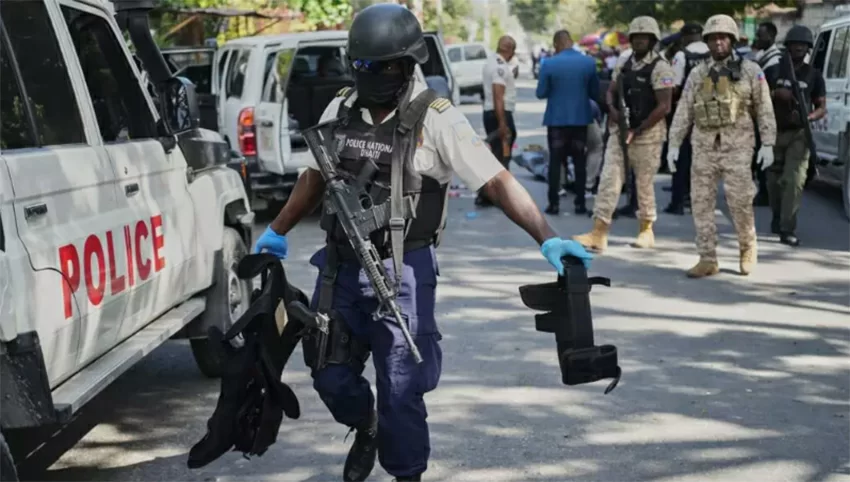
For months, armed, powerful criminal gangs have held swathes of Haiti’s capital Port-au-Prince in a violent grip, extorting communities, carrying out mass kidnappings, and terrorizing civilians. A new United Nations expert report released this week finds that while coordinated anti-gang operations have managed to slow the gangs’ rapid territorial expansion across the capital, the overall security threat in the Western Hemisphere’s poorest nation remains as severe and unpredictable as ever.
The report, published Tuesday by a panel of experts monitoring UN Security Council sanctions on Haiti, notes that stepped-up security operations, supported by drone strikes and local self-defense groups, have pushed gang factions back from several key areas in central Port-au-Prince. But the assessment warns that these hard-won gains remain deeply fragile and unevenly distributed across the city. Without sustained, coordinated pressure on criminal networks, the report cautions, all recent progress could be erased in a short period of time.
Gangs currently control most of Port-au-Prince’s urban territory, and have become infamous for widespread systemic violence including routine murders, sexual assault, and mass kidnapping for ransom. In response to intensified security operations and targeted drone strikes, the report finds, gang leaders – the majority of whom remain at large – have adapted their behavior, becoming far more discreet to avoid targeting. Most have cut back on public appearances and halted active activity on social media to reduce their exposure to counter-gang operations.
Increased pressure in central Port-au-Prince has also pushed many gang factions to relocate their core criminal operations to outlying rural and semi-urban areas on the capital’s periphery, where they face far less resistance from security forces and can continue illegal activity with minimal interference. This shift has forced Haitian security units to reposition their personnel and resources to respond to the new threat, weakening their ability to hold and stabilize territory that has already been reclaimed from gang control.
Beyond shifting their operational hubs, gangs have tightened their grip on key infrastructure that touches nearly every Haitian household: remittance processing facilities, which handle the critical flow of money sent home by Haitians living abroad that makes up a large share of the country’s total household income. Criminal groups have also increasingly carried out extortion and kidnapping-for-ransom schemes while disguised as police officers, allowing them to operate with greater impunity and trick civilians into cooperating.
The report also documents the staggering human cost of the year-long anti-gang campaign, which has been supported by private military contractors. Between March 2025 and January 2026 alone, UN High Commissioner for Human Rights Volker Türk recorded 5,519 total conflict-related deaths across Haiti, with at least 3,497 of those fatalities occurring during active anti-gang operations. Casualties have been reported on all sides, including both gang members and innocent civilian bystanders caught in the crossfire.
Worryingly, the report adds, gangs have even turned the civilian harm from drone strikes and security operations to their advantage, leveraging public anger to consolidate local influence. Many gangs have provided financial aid to civilians who suffered property damage or lost family members during security operations, building local support and strengthening their social control over affected communities. The report also highlights a disturbing upward trend in the recruitment of child soldiers, who are deployed directly in frontline combat and used as human shields against security forces during operations.