Every person who has navigated the formal education system understands the weight of assessments, from small end-of-topic quizzes to high-stakes national examinations. For most, exams are a universal source of dread — yet they remain a universally accepted mechanism to measure academic progress, a necessary evil that paves the way for growth. After years of traversing this landscape of testing, students ultimately learn that these evaluations are designed to build the skills needed to become independent, contributing members of society.
Central to this process of academic accountability is the report card: a consistent record of performance that documents a student’s progress from one grade to the next, regardless of whether the student agrees with the marks they received. Unlike self-assessment, report cards are graded by independent third parties — teachers — who score work based on observed performance. Report card day is always a day of reckoning: parents learn whether their child has made them proud or squandered a year of opportunity, and grades determine whether a student moves on to the next level or is held back. Being held back, or “stopped down,” carries a heavy social stigma, marking a student out for ridicule from peers.
This well-known educational process offers a perfect analogy for general elections, argues political commentator Yves Ephraim. Just as students wait for their end-of-year report cards after a term of coursework, politicians who have held office for a full term receive their assessment from the only graders that matter: the voting public.
Most popular framing of general elections focuses on the slate of new candidates standing for office, but Ephraim argues this perspective misses the core purpose of democratic elections. The fundamental role of a general election, he contends, is not just to pick new leaders — it is to evaluate the performance of the incumbent administration that has held power over the previous term, and decide whether they deserve another term in office. Challenging candidates represent alternative options, but it is impossible to fairly judge individuals who have never held executive power; grading untested challengers alongside sitting incumbents amounts to comparing apples to oranges. Only after a candidate has served a full term can voters produce an evidence-based report card to decide whether they deserve re-election. Even the most experienced sitting leaders had no executive experience before their first election win, after all.
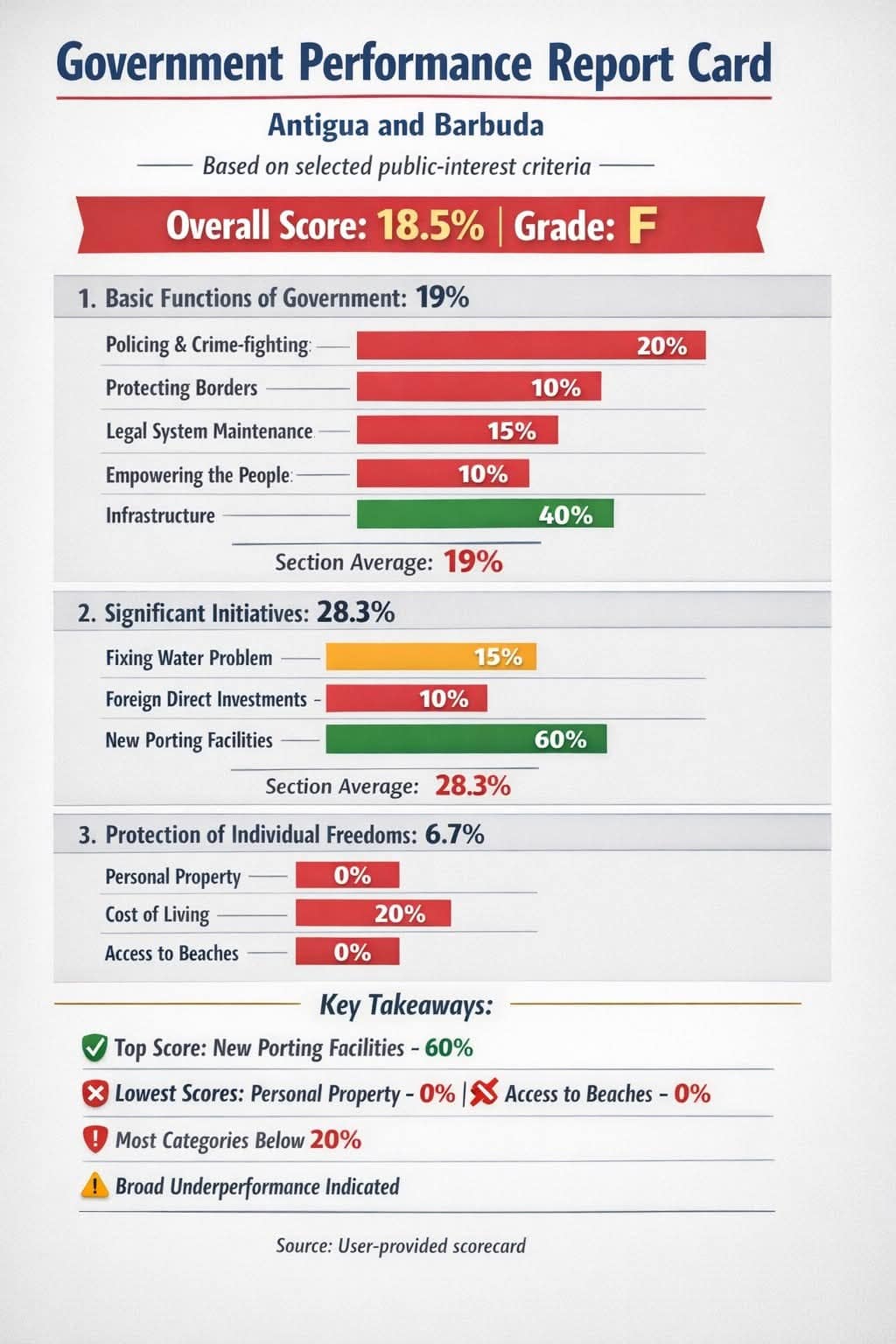
With this framing in mind, Ephraim has produced a comprehensive 12-year report card for Antigua and Barbuda’s current ruling administration, grading it across three core pillars: delivery of basic government functions, progress on major national initiatives that advance sovereignty, sustainability and self-sufficiency, and protection of individual civil freedoms.
### Grading Basic Government Functions
Ephraim weights basic government functions as follows: policing and crime-fighting (20%), border protection (10%), maintenance of the legal system (15%), citizen empowerment (10%), and public infrastructure (40%).
On policing, the administration earns low marks: the national police force lacks independence, struggles to solve most non-trivial crimes, and is grossly under-resourced in both equipment and expertise, leaving it unable to curb rising robbery rates. For border protection, the 2010s Antigua Airways scandal and the case of Cameroonian refugees, who were able to enter and exit the country with equal ease despite being granted temporary residency, exposed critical gaps in border security. Little meaningful action has been taken to tighten border controls since that incident, Ephraim notes, raising questions about how porous borders enable gun violence and other criminal activity. The national legal system also continues to languish under persistent underfunding and resource shortages.
On citizen empowerment, the administration has confused handouts and temporary subsistence jobs with genuine empowerment, Ephraim argues. True empowerment focuses on teaching citizens to “fish” rather than giving them fish, yet current policies have fostered widespread dependency that is particularly visible during this election cycle. For infrastructure, decades of neglect have only been met with last-minute activity ahead of the upcoming election and the hosting of the Commonwealth Heads of Government Meeting (CHOGM). Poor drainage systems across the country stand as evidence of rushed, low-quality work done to meet a political deadline rather than deliver long-term public benefit.
### Grading Major National Initiatives
For key initiatives, the grading breakdown is: water sector reform (15%), foreign direct investment attraction (10%), and new port facilities (60%).
Before 2014, an estimated 40% of water produced by the Antigua Public Utilities Authority (APUA) was lost to leaks in the country’s aging distribution network. Ephraim notes that basic engineering logic makes fixing distribution leaks the clear top priority for the water sector, as it would deliver the highest return on investment — analogous to a bakery fixing waste in its production process before expanding output. Instead, the government ignored the distribution network and pursued a costly strategy of expanding production through multiple new reverse osmosis plants. This inefficient approach means that to deliver 100 gallons of water to end users, APUA must pump 167 gallons, wasting 67 gallons daily and leaving the country with higher national debt and still no reliable running water for many residents. Most high-profile signature foreign investments, including the YIDA project, never moved past the planning stages. Only the new St. John’s harbour facility earns a passing grade from the author.
### Grading Protection of Individual Freedoms
For civil liberties, the grading breakdown is: personal property rights (0%), cost of living relief (20%), and public access to beaches (0%).
Since Antigua and Barbuda gained independence in 1981, the current administration holds the unenviable record of widespread violation of individual property rights across multiple high-profile cases from Booby Alley to Barbuda. It also famously coerced citizens into accepting injection of an untested medical substance against their free will during the COVID-19 pandemic. On the cost of living, recent temporary cuts to food tariffs demonstrated that high government taxes are a major driver of rising consumer prices: for example, the cost of a standard quantity of strawberries fell from $35 to less than $15 immediately after tariffs were cut. This proves far more could be done to ease financial pressure on households by cutting taxes and reducing the size of government. Finally, the recent dismissed trespassing charge against a citizen accessing a public beach highlights the administration’s failure to uphold public access rights. The government has failed to act as a guardian of public beach access, instead enabling adjacent private property owners to block public pathways to the coast.
### Unintended Consequences of Incumbent Policy
Ephraim also outlines multiple negative unplanned outcomes of the administration’s 12 years in power: the loss of U.S. visa access for most Antiguans and Barbudans, even for educational travel; unchecked government spending that has doubled the national budget from less than $1 billion in 2014 to more than $2 billion, pushing the country deeper into debt; a steady shift toward becoming a full welfare state; sky-high youth unemployment, demonstrated by the thousands of young people who queued for a single temporary job at the Ministry of Works; and secretive negotiations over a memorandum of understanding to accept deportees from the United States without public consultation.
After compiling this full 12-year report card, Ephraim concludes that the incumbent administration has failed to earn passing marks, and does not deserve to graduate to another term in office — regardless of the positive self-assessment the government has promoted to voters.