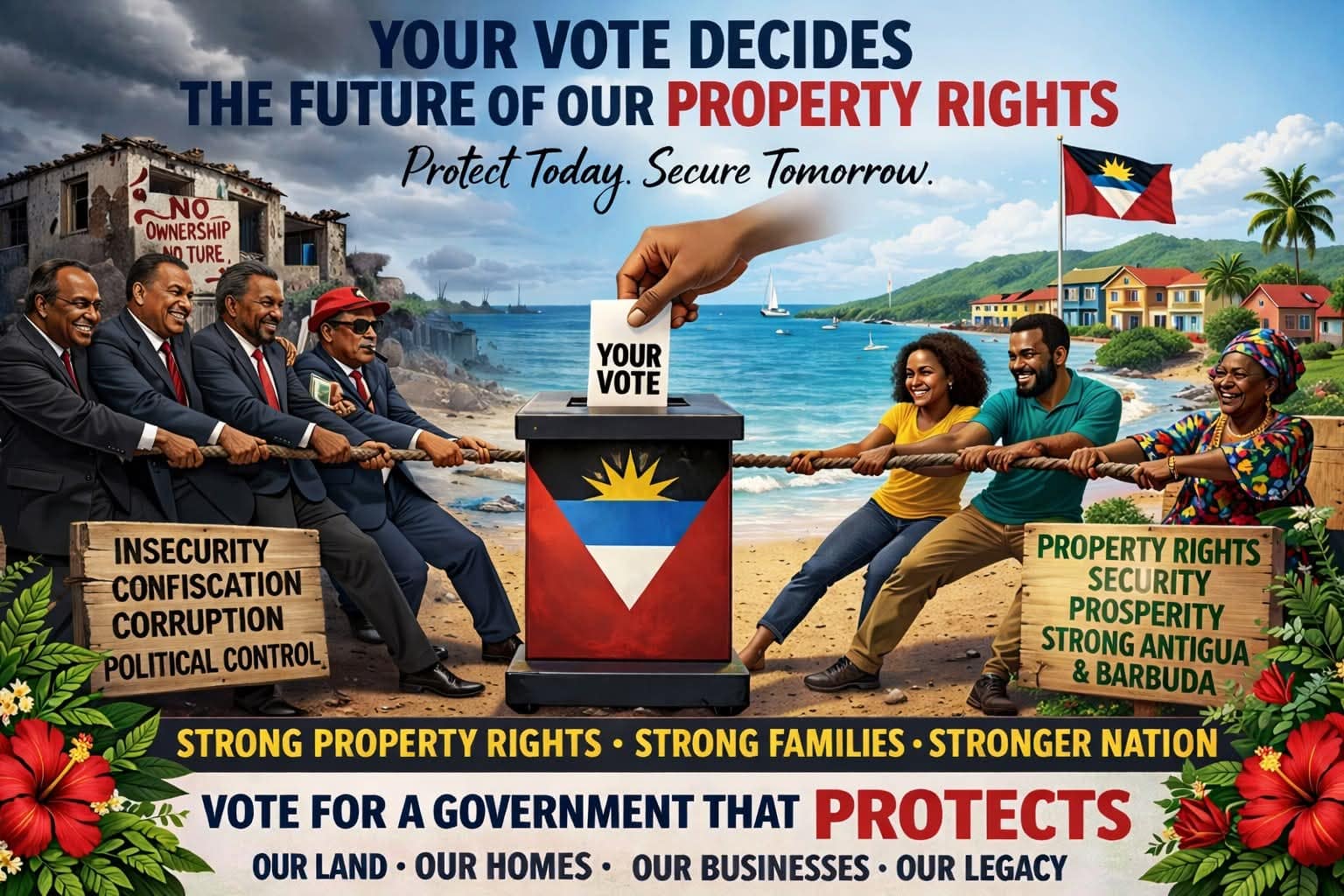
As Antigua and Barbuda enters another national election cycle, a long-simmering debate over land ownership and property rights has moved to the center of national discourse, rooted in the nation’s complex history of emancipation and post-independence governance.
Writer Yves Ephraim recently sparked this conversation after drawing a throughline from historical accounts of land access to modern policy failures in the island nation. Opening with a reflection on Agnes Meeker’s *Plantations of Antigua*, Ephraim highlights a striking observation from the text: in the early days following emancipation, the most pressing desire of newly freed people was to secure permanent, individual ownership of land — a goal that remained frustratingly out of reach for most.
This historical reality resonates deeply with ongoing inequities in 2026, Ephraim argues. Property ownership is not merely a personal convenience; it is a foundational pillar of human freedom, economic stability, and national prosperity. Economically, land stands as one of the four core factors of production, alongside capital, labor, and entrepreneurship. Without access to secure land tenure, individuals cannot build homes, launch businesses, or achieve long-term financial security. Historically, concentrated land ownership has always equated to concentrated power, from the feudal systems where monarchs controlled all territory to the colonial era where enslaved labor generated massive wealth from Antigua and Barbuda’s fertile sugar lands, while those who did the work were barred from owning any land themselves.
In a democratic society built on the principles of individual freedom, the protection of private property rights is a non-negotiable obligation of government. Land ownership and personal liberty are inextricably linked: without secure claim to a plot of land, people face homelessness, systemic abuse, and constant vulnerability to state action. Yet 180 years after emancipation and more than four decades after independence in 1981, Ephraim questions why successive governments have failed to deliver widespread land access to the descendants of formerly enslaved people.
Simple arithmetic underscores the feasibility of broad land distribution, he notes. Antigua alone holds roughly 3 billion square feet of total land mass. Allocating a 5,000 square-foot plot to each of the nation’s 100,000 citizens would require just 500 million square feet — less than a fifth of the total available area, and an amount that fits easily within the footprint of the publicly acquired Syndicate Lands alone. Decades ago, the nation took on debt to purchase these lands, a debt that was repaid by ordinary taxpayers. Instead of distributing these plots broadly to ordinary citizens, however, past administrations limited cheap land grants to political cronies and sold off vast swathes of public land to foreign investors, treating the finite resource as if it were unlimited.
This mismanagement has created the current housing crisis, where low-income families struggle to find affordable land and homes. Rather than address the legacy of poor stewardship of public land, the current government has turned to seizing privately held land from citizens who lawfully purchased and paid taxes on their property, framing the seizures as necessary to build low-income housing. Ephraim calls this action a fundamental violation of individual freedom and constitutional principles, arguing that overreach by the state has always been the greatest threat to personal liberty in the nation’s history — from the legal enshrinement of slavery to today’s arbitrary property confiscation.
Secure property rights are also the backbone of a growing, stable economy, he emphasizes. No investor will commit to a mortgage or business venture if there is a constant threat that the government will seize their property for arbitrary reasons. As voters head to the polls in the upcoming election, Ephraim urges Antiguans and Barbudans to make property rights a core voting issue. He challenges all citizens to support only candidates and administrations that explicitly pledge to protect private property rights, laying the groundwork for a free, prosperous nation where all citizens can thrive.