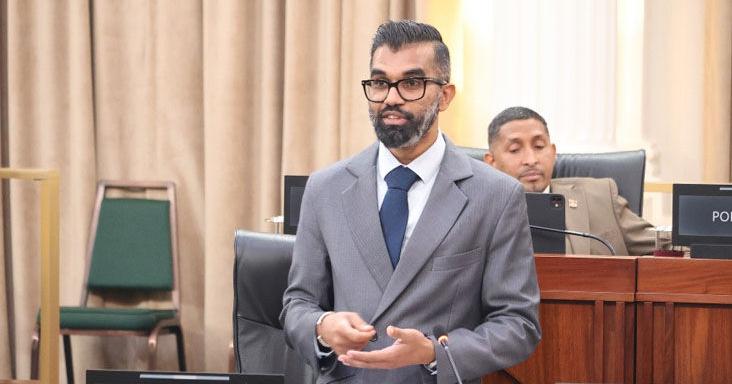
A fiery confrontation erupted in Trinidad and Tobago’s Parliament on Wednesday, triggered by explosive historical claims from Legal Affairs Minister Saddam Hosein about a former junior housing minister, that ultimately ended with the unanimous approval of a landmark piece of border security legislation.
During debate over the proposed Advance Passenger Information and Passenger Name Record Bill 2026, Hosein took the floor to frame the critical importance of the new law, which the government says will strengthen border screening and national security through upgraded digital processing systems. Beyond policy, Hosein anchored his argument in a recent corruption and gang affiliation scandal, reviving 2025 allegations against former junior housing minister Adrian Leonce, who once served under ex-housing minister Camille Robinson-Regis, currently a member of the Opposition.
Citing an investigative report published by *Express* in May 2025, Hosein detailed that Leonce was listed as a co-director of a United Kingdom-registered company incorporated in 2023 and dissolved just 10 months later in July 2024. The report alleged Leonce helped an individual with confirmed gang connections travel to the UK, where the traveler used the address of Leonce’s own grandmother for entry documentation. Hosein added that Leonce has publicly stated he cut all ties with the company immediately after learning of his associate’s alleged corrupt and problematic activities, and that the entire incident remains an open active investigation by local police.
What particularly ignited the confrontation was Hosein’s note that Leonce held his junior minister post under Robinson-Regis, the current Member of Parliament for Trincity/Maloney. Robinson-Regis immediately rose to a point of order, claiming Hosein had intentionally impugned her reputation by implying she had prior knowledge of improper government contracts awarded to Leonce’s associate.
House Speaker Jagdeo Singh quickly overruled Robinson-Regis’s objection, stating he had not heard any damaging accusation against her from the government minister. The ruling did little to calm tensions, however, as heated cross-talk erupted between government and opposition benches, with Robinson-Regis repeatedly insisting she would not tolerate the implied attack on her integrity.
The confrontation escalated further when Singh demanded Robinson-Regis apologize and withdraw unparliamentary, “vile and offensive” remarks she had directed toward Defence Minister Wayne Sturge, the MP for Toco/Sangre Grande. The Speaker threatened to enforce Standing Order 55, which outlines disciplinary actions for parliamentary disorder, repeated interruptions and excessive cross-talk.
After continued protest, Robinson-Regis issued the required apology under parliamentary rules, though she reiterated her claim that she had been wrongfully impugned. “I apologise and withdraw but I will not be impugned by any member of this House,” she stated. Singh again pushed back, maintaining he had heard no accusation of wrongdoing against Robinson-Regis, and invited Hosein to withdraw any unintended implication and continue his speech.
Hosein rejected the call for an apology, challenging Robinson-Regis to file a formal privilege motion if she believed her rights had been violated. He doubled down on his claims, arguing that if Robinson-Regis had no knowledge of government contracts awarded to Leonce, she was unaware of core activity within her former ministry. He also referenced a previous Joint Select Committee meeting where Robinson-Regis had herself disclosed that former minister Foster Cummings received millions in state contracts, drawing another rebuke from opposition members. San Fernando East MP Brian Manning interrupted, shouting for Hosein to stop, labeling him a “clown” in the exchange. Hosein shot back, questioning why the opposition bench was so shaken by publicly reported facts.
Even amid the repeated clashes between government and opposition members, Speaker Singh ultimately ruled Hosein’s remarks relevant to the debate, noting that the minister was justified in establishing a factual context to demonstrate why the new border security legislation is necessary.
Following the heated confrontation and extended debate, the chamber moved to a vote on the bill, and the outcome defied the earlier tension: the Advance Passenger Information and Passenger Name Record Bill 2026 passed unanimously. All 32 voting members supported the legislation, with no votes against and no abstentions. Minister Hosein emphasized during his opening remarks that the new system is a critical step for Trinidad and Tobago to meet United Kingdom security requirements, a necessary precondition to convince the UK to remove its mandatory visa requirement for all Trinidad and Tobago nationals traveling to the country.