Trinidad and Tobago Prime Minister Kamla Persad-Bissessar has announced that a diplomatic delegation bound for Venezuela will depart the twin-island nation in the near future, with the core goal of securing what the government describes as the country’s rightful share of jointly owned oil and gas resources held via the state-run National Gas Company (NGC).
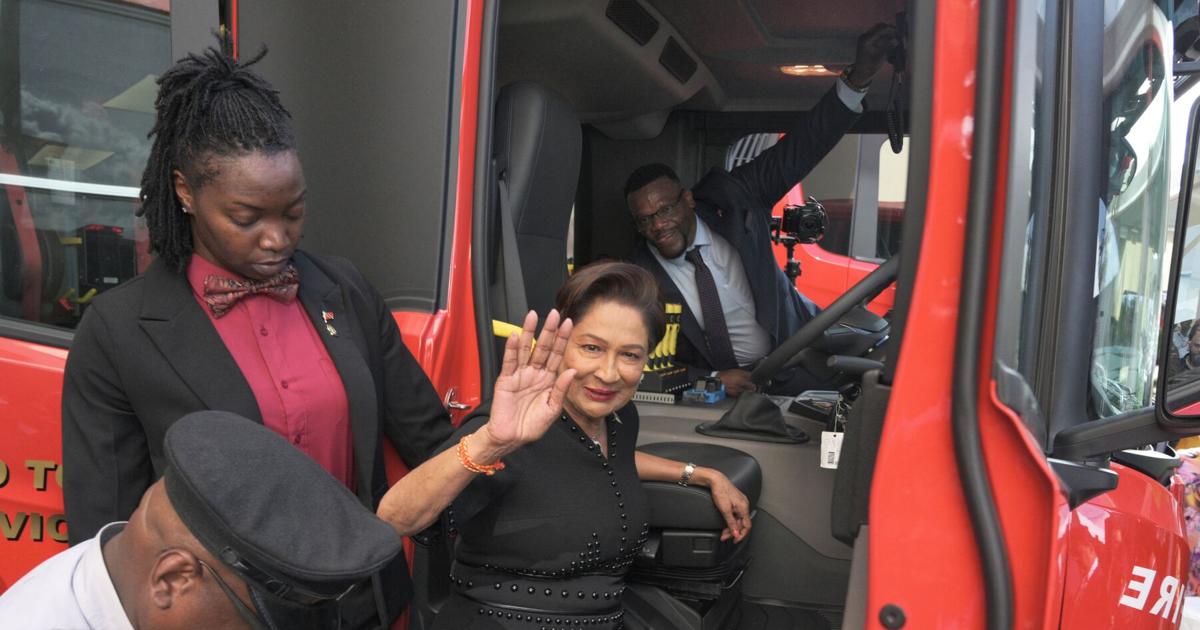
Persad-Bissessar made the announcement during a public event on Wednesday, where she oversaw the official commissioning of six new fire tenders at the Penal Fire Station. She framed the upcoming diplomatic mission as part of her administration’s broader work to safeguard national security both in public safety and in the critical economic domain.
“Whilst we bring help and promote safety and security with these fire tenders, I just want to tell you that we’ve been working really hard with the government of the United States and other governments, and that shortly, a diplomatic delegation will depart Trinidad and Tobago to go to Venezuela to ensure we get our just share of the oil and gas that we partly own through the NGC,” Persad-Bissessar told attendees at the ceremony. She added, “So, while we look to safety and security in this sense, we are looking for your safety and security in the economic space, which is very important. We have not forgotten.”
When pressed by reporters on whether she would personally join the traveling delegation, the Prime Minister described the travel plans as still “a work in progress” with no final details confirmed.
The planned mission comes against the backdrop of months of tense diplomatic and energy relations between the two neighboring Caribbean and South American nations, and recent progress in securing US regulatory approval for energy cooperation. Back in October 2025, Trinidad and Tobago received an official OFAC (Office of Foreign Assets Control) license from the US Treasury Department, clearing the way for the country to advance work on the joint Dragon gas development project with Venezuela. This license marked a key milestone for the initiative, as sweeping US sanctions on Venezuela’s energy sector have long restricted cross-border energy projects involving the country.
Persad-Bissessar previously noted that the OFAC license was the outcome of extensive behind-the-scenes diplomatic work, and represented a new opening for ongoing negotiations. She credited progress to a recent productive meeting with US Secretary of State Marco Rubio in Washington D.C., where the two sides discussed deepening bilateral cooperation and advancing shared strategic and economic interests.
Weeks before the license was granted, however, bilateral relations hit a major low. In October 2025, then-Venezuelan Vice President Delcy Rodriguez announced that Caracas would immediately suspend all gas cooperation agreements with Trinidad and Tobago, a decision that was approved by Venezuelan President Nicolas Maduro following a proposal from the board of state-owned oil giant PDVSA (Petroleos de Venezuela).
The suspension was triggered by Venezuelan anger over a port call by the US warship USS Gravely to Port of Spain on October 26, 2025. Caracas accused Trinidad and Tobago of collaborating with the US on what it claimed was a planned false-flag operation hostile to the Venezuelan government, with Rodriguez stating that the warship’s presence amounted to an act of aggression against Venezuela.
The terminated 2015 Framework Agreement on Energy Cooperation covered a wide range of joint initiatives, including shared gas field development, cross-border energy infrastructure, hydrocarbon exploration, and coordinated development of shared natural resources. The agreement was originally set for a 10-year term, and had been automatically renewed for an additional five years just months before the suspension, in February 2026. Rodriguez noted at the time that the agreement’s Article 13, Paragraph 3 granted either party the unilateral right to terminate the deal, justifying Caracas’s action. Following the suspension, Venezuela’s National Assembly voted to declare Persad-Bissessar persona non grata.
This is not the first round of diplomatic outreach to Caracas on energy issues under the current administration. The upcoming mission follows more than a dozen trips to Venezuela by former Trinidadian Energy Minister Stuart Young between August 2022 and June 2024, totaling 34 days of on-the-ground negotiations. Prior to the 2025 Dragon project license, OFAC issued a separate license in 2024 clearing the way for development of the cross-border Manakin-Cocuina gas field, which is set to be operated by British energy major BP. Both licenses are required to comply with longstanding US sanctions targeting Venezuela’s energy sector.
Despite the past months of tensions, Persad-Bissessar has pushed back on claims of a permanent rupture, confirming that formal diplomatic relations between Trinidad and Tobago and Venezuela remain intact.