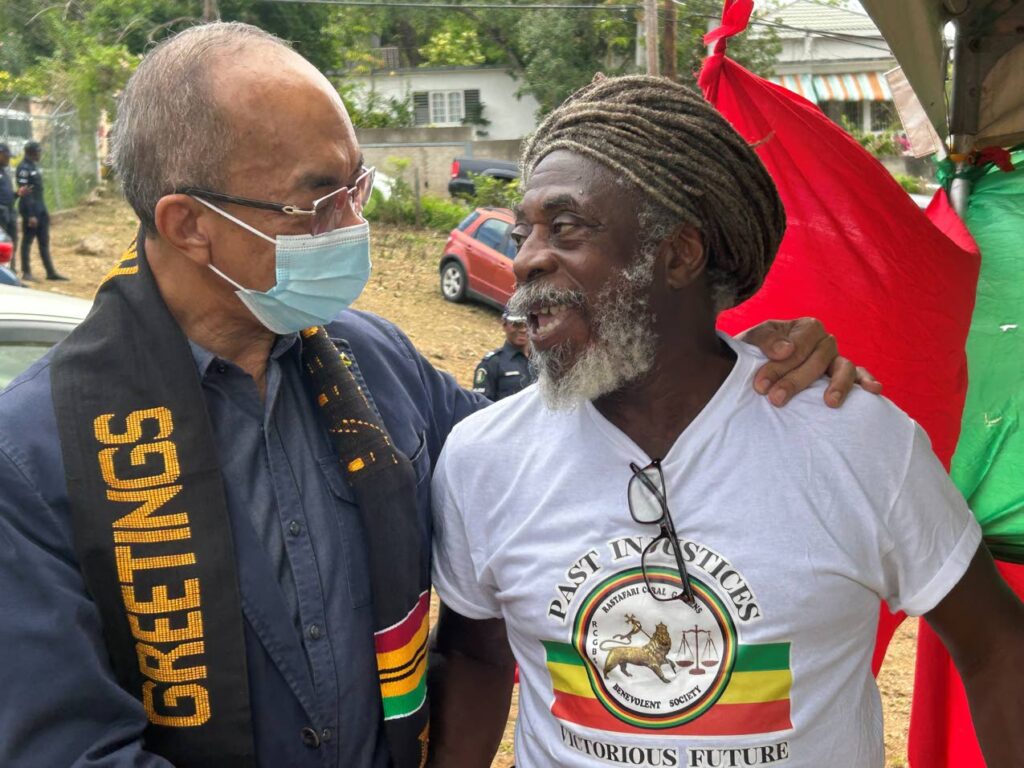
MONTEGO BAY, St James — On Good Friday, during a historic ceremony marking restitution for one of Jamaica’s darkest chapters of state violence against the Rastafarian community, a senior Jamaican politician has called for sweeping updates to the country’s existing marijuana regulations, following a Rastafarian leader’s refusal of a public service appointment over conflicting current drug laws.
Deputy Prime Minister and National Security Minister Dr. Horace Chang, who also serves as Member of Parliament for St James North Western, told attendees at the event that Lewis Brown — better known as Ras Brown, head of the Rastafari Coral Gardens Benevolent Society (RCGBS) — declined his nomination for a justice of the peace (JP) post. Brown explained his decision by noting that his Rastafarian sacramental practice requires the use of cannabis, a ritual that still falls outside the bounds of Jamaica’s current regulatory framework, placing him at risk of criminal penalty if he accepted the role.
Chang’s comments came as officials formally transferred ownership of two parcels of land in Albion, St James, to the RCGBS, a long-awaited step toward amending a decades-old injustice. The land handover was held as part of the annual commemoration of the 1963 Coral Gardens massacre, a state-led operation where Jamaican police raided a Rastafarian camp on Good Friday 1963, leaving eight Rastafarians dead and hundreds more injured or displaced. The newly transferred Lots 84A and 84B will serve as a secure, community-centered space for Rastafarian elders, designed to honor their cultural and social needs.
Jamaica took a major step toward accommodating Rastafarian religious practice a decade ago with the 2015 Dangerous Drugs (Amendment) Act, which decriminalized possession of small amounts of cannabis and officially recognized its sacramental use for the Rastafarian community. But the partial reform still leaves legal ambiguities that prevent devout Rastafarians like Brown from participating fully in public office, Chang argued.
Addressing Culture Minister Olivia Grange directly during the ceremony, Chang urged joint action to resolve the inconsistency: “I think as we move on, we have to change that situation. Minister Olivia Grange, you have to work with me to ensure that we can have Rastafari JPs who can serve without breaching their beliefs and their principles. I look forward to that.”
Chang praised Brown’s refusal as a demonstration of unwavering commitment to his faith and values, noting that Brown’s decision reflects a gap in policy that the Jamaican government must close. He acknowledged that Jamaica has already made substantial progress in honoring and protecting Rastafarian culture as a core part of national identity, but stressed that deeper change is still required.
“We have come a long way, and we need to show respect for our culture, our people, and the practices that have shaped us as a nation,” Chang said.
A long-time participant in behind-the-scenes discussions on cannabis policy reform, Chang said he has engaged with the debate for years, even as he has kept a lower public profile on the issue in recent years due to his government role. “We have achieved some progress, but there is still more to be done,” he said. “Much of the current discussion is not something I will get into publicly, given my role as a minister of government and the issues involved. But I can say that the present situation needs to be reviewed, and I will leave it at that.”
Chang also credited RCGBS leaders including Brown and Pamela Rowe-Williams for their decades of persistent, patient advocacy to secure justice and land restitution for the community. As the local MP for the area where the 1963 massacre took place, Chang called the Albion land transfer a meaningful step toward redress: “As a Member of Parliament for this area I am very pleased that some of the correction is taking place in the same constituency that it started in. So we’ll speak now not only of Coral Gardens, but of Albion…”
Alongside Grange, National Land Agency CEO and Commissioner of Lands Cheriese Walcott also took part in the title handover ceremony. Speaking on behalf of the Rastafarian community, Brown expressed gratitude for the secured land tenure, marking a new chapter for the community decades after the violence that displaced them.