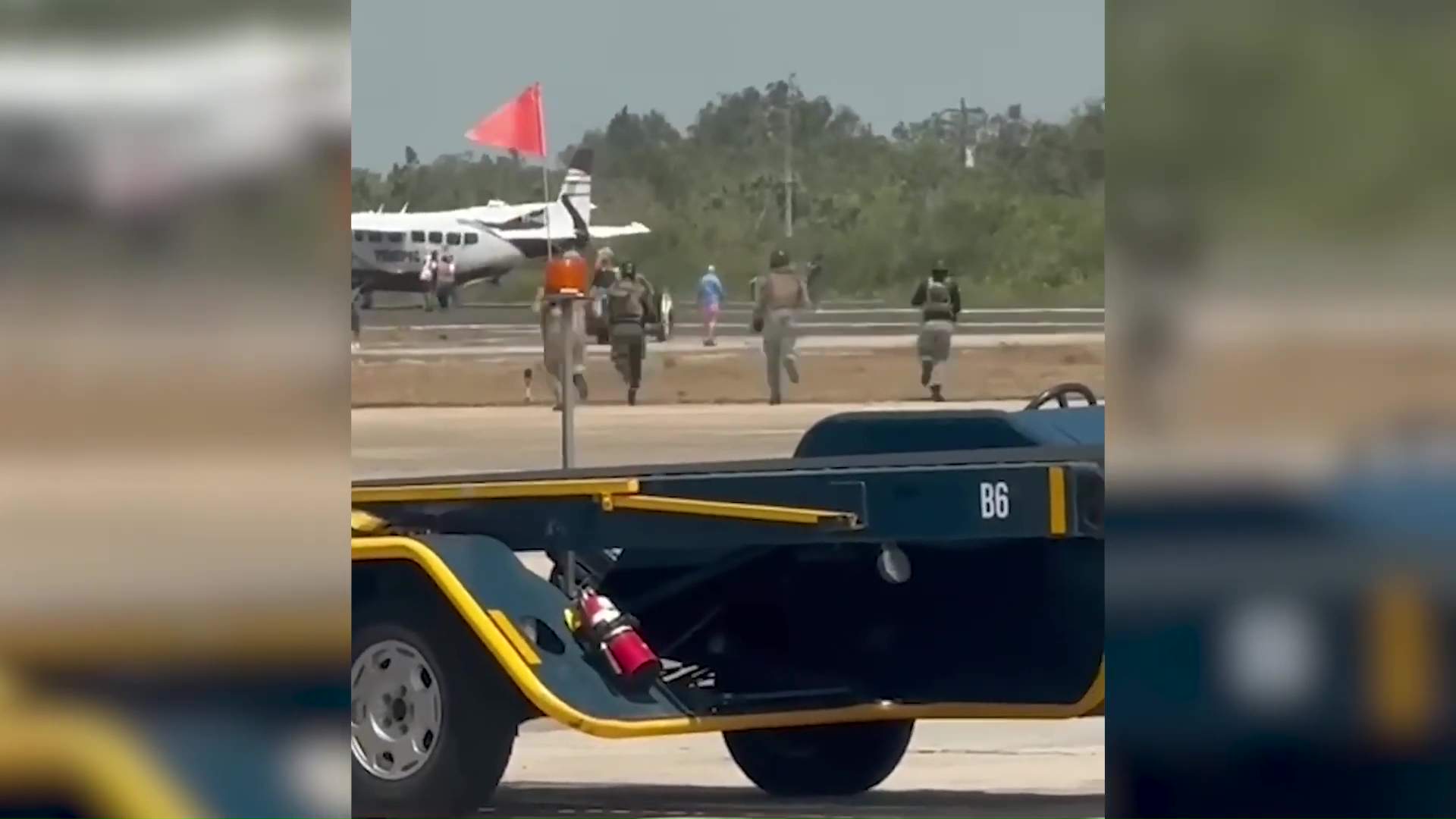
It has been 12 months since the 2025 Tropic Air hijacking, a national crisis that laid bare critical, life-threatening security gaps across all of Belize’s municipal airports. What began as a tragedy that left the public shaken and distrustful of domestic air travel has now evolved into a sweeping push for institutional reform, with a complete restructuring of airport security operations entering its final phase this week.
At the heart of this transformation is Vinay Bhojwani, the current General Manager of the Belize Airports Authority, who has prioritized closing the vulnerabilities that allowed the 2025 hijacking to occur. In an interview, Bhojwani outlined the sweeping upgrades the authority has rolled out across all of the country’s aerodromes. “We’ve definitely made a lot more improvements in terms of security,” he said. “I know that before there was a question whether the security implementation was up to par and met international standards. However, this time around we made sure that we went through the proper channels, the proper avenues to engage proper security that are qualified to takeover at all of our aerodromes.”
The upgrades stretch far beyond just increased personnel, Bhojwani confirmed: more than 100 new high-resolution surveillance cameras are currently being installed across airport premises, creating full coverage to monitor all public and restricted areas for potential threats.
Unlike the unvetted contracting processes that drew widespread criticism after the hijacking, this overhaul has followed strict competitive bidding rules. As of this week, all national municipal airport security operations are officially under the management of Security Alliance, a private firm that already holds the trusted contract to protect the U.S. Embassy in Belize. This marks the first time in Belize’s history that a fully vetted, experienced professional security company is responsible for the safety of domestic air travel.
Narda Garcia, CEO of Belize’s Ministry of Civil Aviation, noted that the contracting process followed all required public protocols. “They have gone through the process. They tendered, they advertised, and they tendered out. And I think the board has arrived at a decision of contracting a company that has all, has filled all the requirements that were put out there,” Garcia explained.
This sweeping reform did not materialize immediately. In the chaotic days immediately following the April 2025 hijacking, the Belize government relied on emergency temporary measures, deploying armed officers from the Belize Police Department to all aerodromes to stabilize the system and calm public fear. Nigel Carter, Director of Civil Aviation, recalled that immediate intervention required domestic airlines to implement basic baseline safeguards that had been missing before the attack. “The Government of Belize deployed police officers to all aerodromes,” Carter said. “The CEO in the ministry consulted with the domestic airlines and we asked or required them to put in place basic security measures, passenger screening, bag screening and so forth.”
The 2025 hijacking, which occurred on Holy Thursday, exposed not just security gaps, but deep flaws in the government’s contracting and oversight process. In the weeks after the attack, public controversy erupted when it was revealed that months before the hijacking, authorities had awarded security contracts to two firms, I-Security and Four Diamond Security, neither of which had any prior experience protecting airport operations. Thea Garcia-Ramirez, the former General Manager of the Belize Airports Authority, told reporters she had raised procedural concerns about the contracts before the attack. “I was sick. So when it came to me I advised that maybe it would be better for legal counsel to look over the contract, which would be basic and standard procedure,” Garcia-Ramirez said. “I am unaware if that was done, but when I came back those contracts were signed and on my table.”
That lack of proper oversight and screening allowed the hijacker to board a Tropic Air domestic flight without detection, thanks to minimal passenger and bag screening and inconsistent oversight across the country’s municipal airstrips. Today, Bhojwani says the core mission of the Belize Airports Authority is non-negotiable: to ensure such a catastrophic security breach never happens again.
Bhojwani, who took on his role after the hijacking to lead the reform effort, noted that preventing a repeat attack has been his top priority from day one. “I know it was definitely a turn of events. No one saw it coming. However, I knew that in this position I was more than capable enough to be able to make that change. So something like that doesn’t happen again. And that has been my number one priority since entering into the position,” he said. “Coming up on the one year anniversary, of course it’ll still be at the forefront of a lot of people’s minds. Especially after that time, I know everyone was a bit timid when it comes to flying and different things like that. However, my goal is to change a narrative. We’re making sure that there’s a security presence there to help you feel safe and they’re actually very good at communicating with people as well.”
One year on, the public memory of the Tropic Air hijacking and the fear it sparked still lingers for many Belizeans. But alongside those scars, the crisis has spurred long-overdue institutional change, creating a far more tightly monitored, accountable and secure system for domestic air travel across the country. This report from Shane Williams was produced for News Five.