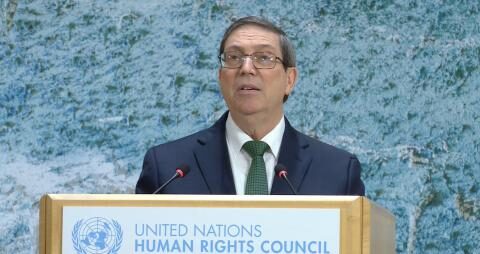
In a forceful address to the United Nations Human Rights Council, Cuban Foreign Minister Bruno Rodríguez Parrilla issued a stark warning about what he characterized as a new global dictatorship spearheaded by the United States. Speaking at the High-Level Segment of the Council’s 61st session in Geneva on February 23, 2026, Rodríguez Parrilla condemned what he described as a philosophy of dispossession and the normalization of force that undermines the post-World War II international order.
The Cuban diplomat asserted that beyond ideological divisions, all nation-states now face existential threats from policies of aggression, interventionism, and resource competition. He specifically highlighted the struggle over strategic assets including hydrocarbons, critical minerals, rare earth elements, water resources, biodiversity, and commercial trade routes as flashpoints for potential conflict.
Rodríguez Parrilla reserved particular criticism for American economic policies, labeling tariffs as instruments of aggression and condemning the extraterritorial application of U.S. laws. He characterized attempts to subject global affairs to the jurisdiction of American courts as a fundamental violation of state sovereignty and international legal norms.
The address focused significantly on a January 29 executive order from the U.S. president that Rodríguez Parrilla described as imposing collective punishment on the Cuban people. He asserted this policy deliberately seeks to create a humanitarian catastrophe through an energy blockade, asking rhetorically whether the international community would allow ‘a great power to attempt to destroy a small, peaceful nation under the crude pretext of national security.’
Despite these challenges, the Foreign Minister emphasized Cuba’s determination to defend its self-determination, independence, and constitutional order through national unity and consensus. He outlined the nation’s resilience measures, including leveraging its educated population, robust healthcare and education systems, agricultural resources, water reserves, mineral wealth, and domestic energy production capabilities. Rodríguez Parrilla noted Cuba produces nearly half of its consumed crude oil and is expanding its solar energy investment program as part of its strategy to prevent humanitarian crisis through self-reliance.