A landmark 48-year-old tropical forest research site in Suriname, the Kabo Special Protected Forest, is now under unprecedented threat as large-scale agricultural deforestation has breached its formal protected boundaries, according to official alerts from Suriname’s Agricultural Research Center CELOS. Launched in 1978 as a collaborative project between CELOS and Wageningen University, the Kabo experimental plot network ranks among the oldest continuously running intact tropical forestry research initiatives on the planet, with decades of longitudinal data that have shaped national forestry policy in Suriname and informed global best practices for sustainable forest management.
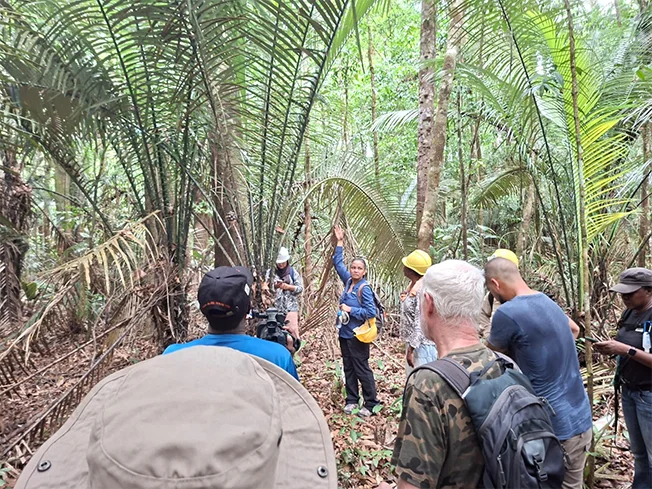
Despite repeated formal reports to relevant government authorities, no enforceable protective actions have been implemented to halt the encroachment to date. To draw cross-sector attention to the crisis, CELOS partnered with Conservation International Suriname to host a guided site visit on a recent Tuesday, bringing together representatives from government regulatory bodies, research institutions, and environmental and conservation organizations to survey newly cleared logging tracks and deforested parcels both adjacent to and inside the protected zone.
Documents show that in 2023, the Foundation for Forest Management and Supervision (SBB) notified CELOS of plans to allocate adjacent forest tracts to Mennonite communities for large-scale agricultural use, a proposal that CELOS and partner environmental groups successfully blocked at the time. However, under the current administration, the land allocation process for these surrounding parcels has moved forward regardless of earlier formal objections. Routine monitoring conducted by CELOS teams in May 2026 confirmed that deforestation operations had expanded past the protected forest’s official demarcation lines. A prior CELOS application to expand the Kabo site’s buffer zone was rejected by the Ministry of Land Policy and Forest Management, as the targeted surrounding parcels had already been issued as commercial logging concessions.
Unregulated logging and the conversion of forest tracts to agricultural land are progressively isolating the long-term research plots, with shifts in local ecological conditions poised to compromise the integrity of decades of accumulated research data. Designated a Special Protected Forest via state decree in 2012, the Kabo site’s datasets are now globally recognized as critical resources for international research on climate change, carbon sequestration, and tropical biodiversity, with CELOS receiving roughly 20 formal data requests from global research teams annually.
During the site visit, attendees toured Plot 23, one of the core permanent experimental plots that forms the backbone of the 48-year study measuring how varying logging intensity and silvicultural treatments impact tropical forest growth and natural regeneration. Verginia Wortel, head of CELOS’ Forest Management Department, walked participants through the unparalleled value of the half-century of continuous measurements, noting that no other tropical forest research site on the planet offers such a long unbroken timeline of ecosystem observation.
Compounding the deforestation threat, CELOS faces persistent gaps in structural long-term funding for the site’s operations. Full re-measurement of all Kabo experimental plots, required every 3 to 5 years to maintain data accuracy, costs approximately $50,000 per survey cycle, with the next full round of data collection scheduled for 2027. Wortel emphasized that the site’s scientific value has far outgrown its original mandate focused on timber production and forest recovery, as the decades of historical data now allow researchers to trace climate change impacts on tropical forest systems through metrics including tree mortality rates, biodiversity shifts, seasonal leaf fall patterns, and long-term changes to forest structural composition. She also highlighted a critical disconnect between scientific research outputs and government policy frameworks, noting that evidence-based research should guide policy development, while state regulations in turn must provide clear direction and tangible support to safeguard long-term scientific infrastructure.
Rudi van Kanten of Tropenbos Suriname echoed the urgency of the situation, framing the 59-year-old Mapane and 48-year-old Kabo experimental plot networks as irreplaceable “living libraries” of tropical forest knowledge that cannot be sustained through short-term project-based grant funding alone. The official field visit report calls for full cross-ministerial alignment of forestry, agriculture, land allocation, environmental, and research policy frameworks to eliminate conflicting regulatory loopholes that enable encroachment on protected research sites. Stakeholders have scheduled a follow-up meeting on December 4 to negotiate binding concrete protective measures for the Kabo forest and establish a sustainable structural funding model to secure the site’s research operations for future generations.