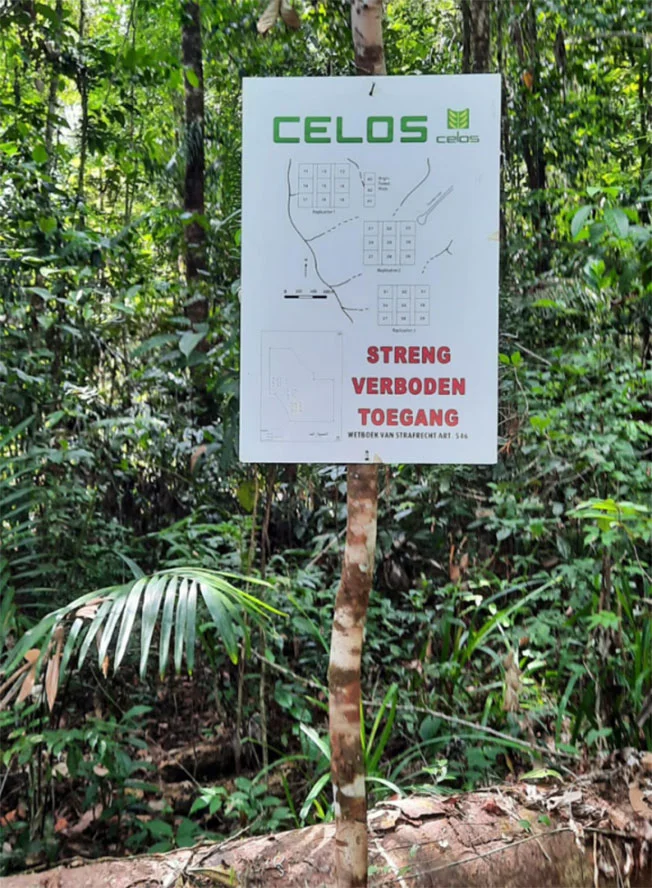
For over 30 years, every tropical forestry professional operating in Suriname has been intimately familiar with the CELOS Management System (CMS), a pioneering framework for sustainable timber harvesting and forest stewardship that enables selective logging cycles of roughly 25 years, allowing natural forest regeneration to restore viable timber stock in the same area for repeated, low-impact harvests. Developed through a longstanding partnership between Suriname’s Center for Agricultural Research (CELOS) and Wageningen University in the Netherlands, the first CMS experimental plots were established at Mapane in 1967, followed by a second site at Kabo in 1978, both located in the country’s Para district. Recognized as some of the oldest continuously operating tropical forest management research sites on the planet, the two reserves were designated Special Protected Forests via Suriname’s 2012 State Decision No. 124, banning all logging and disruptive activities that could compromise decades of ongoing long-term monitoring. CELOS holds full administrative and scientific oversight of these unique sites, though underfunding has long prevented the reserves from being leveraged to their full research potential. The datasets collected across nearly 60 years of continuous observation are far more valuable than originally envisioned: what began as local trials for sustainable tropical timber harvest has evolved into a globally irreplaceable resource for tracking climate change impacts on shrinking tropical forest ecosystems, with data from the Kabo site now integrated into dozens of international research networks that receive an average of 20 formal data requests annually from tropical forestry researchers across the globe. These reserves represent an incalculable asset for both Suriname’s national scientific heritage and the global fight against forest loss, with targeted investment in stewardship and research set to preserve their value for generations of future scientists. That critical legacy is now under active threat, as documented during a joint stakeholder field visit to the Kabo site organized by CELOS on November 24, 2026, with logistical support from Conservation International-Suriname. The delegation, which included representatives from Suriname’s Anton de Kom University, the Foundation for Forest Management and Production Control, the Nature Management Division of the Ministry of Spatial Planning, Land and Forest Management, the Ministry of Agriculture, Livestock and Fisheries, the National Environment Agency, and leading local and international conservation NGOs, uncovered widespread unlawful deforestation and unauthorized road construction carried out by Mennonite agricultural settlers in and along the edges of the protected research zone. The settlers, who operate commercial farming operations, are backed by a well-documented network of brokers, consultants, and land speculators fully aware of the area’s protected legal status and ecological sensitivity. Local land intermediaries including the Braganza Marketing Group (formerly known as Terra Invest) facilitate the sale and distribution of protected forest land to Mennonite colonists, in many cases without securing the legally required environmental permits or official land use approvals, constituting clear environmental criminal activity under Surinamese law. Initial plans by the settler networks to carry out mass deforestation across the Kabo region during the 2026 dry season were halted before they could fully erase the core CMS experimental plots, but significant, permanent damage to the buffer zones of the research site is already clearly visible. The statement from the visiting coalition, authored by leading Surinamese agroforester Dr. Rudi F. van Kanten, calls for immediate action to evict unauthorized settlers from the protected forest boundaries, pursue full legal and financial restitution from the individuals and organizations responsible for the unlawful encroachment, and foster coordinated collaboration between government agencies, research institutions, civil society groups, and local communities to strengthen long-term protection and sustainable utilization of the Kabo and Mapane reserves. The report emphasizes that safeguarding these one-of-a-kind research sites is not merely a domestic priority for Suriname, but a core international responsibility, as any permanent damage to the plots would erase a globally unmatched 60-year longitudinal dataset critical to global tropical forest and climate action.
Het belang van het Speciaal Beschermd Bos en het CELOS Management Systeem