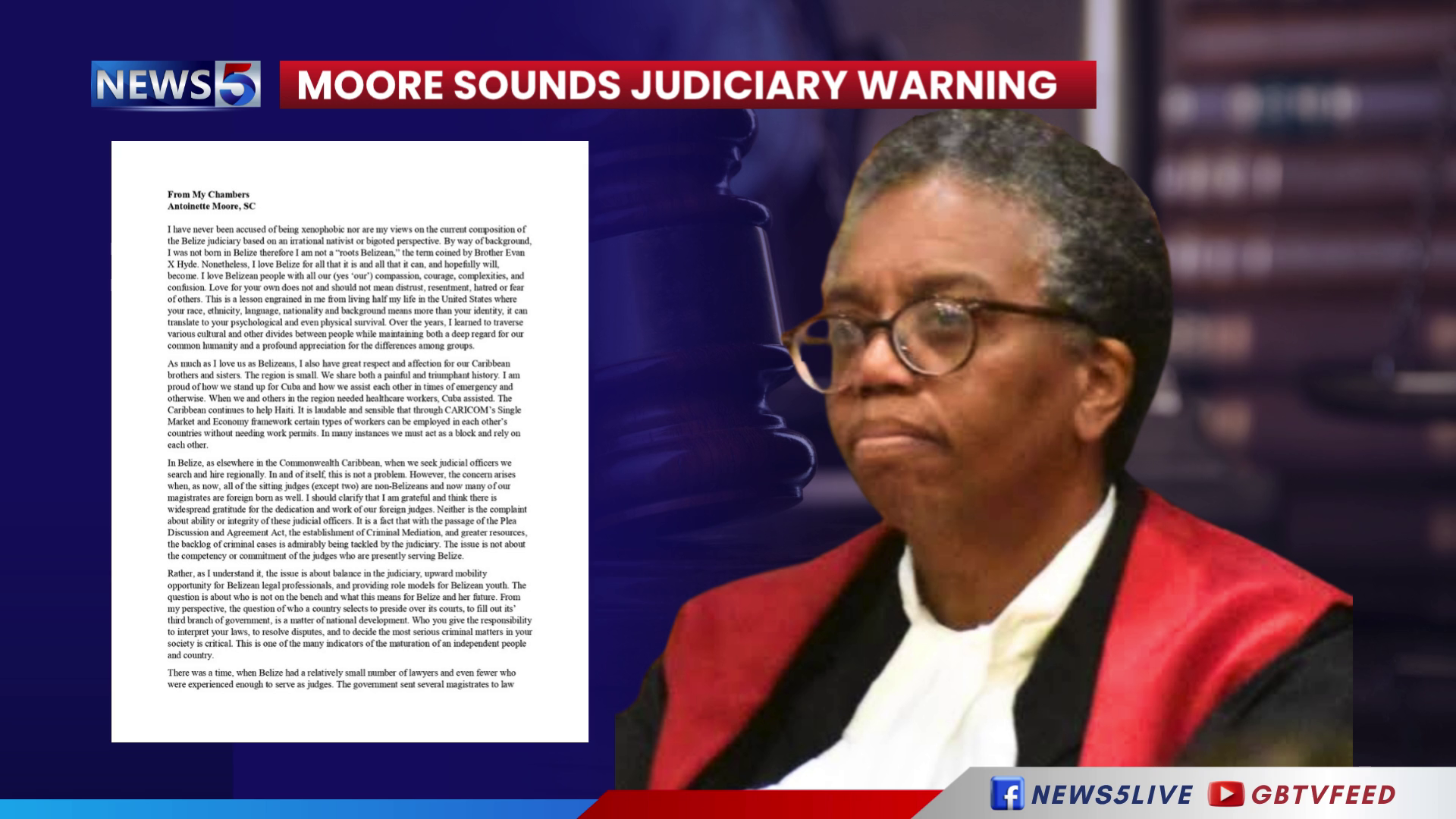
On November 25, 2026, a provocative public statement from recently retired Belizean Senior Counsel and former High Court Justice Antoinette Moore has sparked widespread public discourse over the composition of the country’s senior judiciary. In her widely shared “From My Chambers” commentary, Moore laid out stark data showing that only 2 of Belize’s currently serving High Court judges hold Belizean nationality, alongside a growing majority of non-local magistrates across the lower court system.
Moore, a U.S.-born jurist with deep familial and professional roots in Belize, explicitly rejected accusations of xenophobia, noting her own non-native status as proof her advocacy is rooted in institutional equity rather than anti-foreigner sentiment. Her public intervention comes just three weeks after official notices published in the Belize Gazette and formal correspondence from the Judicial and Legal Services Commission confirmed the appointment of two additional foreign High Court jurists: Guyanese legal practitioner Sheiniza Smith, whose 25-year tenure will run through 2051, and Trinidadian attorney Peter Carter, whose appointment extends 27 years to 2053. Prior to Moore’s scheduled retirement from the bench in August of this year, she was the only one of 13 sitting High Court judges with close, established ties to Belize.
Moore emphasized that over the past four consecutive years, judicial appointment processes have systematically sidelined a large, qualified cohort of experienced, reputable Belizean senior lawyers who are fully eligible for High Court postings. She clarified that she does not impugn the professional competence, ethical standing, or work ethic of the current cohort of foreign judges, and specifically praised recent institutional reforms including the Plea Discussion and Agreement Act and formal criminal mediation frameworks for delivering tangible progress in reducing the national criminal case backlog. That said, Moore warned that with the current long-term tenures of existing foreign judges and no planned expansion of High Court bench seats, Belizean magistrates and local senior lawyers could be locked out of High Court appointment opportunities for decades to come.
She pushed back firmly against the common official argument that local candidates are disqualified by alleged partisan political or familial conflicts of interest, pointing to a long track record of distinguished Belizean judges from across the full political spectrum who served on the bench with unassailable impartiality for generations. Moore further noted that public trust in the national judiciary has not improved under the current majority-foreign bench, compared to the era when nearly half of all High Court judges were Belizean nationals, and that public controversy surrounding judicial appointments has in fact risen sharply in recent years. She concluded that the composition of the national judiciary is a core pillar of sovereign national development and a key marker of a young independent country’s institutional maturity, arguing that Belize’s bench must adopt a balanced model that welcomes qualified, respected Caribbean jurists while also reserving meaningful pathways for eligible, independent local legal professionals to serve.