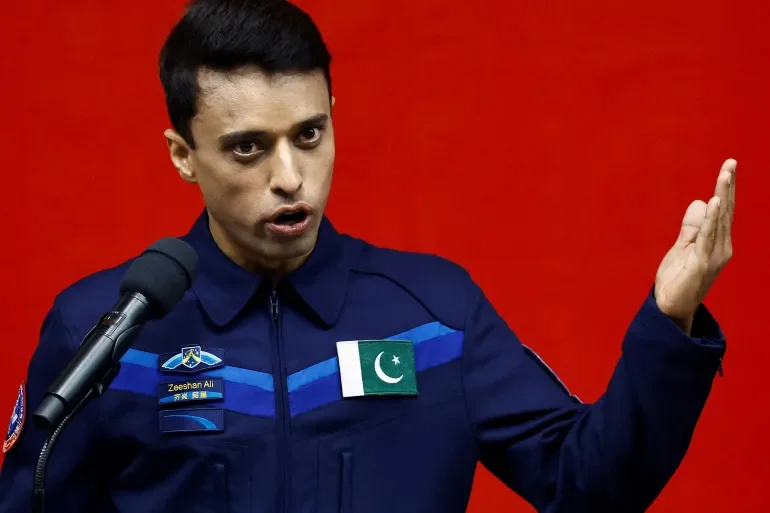
On November 24, space authorities confirmed that a landmark milestone in global collaborative human spaceflight is imminent: 40-year-old Pakistan Air Force veteran pilot Muhammad Zeeshan Ali will become the first Pakistani national to travel to outer space, and the first non-Chinese astronaut to visit China’s Tiangong Space Station, as part of the Shenzhou-24 crew launching from Jiuquan Satellite Launch Center in northwest China’s Gansu Province at 8:18 a.m. local time on November 25. Ali will join mission commander Tang Hongbo and on-board engineer Wu Yi of the Chinese Astronaut Corps, serving as payload specialist to oversee and execute joint scientific experiments during his 5 to 7 day stay aboard the orbital outpost, before returning to Earth aboard the already docked Shenzhou-23 capsule. The China Manned Space Agency (CMSA) formally announced the full crew roster on November 25, confirming all three astronauts are in peak physical condition and all pre-launch preparations have been fully completed. This mission represents a historic first for China’s independent human spaceflight program, which developed the Tiangong station after being excluded from the U.S.-led International Space Station under 2011 U.S. legislative restrictions that barred bilateral NASA cooperation with Chinese space entities. Ali was selected alongside fellow Pakistan Air Force pilot Khurram Daud for Pakistan’s national astronaut program, following a rigorous three-stage evaluation process covering medical, psychological, and technical assessments. The pair were named as official reserve astronauts by CMSA on April 22, and completed months of intensive training at the Chinese Astronaut Center in Beijing, including centrifuge stress tests, flight simulation drills, emergency response protocols, survival and rescue exercises, and mandatory Mandarin language proficiency training. While Daud will not fly on this mission, Pakistan’s Minister of Planning Ahsan Iqbal, who is attending the launch in China, honored both pilots for their shared contributions to the landmark achievement. Far beyond its symbolic weight, the mission will deliver four joint Sino-Pakistani research projects spanning biotechnology, materials science, fluid physics, and life sciences. Ali will be tasked with deploying specialized research hardware, loading test samples, and running initial microgravity experiments, including a landmark study on cyanobacteria — photosynthetic microorganisms critical to oxygen production and carbon dioxide sequestration. Pakistan’s national space agency SUPARCO noted that Ali’s short stay is designed to validate that all research equipment survived launch and operates correctly in orbital conditions, with full 6 to 12 month data collection for the projects to follow, delivering real-world applications for climate resilience, food security, and industrial innovation. This mission stems from a formal bilateral cooperation agreement signed between SUPARCO and CMSA in February 2025, aligned with the broader deep-rooted strategic and economic partnership between the two nations, which are marking 75 years of formal diplomatic ties this year. For China, hosting the first international astronaut aboard Tiangong fulfills its long-stated goal of opening the station as a global collaborative platform for space research, while for Pakistan, the partnership grants access to advanced technical expertise, research infrastructure, and operational experience that it could not develop independently at this stage of its space program. The two nations already have a robust track record of joint deep space missions: Pakistan’s iCube-Qamar satellite was deployed into lunar orbit aboard China’s Chang’e-6 mission in 2024, and a SUPARCO-developed lunar rover is scheduled to fly on China’s Chang’e-8 uncrewed mission targeted for 2028, as part of a broader joint lunar exploration roadmap. China itself is progressing toward its stated goal of landing Chinese astronauts on the moon no later than 2030, alongside ongoing development of next-generation heavy-lift rockets, crewed deep space vehicles, and lunar landing systems. Ali, speaking at a pre-launch press conference at Jiuquan, emphasized that he does not carry only his own personal ambition into orbit, but the hopes and national pride of Pakistan’s 250 million residents, framing his flight not as an end point but as the foundation for expanded future bilateral cooperation, including follow-up crewed missions, joint lunar research, and eventual collaborative deep space exploration efforts targeting Mars.