BASSETERRE, St. Kitts – The United States International Development Finance Corporation (DFC), the U.S. government’s official global investment arm established in 2019, has set its sights on expanding its operational footprint across St. Kitts and Nevis, with a curated focus on high-impact sectors that can accelerate inclusive local economic growth while aligning with U.S. foreign policy priorities.
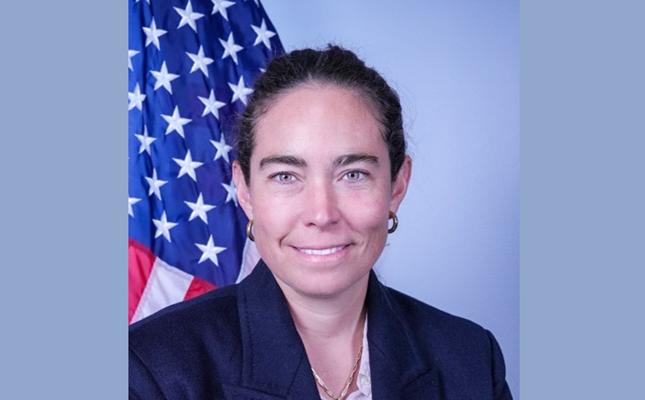
Leading the agency’s on-the-ground outreach, DFC Chief Policy Officer Caroline Vik arrived in the Federation on Wednesday, November 18, 2026, for a series of closed-door consultations with federal government officials, Nevis Island Administration leadership, and local private sector stakeholders to map viable, mutually beneficial investment pathways.
During an exclusive interview with SKNVibes News, Vik revealed the DFC commands an estimated $205 billion in total deployable investment capacity, with a broad eligible sector portfolio spanning critical mineral extraction, pharmaceutical manufacturing, agricultural input production (including fertilizers and crop protection solutions), and advanced microelectronics and semiconductor development.
“Our core mandate is to drive tangible economic progress for U.S. allies and partner nations, while simultaneously advancing U.S. foreign policy objectives through fully commercially sustainable investment vehicles,” Vik explained, noting the agency’s full suite of financial tools includes low-interest debt financing, direct equity stakes, political risk insurance, structured loan guarantees, and pre-project development grants that cover early-stage feasibility assessments to de-risk projects for subsequent full-scale financing.
Vik outlined three overarching strategic pillars that guide all DFC global investment decisions: diversifying fragile global critical material supply chains away from overconcentrated sources, bolstering the long-term resilience of high-priority strategic industrial sectors, and upgrading underdeveloped critical infrastructure in geographically priority locations. Among the sectors receiving heightened DFC attention globally are renewable and conventional energy systems, information and digital technology infrastructure, and inclusive financial services.
In the energy space, the DFC’s existing global portfolio covers end-to-end power ecosystem assets including import terminals, utility-scale power plants, cross-jurisdictional transmission pipelines, upgraded transmission lines, and modernized national electricity grids, with active investments across natural gas, geothermal, and hydroelectric assets, alongside exploratory interest in next-generation low-carbon nuclear energy projects. The agency is also actively pursuing investments in regional data centers and cross-border digital infrastructure, including subsea telecommunications cables and terrestrial fiber optic networks. For financial services, the DFC partners with local commercial banks and regulated fintech platforms to expand targeted lending that unlocks secondary economic activity tied to large-scale infrastructure and responsible mining developments.
Vik emphasized that the entire Caribbean region ranks as a top operational priority for the DFC, and the core goal of her St. Kitts and Nevis visit was to build a robust local project pipeline that aligns both with the agency’s global strategic priorities and the unique, context-specific development needs of the twin-island nation. “We are actively scouting for high-impact projects here, and we came to listen first to identify where our support can deliver the greatest public good,” she noted, adding that the delegation held productive initial conversations around the country’s promising geothermal energy prospects, opportunities to reduce national electricity costs to expand industrial competitiveness, and gaps in unmet critical infrastructure needs.
Crucially, Vik clarified that while the DFC coordinates closely with host national governments to identify national development priorities, 100% of its financial support is deployed directly to private sector entities, not public government bodies: all loans, equity investments, and risk insurance policies are issued to qualified private businesses operating in target partner markets.
For small island developing states like St. Kitts and Nevis, Vik stated the DFC is intentionally structured to prioritize projects that generate widespread, long-term local economic opportunities, rather than small-scale, low-impact transactions. “We aim to be a reliable, transparent long-term partner to St. Kitts and Nevis, focused on delivering projects that move the needle on national economic growth and shared prosperity for all residents,” she said.
The outreach visit unfolds against a backdrop of rising economic uncertainty across many Caribbean small island states, where longstanding traditional revenue streams – including widely used Citizenship by Investment (CBI) programs that have formed a core pillar of St. Kitts and Nevis’ national development budget for decades – face growing external regulatory and market pressure, creating an urgent national policy priority to diversify revenue streams and expand productive non-CBI economic sectors.
Vik confirmed the DFC’s Caribbean-wide investment model is fully customized to each individual nation’s unique gaps: for some markets, the priority need is energy system upgrades, for others it is port infrastructure to boost regional trade, and for others it is resilient water security infrastructure, and the agency will adjust its focus accordingly to match local needs. She added that all DFC-supported projects are required to deliver measurable spillover economic benefits for local communities, rather than serving narrow commercial interests for external investors.
While initial stakeholder meetings generated enthusiastic local interest in DFC partnership opportunities, Vik noted formal discussions remain in early stages, with no finalized project agreements announced to date. She confirmed expanding U.S. private sector investment across allied partner nations is a top stated policy priority for the current U.S. presidential administration, the U.S. State Department, and the DFC leadership team, and the next phase of the engagement will focus on translating exploratory talks into tangible, shovel-ready projects.
Vik extended a direct public invitation to all local St. Kitts and Nevis businesses and private investors to reach out directly to the DFC via initial introductory emails outlining proposed project details. Submitted proposals will first undergo a rapid, streamlined preliminary assessment to confirm alignment with the DFC’s strategic priorities, and projects that pass this initial screening will move to a full, detailed financial due diligence process to verify long-term commercial viability before any funding commitments are issued.
US development finance agency eyes investment opportunities in St. Kitts and Nevis