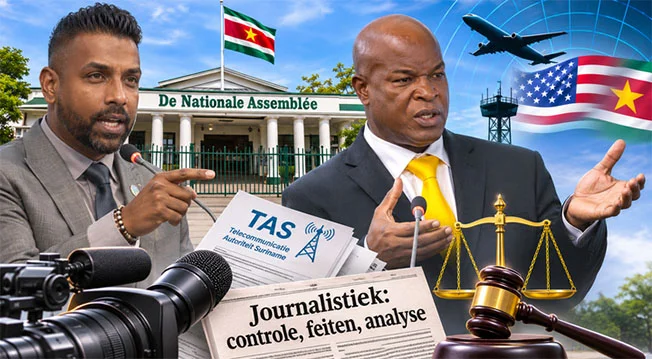
On November 20, political analyst Wilfred Leeuwin published a critical analysis of two intertwined unfolding political controversies in Suriname that are laying bare gaps in administrative accountability, independent press freedoms, and consistent political governance. The first controversy centers on the abrupt departure of Harish Monorath, former Minister of Justice and Security, who has publicly framed his political ouster as the product of a coordinated public and political “witch hunt” led by local journalists, rather than the outcome of his own documented administrative missteps. Contrary to Monorath’s claims, the chain of events that undermined his position began not with a pre-planned media campaign, but with a 2023 administrative dispute at the Telecommunications Authority Suriname (TAS). When then-TAS director Wendy Jap-A-Joe refused to step down from her post, the resulting court proceedings uncovered a 2021 employment contract signed by Monorath, who served as supervisory board chair of TAS at the time. Suriname’s Court of Justice later ruled that no formal approval from the Council of Ministers or required ministerial authorization for Monorath to sign the agreement had ever been produced, temporarily suspending the contract’s legal validity, while a separate criminal complaint has since been filed by the TAS supervisory board. Journalists did not draft the disputed contract, negotiate its terms, or assume unvetted financial obligations on TAS’s behalf: they only cross-verified public court documents, mapped administrative connections, and published verified findings to inform the public, a core function of independent oversight media. For a sitting Justice Minister to mischaracterize this standard public interest reporting as a targeted harassment campaign erodes the core distinction between legitimate investigative scrutiny and political persecution, while diverting public attention from the administrative actions that triggered the crisis in the first place. The analysis also clarifies misinformation circulating around President Jennifer Simons’s rationale for accepting Monorath’s resignation. ABOP party chair Ronnie Brunswijk had publicly claimed the minister was forced out solely by public pressure, but Simons explicitly stated to reporters that she acted on the basis of an unsustainable administrative situation, not popular backlash — a critical distinction that rejects the framing that elected leadership must bow to media-driven public opinion rather than formal administrative assessment of ministerial conduct. The analysis then turns to Brunswijk’s own contradictory conduct, which raises separate questions of political credibility. As a former Vice President serving in the previous Santokhi administration, Brunswijk formally signed a 2024 bilateral agreement with the United States to allow joint interception of suspected civilian aircraft involved in transnational drug trafficking, via an official administrative memo. Now, as parliamentary leader of the ABOP, he has publicly condemned the treaty as a threat to Suriname’s national sovereignty, arguing that U.S. agencies would gain undue access to sensitive domestic aviation and law enforcement data. While concerns about protecting national sovereign decision-making are entirely legitimate, Brunswijk has not provided any public record of raising these objections during his tenure as vice president, when he held the authority to revise or reject the treaty before it was finalized. His long-documented prior 2000s conviction in a high-profile international drug trafficking case adds a layer of unique political sensitivity to his public opposition to the anti-drug accord, requiring full, transparent public justification of his current stance to avoid perceptions of conflict of interest. The analysis concludes that the cascading controversies surrounding Monorath’s ouster and Brunswijk’s contradictory treaty stance represent a defining test for Suriname’s post-transition administrative culture: a government that campaigned on promises of transparency cannot afford to scapegoat independent journalists for exposing administrative missteps, nor can senior political leaders disavow responsibility for policy decisions they personally approved while in high office. Blaming messengers for verified, fact-based reporting does not erase underlying administrative irregularities, and undermines the system of checks and balances that sustains Suriname’s rule of law, which relies not only on courts and parliament, but on an unobstructed free press holding public officials to account.