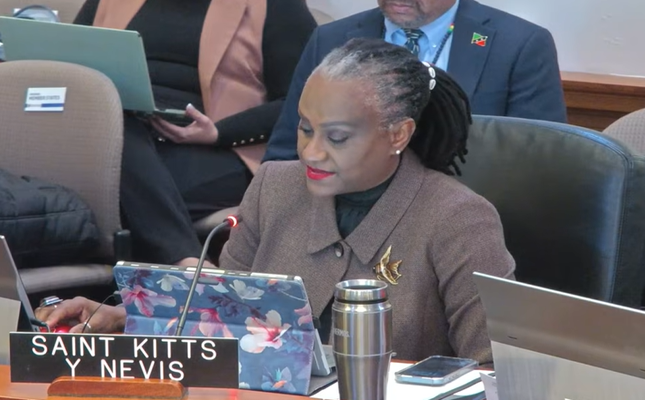
During a special session of the Organization of American States (OAS) Permanent Council in Washington D.C., St. Kitts and Nevis’ top representative to the hemispheric body Ambassador Jacinth Henry-Martin delivered a stark, evidence-backed address flagging the rapidly escalating crisis of technology-enabled gender-based violence that is eroding the safety, rights and public participation of women and girls across the Americas.
While the global expansion of digital connectivity has unlocked unprecedented access to educational resources, remote economic opportunities, cross-community communication channels and public civic engagement platforms, Henry-Martin emphasized that these very tools are increasingly being weaponized by bad actors to perpetuate targeted harm against marginalized gender groups. What was once limited to physical forms of gendered abuse has now expanded to include a sprawling suite of digital harms: relentless cyberbullying, invasive online stalking, explicit threats of physical harm, non-consensual distribution of private intimate imagery, and a growing wave of sophisticated AI-fueled abuse such as deepfake non-consensual pornography that is nearly impossible for many survivors to remove from public digital spaces.
Citing widely cited 2024 data from the United Nations Regional Information Centre for Western Europe, Henry-Martin noted that global studies confirm between 16% and 58% of all women and girls have already experienced some form of online gender-based violence, harms that carry devastating, long-lasting real-world consequences far beyond screen boundaries. These incidents have been proven to trigger severe, prolonged psychological trauma, put survivors at direct risk of offline physical harm, derail women’s professional careers and livelihoods, and push many women out of public, political and community spaces entirely to avoid further targeted abuse.
The ambassador pushed back against pervasive societal narratives that dismiss digital gender violence as trivial “online drama”, stressing that abuse perpetrated via digital platforms is no less reprehensible than physical violence, and that fundamental human rights protections must extend fully into digital ecosystems rather than stopping at the edge of internet boundaries.
For the Latin America and Caribbean region specifically, Henry-Martin pointed to UN Women data showing 1 in 3 women across the region have experienced physical or sexual violence in their lifetime – a statistic that, while not limited to digital harms, lays bare the deep, long-standing structural gender inequalities that emerging digital tools are now amplifying at an alarming scale.
She also outlined the robust existing policy and legal framework St. Kitts and Nevis has already implemented to tackle this overlapping crisis, including the 2022-2027 National Gender Equality Policy and Action Plan that codifies eliminating gender-based violence as a core national priority, a cross-agency Domestic and Sexual Violence Complaints and Response Protocol that coordinates prevention work, survivor support and protection services, and the 2022 Domestic Violence Amendment Act that streamlines protection order applications through the Magistrate’s Court to cut down on costly, bureaucratic barriers that previously blocked many survivors from accessing justice. She noted these existing measures provide a critical foundational structure, but emphasized that regulatory and institutional safeguards must keep pace with the breakneck speed of technological innovation to close emerging gaps that bad actors are exploiting.
The ambassador also highlighted the often-overlooked economic toll of technology-facilitated violence, noting that digital platforms are now a core infrastructure for women entrepreneurs, working professionals, educators and young emerging leaders to build their livelihoods and participate in public life – meaning targeted digital abuse does not just harm personal safety, but actively erodes women’s economic empowerment and long-standing efforts to close regional gender equity gaps.
Henry-Martin raises concerns over technology-facilitated violence against women and girls