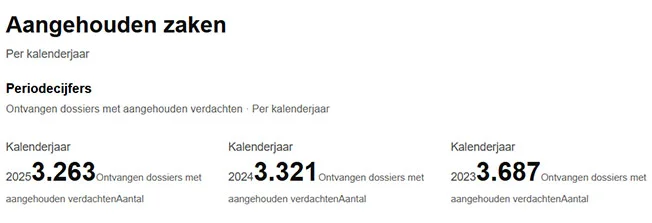
On November 19, local news outlet Starnieuws reported that Suriname’s Public Prosecution Service (known locally as Het Openbaar Ministerie, or OM) has rolled out a new dedicated “Statistics” tab on its official website, granting the general public direct, filterable access to operational data related to its core law enforcement and prosecution work. The new platform, launched the prior Saturday, was developed in direct response to mounting recent public and parliamentary demands for greater clarity around national prosecution policies, and covers verified datasets for calendar years 2023, 2024, 2025, as well as the 2025–2026 judicial term. The OM has emphasized that all published data excludes personally identifiable information, ethnically or socioeconomically categorized breakdowns, and details of ongoing active investigations, in line with its stated commitment to equal treatment of all citizens regardless of status, wealth, or ethnic background. The portal currently includes public metrics on processed criminal case files and approved official permits. The launch has sparked divided responses from two sitting members of the National Assembly (DNA). Krishna Mathoera, a representative from the ruling VHP party and former police commissioner, welcomed the new feature as a meaningful improvement over the OM’s previously released annual static reports, noting that granular public safety data is a critical foundation for evidence-based policy development, parliamentary oversight of government operations, and targeted resource allocation. She called on all other public sector agencies to follow the OM’s example by publishing structured, verifiable performance data to deliver on core public accountability obligations. However, Mathoera flagged a notable 11.5% drop in police-submitted case files to the OM, from 3,687 in 2023 to 3,262 in 2025, as a concerning anomaly that demands formal public explanation, especially amid widespread public reports of rising community insecurity. She stressed that transparency and accountability for public bodies should never be contingent on public outcry or political pressure, but embedded as a standard component of good governance. Jeffrey Lau, a parliamentarian from the opposition NPS party, praised the initiative as a positive first step toward open public data sharing, but criticized the current dataset as overly basic and lacking critical context for meaningful policy oversight. Lau noted that the current aggregated figures only show total case volumes processed, with no breakdowns that would allow lawmakers to hold the Minister of Justice accountable for the effectiveness of prosecution policies. He highlighted the surprisingly low figure of only five recorded alcohol-related traffic offense cases between October 2025 and August 2026, which he said appears inconsistent with widespread on-road observations and public news reports, and suggested that underreporting by discouraged citizens who no longer believe police reports will lead to action may be distorting official statistics. Lau added that while he recognizes operational limits on what sensitive data the OM can release, more detailed breakdowns similar to those already included in the agency’s annual youth justice reports (covering age, gender, and offense type) would vastly improve the portal’s utility. Both lawmakers expressed hope that the OM will expand and refine its public dataset in the coming months, with Mathoera also calling on the national police force to launch its own public statistics portal covering reported crimes, case processing times, recidivism rates, and geographically mapped violent robbery incidents to support targeted community safety interventions. The OM confirmed it is already working on a full website upgrade and planned expansions to its public data offerings.