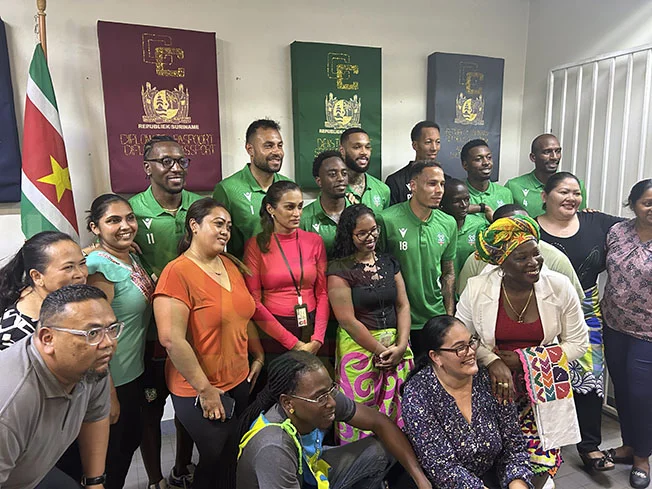
Suriname’s national football governing body, the Surinaamse Voetbalbond (SVB), has officially announced that it has fully resolved the high-profile “passport gate” controversy that previously put Dutch-Surinamese international players at risk of losing their Dutch citizenship when representing Suriname’s men’s national team, Natio. The confirmation came from SVB board member Mike Antonius during the most recent international match window, pushing back against persistent recent claims in Dutch media that dual-national players still faced unaddressed nationality risks for suiting up for Suriname.
Antonius emphasized that the governing body has eliminated all lingering legal uncertainty for its players, pointing to West Ham United striker Joël Piroe – who scored his first two international goals for Suriname against Eswatini earlier that month – as a case in point. Piroe retained specialized legal counsel to conduct a full, line-by-line review of all applicable nationality rules, and has received absolute confirmation that he faces no risk of forfeiting his Dutch citizenship by playing for Natio. The SVB is also providing full, multifaceted support to players who previously ran into nationality-related administrative hurdles earlier in 2024.
The controversy first erupted in March 2024, ahead of Suriname’s World Cup playoff fixture against Bolivia, when questions arose over the eligibility of Go Ahead Eagles defender Dean James. James, who had previously represented Indonesia at the international level, had applied for an Indonesian passport, which automatically stripped him of his Dutch citizenship under Dutch nationality law. The ripple effects of this ruling hit dozens of Dutch-Surinamese players who had applied for Surinamese passports to represent Natio, including top talents Etienne Vaessen, Tjaronn Chery and Gyrano Kerk. Multiple top-flight Dutch clubs temporarily sidelined these players out of fear that their squads’ domestic match results could be ruled invalid if their work permit status was compromised, though legal teams were able to fast-track temporary work permit fixes in the immediate aftermath, long-term ambiguity around nationality risks remained for months.
Following months of closed-door, intensive negotiations between SVB leadership, Suriname’s National Assembly, and cross-border legal teams based in both Suriname and the Netherlands, Suriname’s parliament formally passed a targeted amendment to nationality legislation in early September 2024. The new legal framework rewrites the process for issuing Surinamese passports to eligible dual-national players: rather than requiring footballers to voluntarily apply for a Surinamese passport on their own to represent the national team, the SVB will first confirm a player’s willingness to join Natio, then the Surinamese state will issue them a Surinamese passport by operation of law, explicitly for national interest purposes. This structure is fully compliant with Dutch nationality regulations, per legal reviews.
Since the amendment went into effect, Antonius notes that a wave of new prospective international players have reached out to the SVB to express interest in representing Suriname, rather than holding out indefinitely for a potential call-up to the Dutch men’s national team, Oranje – including Fortuna Sittard rising star Shiloh ’t Zand. Antonius expressed frustration that Dutch media outlets continue to rehash the old passport controversy, pointing out that other national teams including Indonesia and Cape Verde use nearly identical administrative frameworks to recruit dual-national talent, yet face no comparable public scrutiny. He suggested that some parties in the Netherlands may be intentionally spreading misinformation to create unnecessary uncertainty for players considering representing Suriname.
The SVB has also paired its legal resolution with targeted diplomatic outreach, raising the issue during a November 2024 bilateral meeting between Suriname’s Foreign Minister Melvin Bouva and his Dutch counterpart Tom Berendsen in The Hague to formalize mutual goodwill and cross-government alignment on the new rules, ensuring no unforeseen administrative barriers will emerge for players moving forward.