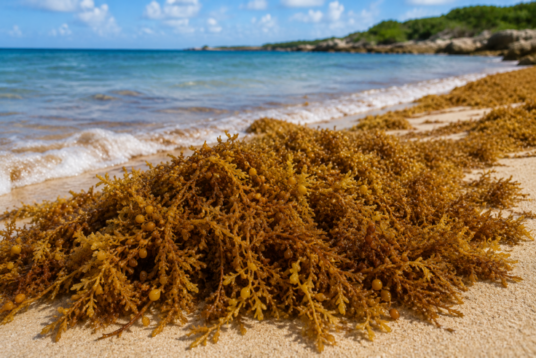
At the 31st UN Climate Change Conference (COP31), the Development Bank of Latin America and the Caribbean (CAF) and the Global Environment Facility (GEF) officially unveiled the SargMarine program, a landmark regional intervention backed by a $10 million GEF grant designed to mitigate the cascading harms of unprecedented sargassum blooms on the Greater Caribbean’s marine-coastal ecosystems, tourism sectors, small-scale fisheries, and frontline coastal communities. The launch event received formal endorsement and co-support from the governments of Mexico and France, marking a cross-continental collaborative commitment to addressing a challenge that no single national government can resolve in isolation.
Lina Mondragón, CAF’s Climate Action and Positive Biodiversity Manager, emphasized the structural gaps in current sargassum response frameworks during her remarks at the launch. “Sargassum is an inherently transboundary phenomenon that drifts across ocean borders unimpeded, but nearly all of our existing mitigation efforts are siloed within national jurisdictions. To break down this fragmented approach, we must scale up proven regional coordination mechanisms, leverage the established operational capacities of intergovernmental regional bodies, and negotiate binding shared agreements that unlock far more coordinated, impactful collective action,” she stated.
The urgency for such a unified response is underscored by latest monitoring data from the United Nations Environment Programme, which recorded a staggering 37.5 million tonnes of sargassum circulating across the Atlantic Ocean in May 2025 – the highest biomass volume ever documented since systematic sargassum tracking began in 2011. These massive, drifting mats of brown algae are already triggering widespread economic disruptions along Caribbean coastlines, smothering critical coral reef and seagrass habitats, and posing growing public health risks to coastal residents who face exposure to rotting sargassum fumes and contaminated shorelines. Program leaders note that the unprecedented scale of the crisis demands an integrated model that connects peer-reviewed scientific data directly to evidence-based public policy and targeted, high-impact public and private investment.
Chizuru Aoki, Manager of GEF’s Conventions and Funds Division, confirmed that the SargMarine initiative has already secured full final administrative approval, clearing the way for immediate on-the-ground implementation. “This program is fully ready to launch, and we are poised to roll out tangible, community-centered action across the Greater Caribbean in short order,” Aoki announced.
Multiple national government representatives from affected Caribbean nations echoed the call for regional collaboration during the launch event. Fabio Arjona Hincapié, Colombia’s Minister of Environment and Sustainable Development, stressed that localized, uncoordinated interventions cannot match the scale of the sargassum threat. “Isolated local solutions will never be sufficient to address a problem that crosses every maritime border in our region,” he noted, adding that coordinated joint action will also strengthen the collective negotiating power of Caribbean nations in global environmental forums to secure additional resources and international support for sargassum mitigation.
Matthew Samuda, Jamaica’s Special Envoy for Climate Change, Environment, Oceans and the Blue Economy, highlighted that enhanced predictive capacity is a core priority for the new program. “Jamaica’s top priorities for this initiative are scaling up real-time sargassum monitoring and advanced forecasting systems. We need precise, actionable data that tells us exactly when sargassum masses will reach our shores, and which coastal communities will be most heavily impacted,” Samuda explained. He added that this granular forecasting data will allow governments to pre-position cleanup resources in high-risk zones, and support long-term planning for the productive, circular use of harvested sargassum as a raw material for agricultural fertilizers, bioplastics, and other value-added products, an economic opportunity that depends entirely on reliable, real-time data on sargassum availability.
Ana Emilia Pimentel, the Dominican Republic’s Vice Minister for Climate Change and Sustainability, emphasized that no regional response will be effective if it overlooks the needs of the coastal communities that bear the brunt of sargassum influxes. “We cannot design this response from top-down technical frameworks alone – we have to center the perspectives, livelihoods, and daily needs of the people who live and work on our coastlines, while also conducting rigorous assessments of the full economic toll that sargassum blooms impose on local economies,” she stated, underlining the critical social dimension of the regional crisis.
For all Greater Caribbean nations grappling with increasingly frequent and severe sargassum surge events, the SargMarine program is structured to turn long-discussed regional cooperation commitments into tangible, coordinated action across three core pillars: unified cross-border monitoring, pre-emptive preparedness, and rapid, harmonized response to incoming sargassum blooms.