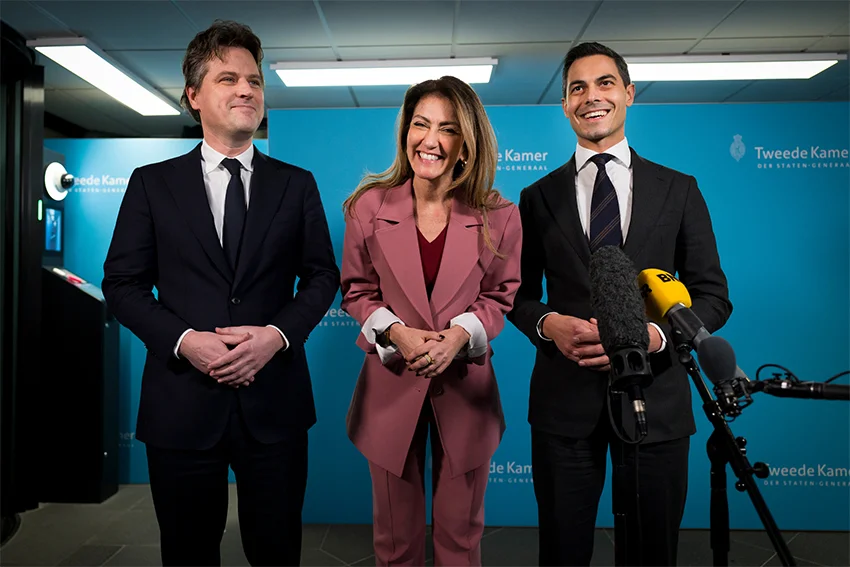
The ruling Dutch coalition, comprising centrist progressive D66, conservative liberal VVD, and Christian democratic CDA, has formally agreed to extend the mandate of its minority cabinet, pulling the country back from the brink of a sudden government collapse after nearly 9 months in office. The breakthrough came after four consecutive days of closed-door emergency negotiations that stretched from the De Zwaluwenberg estate in Hilversum over the weekend to the official prime minister’s residence, the Catshuis in The Hague, concluding on a Monday morning with a joint statement from Prime Minister Rob Jetten’s office confirming that mutual trust between the three governing factions had been fully restored. The unprecedented political standoff erupted last week over a controversial 2027 tax reform package, specifically a proposed €1 billion increase in wealth taxes designed to reduce the financial burden on low and middle-income working households. The rift deepened sharply when D66 and CDA struck a side deal with two opposition parties, Progressive Netherlands (PRO) and Volt, to pass the wealth tax hike, bypassing formal consultation with their VVD coalition partners. The VVD, which staunchly opposed the measure on the grounds that it would harm small business owners and undermine the competitiveness of the Dutch corporate sector, accused its two coalition allies of violating the core terms of their original governing accord, and ultimately voted against the cabinet’s own tax bill. Even with VVD opposition, the legislation passed thanks to the support of the two opposition parties, amplifying long-simmering frictions within the ruling bloc. In the immediate aftermath of the vote, VVD leader and Deputy Prime Minister Dilan Yeşilgöz publicly dismissed the sitting minority cabinet as a “failed experiment” that was unworkable in its current structure, leaving many political analysts predicting early national elections. Over the subsequent three days of marathon talks, which the parties agreed to conduct under a total media blackout to facilitate unfiltered negotiation, negotiators including Prime Minister Jetten, Deputy Prime Ministers Yeşilgöz and CDA’s Bart van den Brink, and all three faction leaders worked to reconcile their competing priorities. While the full details of the compromise agreement remain undisclosed as of Monday, the Dutch Government Information Service confirmed that all cabinet ministers will meet on Tuesday to formalize the new governing arrangements, followed by a public briefing on the outcomes of the crisis summit. Opposition lawmakers have already submitted a formal request for an emergency debate in the Tweede Kamer, the Dutch lower house of parliament, to scrutinize the breakdown in coalition governance and assess the long-term stability of the newly patched governing alliance, as questions linger over whether the restored trust will hold through future legislative disagreements.