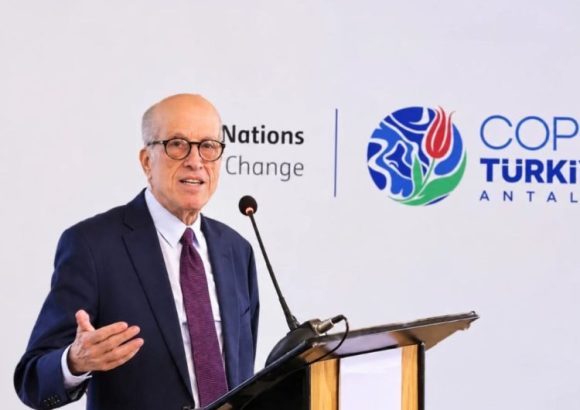
Antalya, Turkey – As global negotiators gather for the 31st UN Climate Change Conference (COP31), the Dominican Republic has emerged as a vocal advocate for marginalized climate-vulnerable nations, framing the global climate crisis first and foremost as a failure of cross-border justice, shared development accountability, and international duty of care.
Leading the national delegation, Max Puig, Executive Vice President of the Dominican Republic’s National Council for Climate Change and Carbon Markets, emphasized that no ambitious national climate action target can be meaningfully delivered without targeted, unburdened support from the world’s highest historical greenhouse gas emitters. Puig called on major emitting economies to immediately ramp up emissions reduction timelines to align with peer-reviewed climate science and the binding obligations of the Paris Agreement, to keep the critical 1.5°C global warming threshold within reach.
A core pillar of the Dominican Republic’s advocacy at the summit centers on reforming global climate finance frameworks: Puig explicitly urged developed nations to fully honor their long-overdue public climate finance pledges, with strict guardrails to ensure new funding does not add to the unsustainable debt burdens already crippling low and middle-income vulnerable states. The delegation outlined a clear set of criteria for ideal climate funding: it must be easily accessible for national governments, predictable across multi-year cycles, heavily concessional with low or zero interest, and disbursed without unnecessary delays to fund critical adaptation work, disaster risk reduction programming, and long-term community resilience building.
The Dominican delegation also formally threw its full support behind the accelerated rollout of the UN Global Goal on Adaptation, prioritizing action across high-impact sectors including water security, food and agricultural systems, public health, ecosystem restoration, climate-resilient infrastructure, poverty alleviation, and protection of at-risk cultural heritage sites. Throughout its interventions, the country repeatedly drew global attention to the disproportionate, existential climate threats facing small island developing states, which contribute a negligible share of historical emissions yet face the earliest and most catastrophic climate impacts.
Puig also highlighted the drastic funding shortfall plaguing the landmark Loss and Damage Fund, established to compensate vulnerable nations for unavoidable, irreversible climate impacts. He noted that pending valid financing requests from eligible countries add up to roughly $2.8 billion – a figure more than eight times the meager $342 million currently held in the fund’s coffers – and called on high-income nations to substantially increase their capital contributions to close this gap.
Parallel to its advocacy, the Dominican Republic formally unveiled its updated third iteration of Nationally Determined Contributions (NDC 3.0) at COP31, laying out legally aligned targets to cut national greenhouse gas emissions by 28% below business-as-usual levels by 2030, and 32% by 2035. The comprehensive national plan includes 26 targeted emissions mitigation measures and 41 distinct adaptation interventions, spanning scaled renewable energy deployment, nationwide upgrades to solid waste management systems, and cross-sector resilience investments, with a total estimated required investment of $23.7 billion to deliver on the full targets. Puig confirmed that the Dominican Republic remains fully committed to advancing its domestic climate action roadmap, while continuing to push for global cooperation that matches the unprecedented scale of the unfolding climate crisis.
For additional localized coverage of Dominican climate policy and national developments, visit DominicanScope.