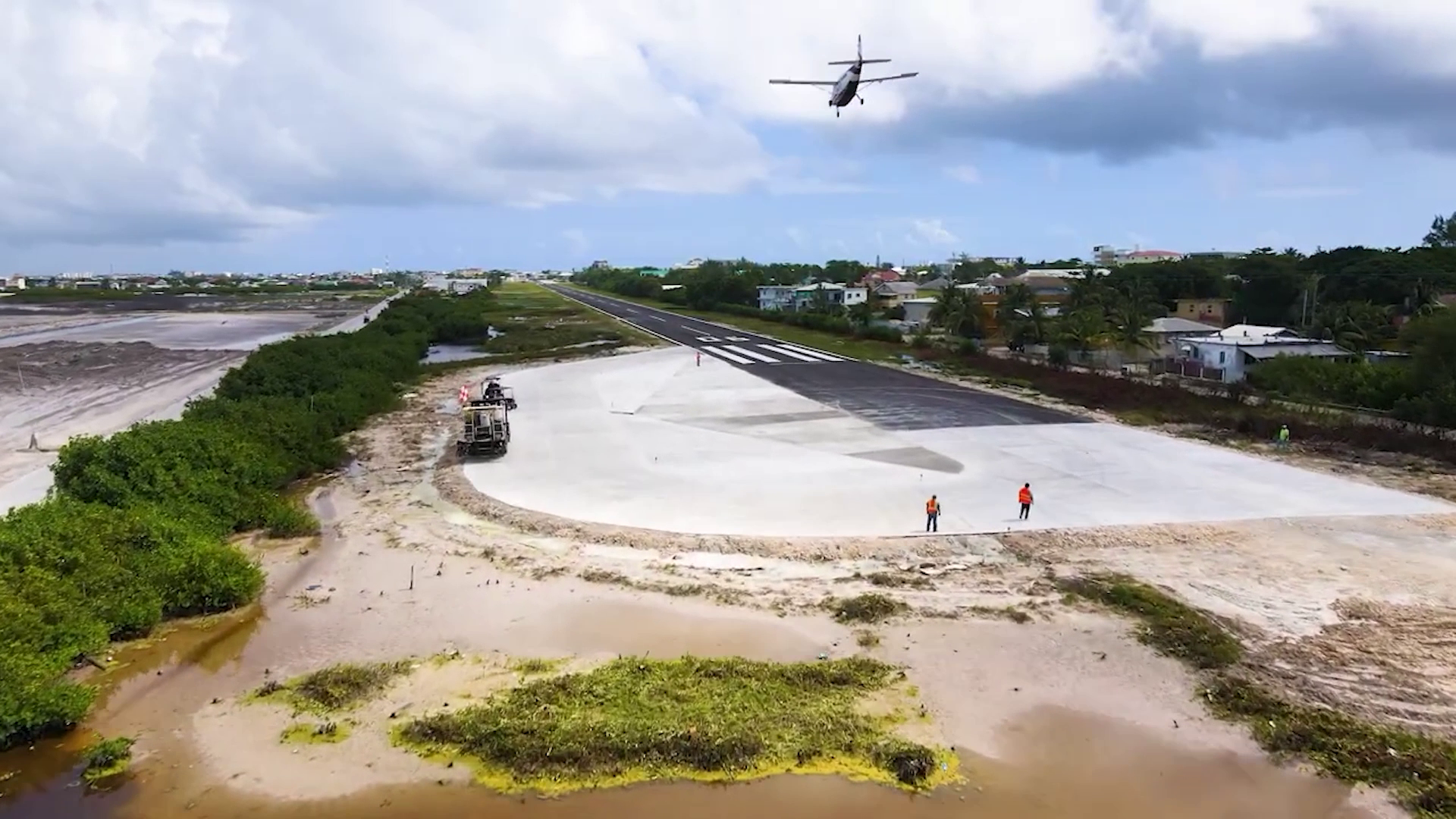
During a Thursday sitting of Belize’s National Assembly in mid-November 2026, Mesopotamia Area Representative Lee Mark Chang raised pointed questions to Prime Minister John Briceño regarding the undisclosed full scope of proposed upgrades and replacement plans for San Pedro Town’s John Greif II Airport on Ambergris Caye, one of Belize’s top tourism hotspots.
Chang presented publicly available 2025 Inter-American Development Bank (IDB) procurement documents that contradict the government’s public framing that the project remains in purely preliminary planning stages. The IDB filings outline a timeline that would break ground on a new northern Ambergris Caye airport in 2027, reach full operational completion by 2029, shutter the existing downtown John Greif II Airport, redevelop its prime waterfront public land, and bring in private sector partners to support the estimated hundreds of millions of dollars in total project costs. The opposition lawmaker emphasized that local San Pedro residents and municipal leaders have been almost entirely excluded from consultations to date, despite the project’s outsized impact on the island’s tourism economy, public land assets, and daily community mobility. He clarified that the San Pedro Town Council is not opposed to building a supplementary secondary airport in the north of the caye, but strongly pushes back against any unvetted plan to permanently close the existing centrally located downtown airport. Chang argued that meaningful public consultation must happen during the planning phase, not after binding construction contracts are signed, public funds are disbursed, or airlines make irreversible fleet adjustments aligned to the new airport’s operations.
Prime Minister Briceño pushed back on Chang’s line of questioning, stating he had long since stopped listening to the representative’s remarks and accusing him of jumping to premature conclusions. The prime minister emphasized that no final binding decision on the airport’s future has been formalized, and that his administration is simply exercising responsible long-term governance by exploring future infrastructure capacity needs, pointing to past failures of the previous administration to proactively plan for national electricity demand, which resulted in widespread sustained blackouts and exorbitant utility costs for Belizean households and businesses for years.
What’s The Full Story Behind John Greif II Airport’s Future?