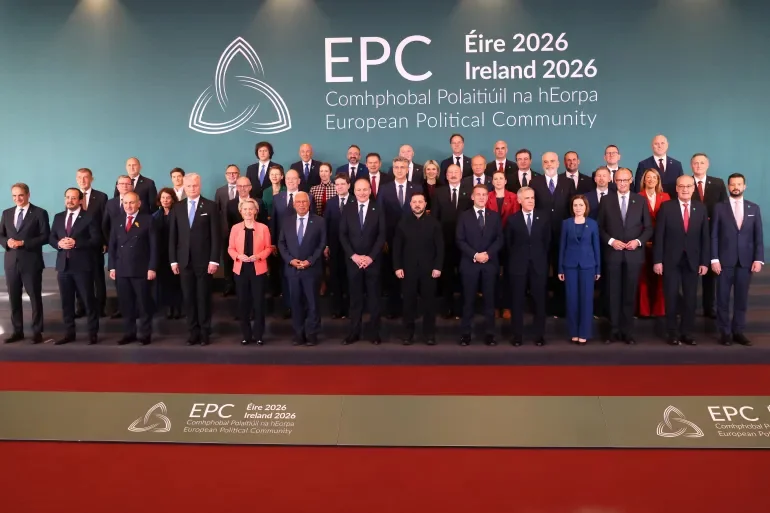
DUBLIN, Ireland – November 13, 2026: More than 40 heads of state and government from across the European continent gathered in Dublin on November 12 for the latest summit of the European Political Community (EPG), where a unified, non-negotiable demand for full, structured European representation in all future negotiations shaping Ukraine’s post-war future and the broader European security architecture emerged as the defining headline of the two-day gathering. Hosted by Irish Prime Minister Micheál Martin, the high-level talks unfolded against a fast-shifting diplomatic backdrop, as U.S. envoys Steve Witkoff and Jared Kushner wrapped up a whirlwind tour that included preliminary meetings with Russian leadership in Abu Dhabi, a follow-up face-to-face with Russian President Vladimir Putin in Moscow, and closed-door consultations with Ukrainian President Volodymyr Zelensky at Dublin’s Casement Aerodrome on the sidelines of the EPG summit.
Ukrainian President Volodymyr Zelensky opened his address to the assembled leaders with a stark warning: no diplomatic negotiations between Washington and Moscow to rewrite Europe’s security order can proceed without formal, permanent European representation at the table. Zelensky noted that while European nations are already loosely integrated into ongoing diplomatic outreach, they lack structured, guaranteed access to direct talks with Russian counterparts – a gap he insisted must be closed immediately to prevent backroom deals that would undermine Ukrainian sovereignty and continental security. Irish Prime Minister Martin echoed that call for collective European alignment, noting that the bloc did not need a single sole representative to speak for all 27 EU member states, but that leaders must reach a clear, binding agreement on who will carry the EU’s mandate in any upcoming peace talks.
European Council President António Costa laid out the bloc’s three non-negotiable priorities for a just, sustainable peace in Ukraine during the summit’s closing press conference: an immediate, verifiable ceasefire, the full restoration of unimpeded commercial shipping access across the Black Sea, and the establishment of preconditions that allow for a durable, mutually respected peace accord. Costa emphasized that Ukraine, as a fully sovereign independent state, retains the exclusive right to choose its own alliances and international partnerships, and reaffirmed that the future of European security can never be decided by external powers without the explicit input and consent of European nations. He also criticized Russia for ongoing actions that continue to escalate the nearly five-year long conflict, noting that little tangible diplomatic progress had been made to date to reduce hostilities.
The EU also formalized a new package of practical, winter-focused support for Ukraine, including the deployment of 500 emergency power generators to shore up the country’s strained energy grid ahead of freezing winter temperatures, four floating bridges donated by Norway to restore damaged critical transport links, and 200 public transit buses to reconnect communities displaced by the war. European leaders confirmed they will convene a dedicated session on November 26 and 27 to hash out Ukraine’s 2027 urgent funding requirements, while the European Commission moves forward with drafting the 22nd round of coordinated punitive sanctions against the Russian Federation.
Beyond Ukraine, the summit dedicated significant agenda time to addressing a recent wave of escalating hybrid threats that have swept across the continent in recent weeks, including targeted cyberattacks, physical infrastructure sabotage, coordinated disinformation campaigns, and mass false bomb threat hoaxes. The most recent spate of hoaxes targeted thousands of Italian schools on November 12, just one day after thousands of other educational institutions across the country received identical threatening alerts, with additional threats also directed at European airlines, major media outlets, and core public service agencies. Prime Minister Martin noted that these coordinated campaigns are explicitly designed to sow public confusion, deepen societal divisions, and erode public trust in democratic governing institutions, and leaders agreed to roll out expanded cross-border information sharing frameworks and coordinated response protocols to detect and disrupt these attacks before they cause widespread disruption. European security agencies are currently investigating potential links between the hoaxes and foreign state-backed influence operations, though no party has been formally identified as responsible to date.
Leaders also mapped out shared priorities for long-term continental competitiveness, focusing on scaled investment in emerging artificial intelligence technologies, improved cross-border digital connectivity, and policies to expand access to affordable, zero-emission clean energy for households and small businesses. At the close of the summit, Martin consolidated the collective action points into four core pillars: unwavering, long-term support for Ukraine, strengthened cross-border cooperation to counter hybrid threats, expanded investment in European innovation capacity, and guaranteed affordable clean energy for all European residents. Founded in 2022 in the immediate aftermath of Russia’s full-scale invasion of Ukraine, the European Political Community operates as a non-binding consultative forum that brings together all EU member states and non-EU European nations to align positions on shared political, economic, and security challenges. The formal EPG summit was followed on November 13 by an informal gathering of EU heads of government to advance discussions on deeper continental integration and evolving global security trends.