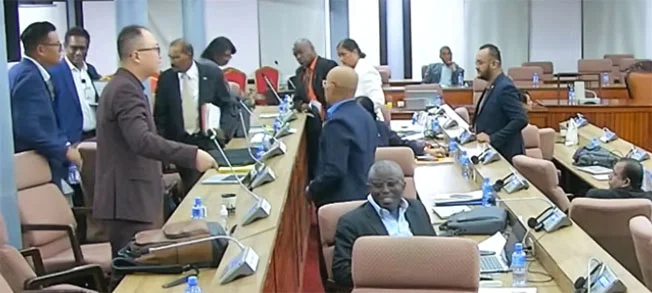
A dramatic procedural showdown unfolded in Suriname’s National Assembly (DNA) on November 13, resulting in the full parliamentary caucus of the Progressive Reform Party (VHP) staging a mass walkout moments after veteran legislator Mahinder Jogi was ordered to leave the chamber by assembly chair Ashwin Adhin. The altercation erupted over long-running disputes surrounding the prioritization of a scheduled interpellation debate on the country’s spiraling public security crisis, which opposition lawmakers argue has been sidelined amid a surge in violent armed robberies, fatal heists, and homicides across the nation. The plenary session, originally slated to convene at 10 a.m., faced extensive logistical delays and did not formally get underway until 12:39 p.m. — hours after a standalone dedicated debate on public safety had been pre-scheduled for the 12 p.m. slot. Jogi, the lead proponent of the security interpellation, challenged Adhin to revise the day’s agenda to move the high-stakes public safety discussion to the top of the order, referencing a formal cross-party agreement reached the preceding Thursday that guaranteed the interpellation would be held that Friday, with 30 minutes allocated for the motion’s sponsors and an additional 30 minutes reserved for government representatives to present responses. Jogi emphasized that further postponement of the debate was morally untenable at a time when ordinary Surinamese citizens face daily threats to their lives and property from rampant criminal violence, noting that the assembly had already formally approved the interpellation and placed it on the agenda in full compliance with Article 85 of the National Assembly’s Rules of Order. “What interest could possibly outweigh a citizen’s fundamental right to protection of their home, their possessions, and their very life?” Jogi challenged Adhin from the floor. Adhin, however, refused to amend the pre-approved agenda sequence, asserting that he would not violate parliamentary procedural rules by rearranging the order of business to accommodate the VHP’s request. When Jogi continued to press his case for immediate debate on the security crisis, Adhin ruled that the lawmaker was disrupting plenary order and formally instructed him to exit the chamber. In a show of collective solidarity, every other member of the VHP caucus immediately followed Jogi out of the assembly, leaving the ruling coalition’s legislators to proceed with the pre-planned agenda. Adhin later defended his ruling by noting that the two items slated for priority debate on the original agenda were themselves directly tied to national security: Suriname’s proposed accession to the Latin American and Caribbean Space Agency (ALCE), and a bilateral mutual assistance agreement with the United States focused on intercepting civilian aircraft involved in transnational illicit drug trafficking. The assembly chair argued that ratification of both international pacts would strengthen cross-border information sharing and collaborative security frameworks, directly improving domestic safety outcomes for all Surinamese residents. Following the VHP’s full departure, Adhin resumed the scheduled plenary proceedings, granting the floor to BEP faction committee chair Ronny Asabina to lead deliberations on the Latin American and Caribbean Space Agency accession bill. The contested public security interpellation, which had already been pushed back from its originally scheduled Thursday slot, is designed to compel the national government to disclose concrete data on the root causes of surging violent crime, the full scope of active mitigation measures being deployed by law enforcement, and the verified effectiveness of existing public safety policy. The incident marks the latest high-profile procedural conflict in Suriname’s legislature over the government’s widely criticized handling of a public security crisis that has left large swathes of the population living in fear of targeted violent attacks.