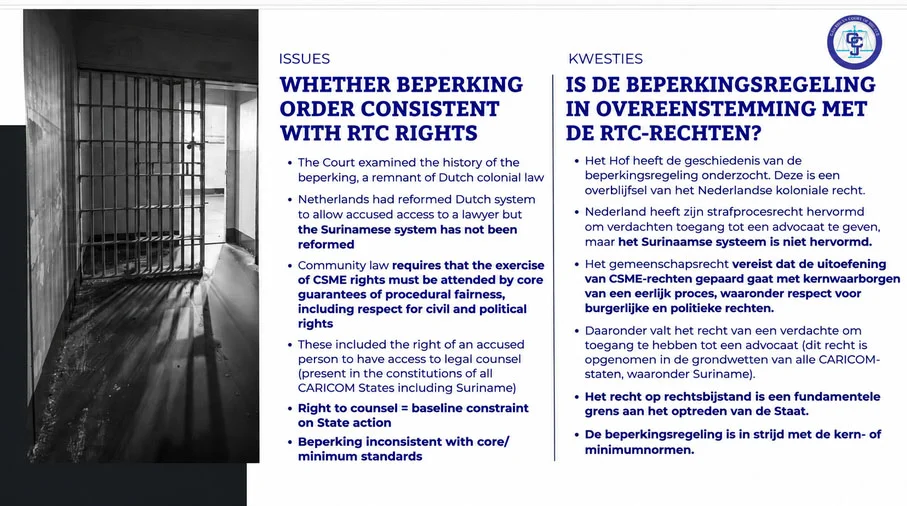
A longstanding Surinamese legal provision that allows authorities to deny suspects access to their legal counsel during criminal investigations has been deemed incompatible with core human rights guarantees enshrined in the Revised Treaty of Chaguaramas by the Caribbean Court of Justice (CCJ). CCJ President Winston Anderson laid out the landmark ruling’s full implications during a joint November 5 webinar hosted by the Inter-American Commission on Human Rights (IACHR) and the CCJ, focused on equality before the law, arbitrary detention, and pre-trial custody. The case at the center of the judgment is Ramsamooj v. State of Suriname, brought by Trinidad and Tobago national Derek Ramsamooj, a political consultant who frequently traveled to Suriname to deliver advisory services for the country’s former administration. The roots of the contested regulation stretch back to Dutch colonial legal frameworks, Anderson emphasized: while the Netherlands has since overhauled its criminal procedure code to enshrine unconditional access to legal representation for all suspects, Suriname never implemented equivalent reforms, retaining the colonial-era restriction that permits authorities to limit or sever communication between a detainee and their lawyer during active investigations. Ramsamooj’s legal ordeal began in October 2020, when Surinamese law enforcement seized his passports and ordered him to report for questioning in connection with a fraud probe targeting the previous government, for which he had performed contracted work. Following his arrest, authorities invoked the contested regulation to block his access to legal counsel; he was also interrogated in Dutch, a language he does not speak natively, and forced to sign a Dutch-language statement that was later used as evidence of a purported confession. He remained in pre-trial detention until December 2020, when he was released due to rapidly deteriorating health, formal criminal charges were only filed against him in March 2021, and his passports were not returned until September 2022. Ramsamooj subsequently filed a case at the CCJ, arguing that his treatment violated not only fundamental universal human rights, but also his legally protected rights as a CARICOM citizen, including the freedom of movement and the right to provide cross-border services across the Caribbean Community. In its defense, the State of Suriname argued that CARICOM’s 1997 Charter of Civil Society was not a legally binding treaty, that the CCJ had no independent jurisdiction to rule on alleged human rights violations, and that the restrictions on legal access were a legitimate safeguard to preserve the integrity of criminal investigations. Suriname also invoked Article 226 of the Revised Treaty of Chaguaramas, which permits targeted limitations on treaty rights to protect public order and security under defined circumstances. The CCJ rejected these arguments as justification for the severe rights violations documented in Ramsamooj’s case, ruling that the right to access a lawyer of one’s own choosing is a fundamental civil and political right recognized across all CARICOM member states, including in Suriname’s own national constitution. The ruling extends far beyond the particulars of Ramsamooj’s individual case, establishing a binding regional legal precedent that national criminal investigation powers cannot be applied in ways that erode the minimum human rights protections guaranteed under CARICOM community law. CCJ Justice Chantal Ononaiwu expanded on the judgment’s broader legal scope during the webinar, noting that while the 1997 CARICOM Charter of Civil Society is not a directly enforceable treaty, it carries authoritative legal weight as a guiding document for interpreting the Revised Treaty of Chaguaramas and establishing general principles of regional community law, alongside member state constitutions and ratified international human rights conventions. The court clarified that fundamental rights are not absolute under all circumstances, and targeted, proportionate restrictions may be permissible under CARICOM law, but no such limitation can hollow out the core of guaranteed legal protections. Anderson further outlined that the precedent carries transformative long-term implications for the Caribbean Single Market and Economy (CSME), extending beyond criminal justice to cross-border commercial activity, including service provision by entrepreneurs, cross-border investment, capital flows, and corporate establishment, where core principles such as non-discrimination, property rights protection, and prohibitions on arbitrary state decision-making will now be anchored to the same regional human rights framework. He noted that further legal development will be required to formalize how these minimum human rights safeguards apply to legal persons including private corporations. For Suriname, the ruling exposes a critical gap between existing national criminal procedure rules and binding regional legal obligations, requiring a full review of current law enforcement and judicial practices to ensure all suspects receive timely, unimpeded access to legal counsel of their own choosing. No timeline or formal policy adjustment plans have been announced by Surinamese authorities in response to the judgment to date, but the CCJ’s clear directive establishes that no member state may invoke domestic investigative powers to override the fundamental legal guarantees embedded in CARICOM community law.