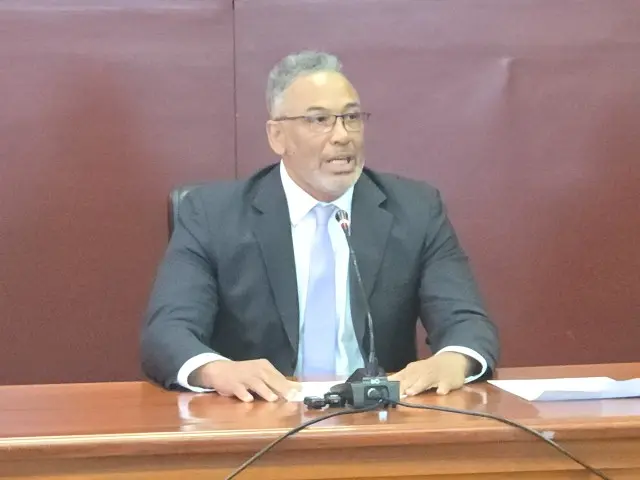
Veteran Belizean jurist and ex-Foreign Minister Justice Godfrey Smith, who currently leads the MV Barima Commission of Inquiry, has publicly stated that he believes the United States government revoked his travel visa on November 7, 2026, explicitly due to his years of active advocacy to expand collaborative ties between Belize and mainland China. The formal notification of the visa cancellation arrived via official US embassy email, which cited unspecified newly surfaced information suggesting Smith was no longer eligible to hold a valid US travel document.
In an exclusive interview with Belize’s 7 News, Smith emphasized that the action did not come as a total shock, pointing to the long-stated public policy of the current US administration to systematically reduce China’s geopolitical and economic footprint across Latin America and the Caribbean. He noted that over the past several months, he has been deeply engaged in initiatives designed to expand Chinese engagement in Belize, a nation that maintains full official diplomatic relations with Taiwan rather than the People’s Republic of China.
Smith forcefully dismissed any potential unstated allegations of wrongdoing that could have justified the visa revocation, explicitly clarifying that he has no history of involvement in drug trafficking, human smuggling, immigration fraud, tax evasion schemes for US citizens, money laundering, terrorism financing, or any other illicit activity. “There is zero ambiguity that this revocation has no connection to any nefarious conduct on my part,” he stressed.
Detailing his pro-China outreach efforts, Smith recounted that in January 2026, he traveled to Beijing for high-level closed-door discussions with Chinese Foreign Ministry officials, despite the absence of formal bilateral diplomatic ties between Belize and mainland China. During those talks, Chinese officials expressed willingness to partner with him to facilitate people-to-people exchanges, even without official state-level relations. He later followed up by visiting the Chinese embassy in Jamaica to formalize a structured study tour program that has already sent cohorts of young Belizean academics and media professionals to mainland China, to give them first-hand exposure to Chinese society, development models, and collaborative opportunities for Belize. A former Attorney General of Belize who served in that post from 1999 to 2003 before taking on the foreign minister role until 2005, Smith noted that these exchanges are designed to help ordinary Belizeans better understand China’s global influence and mutual development possibilities for their home country.
Smith also confirmed that he has no intention of filing an appeal against the US visa revocation, nor will he submit a new application for a US travel document in the future. While he acknowledged the move may create minor logistical inconveniences for his international travel down the line, he stated he holds no personal resentment, and respects the US government’s choice to bar him from entry, noting he will not petition to be granted access to a country that has made clear it does not welcome his presence.
The visa revocation incident unfolds against a broader backdrop of rising diplomatic friction over cross-strait recognition in the Latin American region. Weeks prior to Smith’s visa being canceled, the Chinese government announced sweeping punitive sanctions targeting two sitting regional ministers: Paraguay’s Communications Minister Gustavo Villate and Belize’s current Foreign Minister Francis Fonseca. The Chinese Foreign Ministry stated that the pair had carried out a series of severe actions and public statements that inflicted severe harm on China’s core national interests, and as a result, Beijing would freeze their assets, bar them from entering mainland China, and prohibit all Chinese organizations and individuals from conducting any form of transactions, cooperative engagements, or other related activities with the two officials. A report from Al Jazeera last month noted that Chinese diplomatic representatives criticized the two as self-serving anti-China politicians who have aggressively pushed their respective governments to continue maintaining official diplomatic recognition of Taiwan, in direct contravention of Beijing’s longstanding one-China principle.