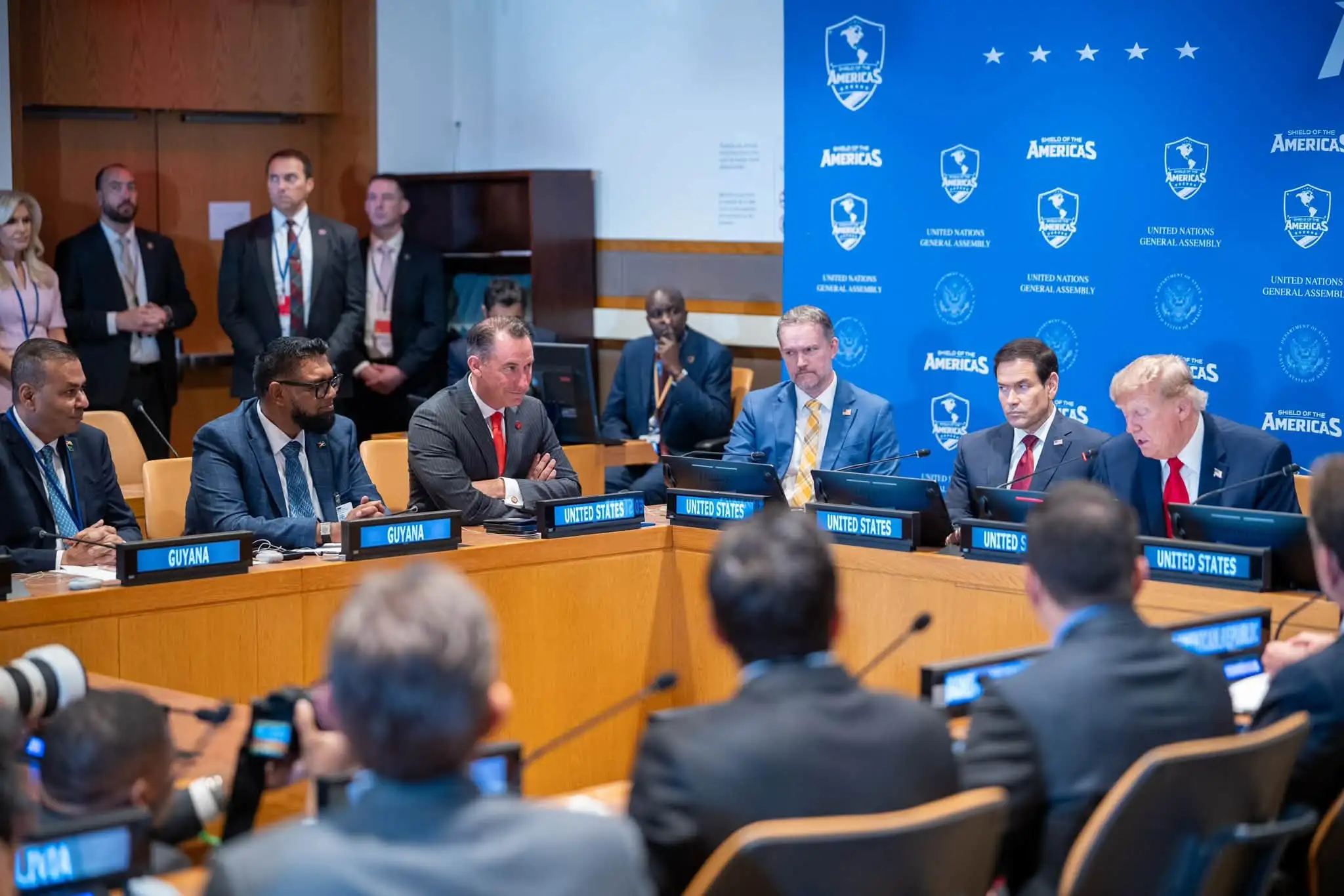
On March 7, 2026, Guyanese President Dr. Irfaan Ali and Foreign Secretary Robert Persaud joined U.S. President Donald Trump, Secretary of State Marco Rubio, and other senior officials for a Shield of the Americas summit, marking a high point in the two nations’ deepening bilateral cooperation that has flourished since the Trump administration returned to office two years prior. This partnership has spanned expanded defense and security collaboration, coordinated pushback against Venezuela’s unlawful territorial claims over Guyana’s Essequibo Region, and a surge in natural resources-focused U.S. investment that has driven unprecedented economic growth for the South American nation.
Following the 2026 U.S. midterm elections that delivered full Democratic control of both the U.S. House of Representatives and the Senate, President Ali has publicly dismissed concerns that the shift in congressional power will erode the strong bilateral framework built over the past two years. Speaking exclusively to Demerara Waves Online News, Ali emphasized that Guyana’s engagement with Washington is rooted in shared national priorities for both nations, rather than narrow partisan political cycles in the U.S. capital. “In terms of our cooperation and collaboration with the U.S., we see no change,” Ali stated, noting that all existing bilateral programs and formal cooperation arrangements will move forward as planned, with Guyana remaining committed to working with the U.S. as a core ally and development partner.
Ali’s remarks come amid renewed attention on Democratic leader Hakeem Jeffries, who is widely tipped to assume the U.S. House Speaker role in the new congressional session. Years prior, in 2022, Ali had publicly warned Jeffries against “playing politics with Guyana’s future” after the Congressman leveled unsubstantiated accusations of systemic racial discrimination against the Afro-Guyanese community, claims the PPP/C-led Guyanese administration has repeatedly rejected as baseless. Even with Jeffries set to hold significant legislative influence, Ali reaffirmed that Georgetown’s diplomatic course will remain steady, with clearly defined national development priorities guiding all engagements across U.S. political branches.
Leading international relations scholars and U.S. foreign policy experts, however, note the Democratic congressional majority is poised to trigger meaningful recalibrations of U.S. foreign policy across the Western Hemisphere. University of Guyana international relations professor Dr. Mark Kirton argues that the shift in legislative power will substantially weaken the Trump administration’s unilateral leverage over smaller partner states like Guyana, replacing the prior dynamic of coercive diplomacy and excessive U.S. demand-making with a new framework rooted in reasoned, mutual dialogue. Kirton added that Democratic control of key congressional committee gavels will likely bring heightened oversight focus on governance transparency, anti-corruption measures, and accountability frameworks across high-profile partner nations including Guyana, whose global profile has surged in recent years due to its booming oil and gas sector.
Analysis from Washington D.C.-based think tank Inter-American Dialogue’s “What Will the U.S. Midterms Mean for Latin America?” report offers further context for regional leaders. Rebecca Bill Chavez, the organization’s president and CEO, cautioned Western Hemisphere heads of state against over-reliance on personal, close ties to a single sitting U.S. president, noting that rapid power shifts in Washington can render those narrow relationships obsolete overnight. “Governments need relationships with both parties, regardless of who’s in the White House,” Chavez advised, pointing out that many regional leaders who prioritized exclusive alignment with Trump now face greater diplomatic uncertainty.
Todd D. Robinson, former U.S. assistant secretary of state for international narcotics and law enforcement affairs and Inter-American Dialogue board member, noted that the new Democratic majority will launch widespread reviews of bilateral deals struck during the Trump administration, including security pacts across Latin America and arrangements related to long-running U.S. engagement with Venezuela. Guyana and Trinidad and Tobago are core members of the Shield of the Americas counter-narcotics coalition, under which Ali traveled to the Pentagon just one month prior to sign a landmark enhanced defense partnership agreement with U.S. authorities. Robinson added that while public scrutiny of these deals may rise across the region, partner nations will not face widespread punitive backlash for their prior alignment with the Trump White House, as flexible diplomatic adjustment is a standard expectation for countries engaging with Washington across partisan administrations.
Melissa Ford Maldonado, director of the Western Hemisphere Initiative at the America First Policy Institute, pushed back against narratives that the prior Trump-era partnerships will be fully discarded, noting that public sentiment across Latin America remains broadly supportive of the Trump administration’s support for regional nations pushing back against cartel activity, systemic corruption, and external adversarial interference. While she acknowledged the new Democratic Congress may move to restrict military operation funding, increase oversight, and create new bureaucratic hurdles for bilateral cooperation, she emphasized that U.S. neighbors across the hemisphere will continue to prioritize advancing their own security, sovereignty, and economic prosperity regardless of partisan shifts on Capitol Hill.
Additional foreign policy experts outlined broader regional ripple effects of the midterm results: former Biden administration National Security Council senior Western Hemisphere affairs official Daniel Erikson noted Brazil will gain new space to expand its strategic autonomy, while Mexico will see little relief on U.S.-Mexico-Canada Agreement trade disputes and ongoing bilateral security tensions. Retired U.S. Ambassador Vicki Huddleston, former chief of the U.S. Interests Section in Havana, called on the new Democratic Congress to pass legislation ending self-defeating U.S. policies, including a responsible exit from the Iran conflict, sustained support for NATO and Ukraine, reduced tariffs on regional allies, an end to extrajudicial at-sea counter-narcotics killings, and the decades-long U.S. oil embargo against Cuba.