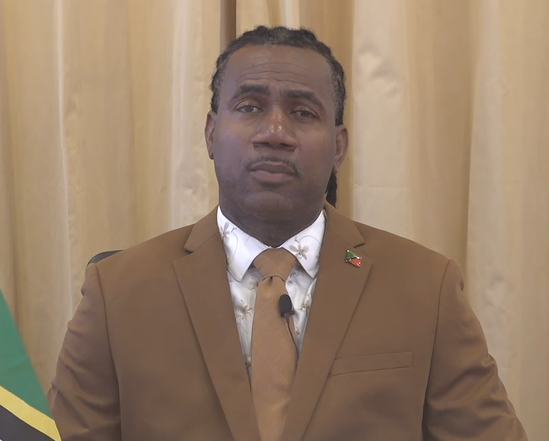
BASSETERRE, St. Kitts – As a fast-approaching November 12, 2026 deadline set by the European Union looms for Caribbean nations operating Citizenship by Investment (CBI) schemes to formally submit their plans for the programmes’ future, prominent opposition figure Shawn Richards, leader of the People’s Action Movement (PAM) and Member of Parliament for Constituency Five, has launched a scathing critique of the Terrance Drew-led Labour Administration for its deliberate lack of transparency on the high-stakes issue.
Richards painted a stark picture of St. Kitts and Nevis standing at a precarious economic tipping point, warning that failure to take urgent, decisive action to prepare for potential CBI programme shutdown would trigger cascading harm that disproportionately falls on the nation’s most vulnerable populations, rather than political elites. “St. Kitts and Nevis is in trouble. When the economic bubble bursts, it will not be the politicians who suffer most. It will be our poor, our working-class families and those who are already struggling to make ends meet,” he asserted, slamming the sitting government for prioritizing information management over responsible national governance, and for allegedly suppressing critical details about the looming crisis ahead of upcoming elections, rather than keeping the public fully informed of tradeoffs that will directly shape their livelihoods.
The opposition leader’s remarks follow public disclosures from Antigua and Barbuda Prime Minister Gaston Browne confirming the EU’s November 12 response deadline, and come against a years-long backdrop of intensifying EU scrutiny of Caribbean CBI frameworks over unaddressed security risks and gaps in applicant vetting that have put the region’s longstanding visa-free access to the Schengen Area under explicit threat.
Richards laid out a detailed timeline of EU outreach to St. Kitts and Nevis and four other Organisation of Eastern Caribbean States (OECS) nations, noting that EU officials first formally requested full closure of the regional CBI programmes in a June 25, 2026 letter. Initial requests for a formal termination response by the end of October 2026, tabled during a September 23 meeting on the sidelines of the United Nations General Assembly in New York, were later pushed back to November 12 after a technical working session in Brussels on October 28.
EU internal affairs and migration authorities presented participating countries with three distinct pathways for moving forward: the first allows jurisdictions to retain their CBI schemes but triggers temporary Schengen visa-free suspension as early as March or April 2027, a measure that could become permanent if programmes are not fully phased out; the second mandates full CBI termination by June 2028 under strict EU oversight; the third permits governments to submit a formal closure notice while negotiating an extended transition timeline, alongside targeted EU financial and technical support to soften the economic blow of the phase-out.
Richards warned that no pathway is without significant risk. An abrupt shutdown would derail ongoing national development projects and put hundreds of jobs across the construction and tourism sectors at immediate risk, while even a phased 2028 closure could spark costly legal disputes with developers, financial institutions, and hundreds of pending CBI applicants who have already paid fees based on existing programme rules.
Citing IMF data, Richards emphasized that CBI revenues made up roughly 6.5% of St. Kitts and Nevis’ total GDP between 2019 and 2023, and accounted for nearly one-third of all non-grant government revenue by 2023. These funds have long underpinned critical public investments in schools, hospitals, road networks, and water and electricity infrastructure, in addition to fueling growth in the country’s two largest economic sectors: tourism and construction. He noted the CBI programme was first launched under former Prime Minister Sir Kennedy Simmonds as a supplementary economic pillar designed to complement tourism investment, not to become the government’s primary revenue stream, and expressed deep disappointment that years of mismanagement by the current administration has left the once carefully designed scheme facing existential threat with no publicly communicated contingency plan to shield ordinary citizens from harm.
Richards questions government’s silence on CBI programme as economic fallout looms