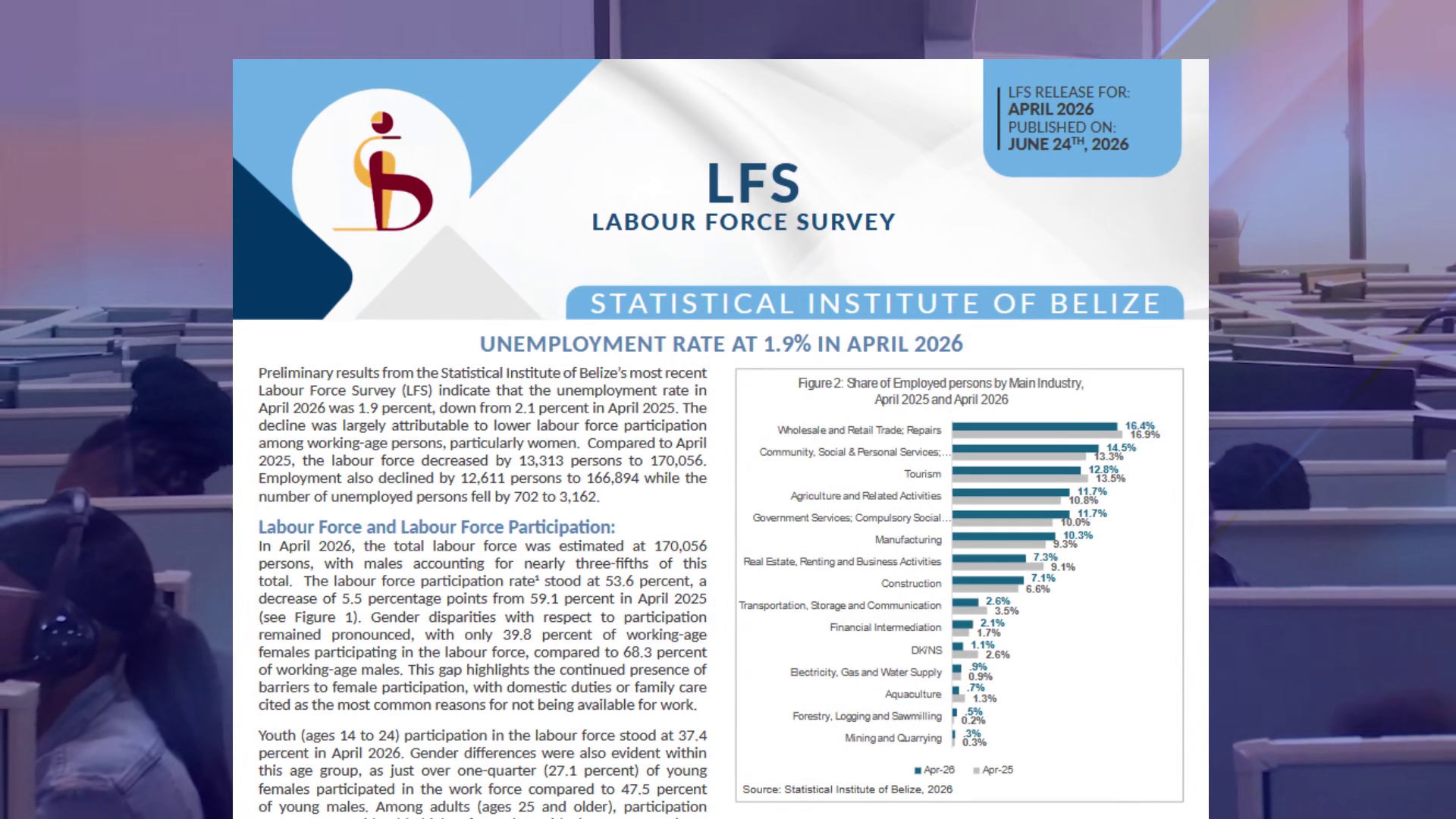
On November 5, 2026, Belize’s Ministry of Governance and Labour wrapped up a three-day multi-stakeholder consultation, convened in partnership with the International Labor Organization and the European Union, to unpack a puzzling and high-stakes labor market paradox: while the country’s headline unemployment rate sits at a remarkably low 1.9%, national labor force participation has plummeted 5.5 percentage points in just 12 months, falling from 59.1% in April 2025 to 53.6% in April 2026, per official Statistical Institute of Belize (SIB) data. That sharp drop means tens of thousands of working-age Belizeans are neither employed nor actively seeking work, even as key growth sectors including tourism, business process outsourcing (BPO), agri-processing and traditional agriculture report widespread unmet demand for skilled labor. Tanya Santos, Chief Executive Officer of the Ministry of Governance and Labour, emphasized during the consultation that stable, accessible employment acts as the backbone of household financial security, community well-being and broad national development, while a skilled, reliable workforce is a non-negotiable prerequisite for private sector expansion, new investment and sustained economic growth. The cross-sector gathering brought together government representatives, private sector leaders, labor advocates and civil society groups to map out targeted solutions that will form the core of Belize’s upcoming 2027–2031 National Employment Policy, as well as a sweeping modernization of the country’s existing labor laws. Valentino Shal, Chief Executive Officer of the Ministry of Rural Transformation, noted that the current regulatory framework was not designed to support Belize’s current economic structure, which is now led by tourism and BPO services rather than the historically dominant agricultural sectors. He highlighted that consistent feedback from private sector operators across all regions of the country points to a pervasive skills mismatch: while there is a large pool of idle working-age residents, most do not hold the specialized certifications, technical competencies or soft skills that growing industries require. Officials confirmed that all feedback collected during the three-day consultation period will be integrated directly into both the five-year national employment strategy and the forthcoming revised labor code, which will be calibrated to address gaps specific to Belize’s highest-priority economic drivers. The government has invited additional public input in the coming weeks to ensure the final policy and regulatory updates are inclusive, responsive to on-the-ground needs, and capable of drawing more disengaged workers back into the formal labor force.