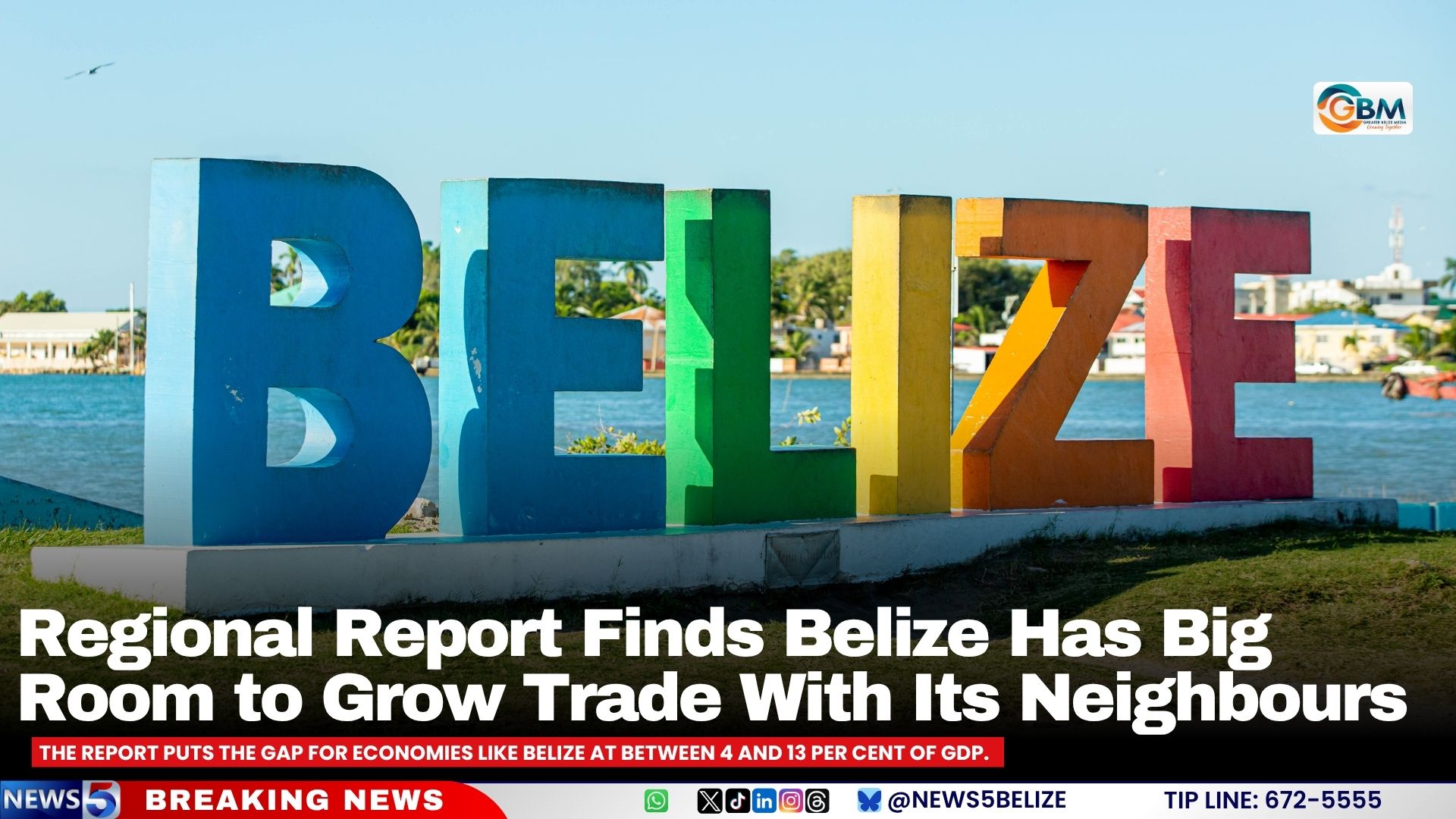
Released on November 5, 2026, the 2026 Latin American Economic Outlook – a collaborative research initiative co-produced by the Organisation for Economic Co-operation and Development (OECD), Latin American development bank CAF, the UN Economic Commission for Latin America and the Caribbean (ECLAC), and the European Union – reveals that Belize’s current trade volumes with neighboring Latin American and Caribbean nations fall drastically short of levels that would be projected for its economic profile.
Drawing on 22 years of historical trade data spanning 2002 to 2024, the report’s gravity model, which calculates expected trade volumes using variables including national economic output, per capita income, geographic proximity, and existing trade infrastructure, estimates Belize’s untapped intra-regional trade gap at 4.6% of its total gross domestic product. This gap ranks as the third largest across the entire Latin American and Caribbean bloc, surpassed only by Uruguay and Ecuador. For small, open economies in the same peer group as Belize, the study notes the typical range of unmet intra-regional trade potential sits between 4% and 13% of GDP, framing these jurisdictions as the highest-growth candidates for cross-border regional commerce expansion, while emphasizing that this upside is conditional on targeted policy action rather than a guaranteed automatic outcome.
Notably, Belize stands out from most of its regional peers for its competitive edge in knowledge-intensive service exports, a stark contrast to the regional average where low-value, travel and transport-focused low-technology services account for 57% of total service exports. Several regional economies lean even more heavily on this low-value service segment, with Bolivia recording a 84% share and Jamaica reaching 87%. Despite this unique competitive advantage, Belize performs poorly on the trade complementarity index, which measures how closely a nation’s export portfolio aligns with the import demand profiles of its regional neighbors, placing it near the bottom of regional rankings alongside Antigua and Barbuda and Guyana. More diversified manufacturing-heavy economies top this metric, with Mexico earning the highest score across the bloc.
The 2026 outlook also highlights Belize’s landmark 2021 debt-for-nature swap, a transformative deal that restructured approximately $550 million in national sovereign debt – equivalent to 30% of the country’s total GDP – and unlocked $180 million in dedicated funding for marine conservation efforts focused on preserving the UNESCO-listed Belize Barrier Reef. Additionally, the report documents ongoing regional policy coordination work led by ECLAC, including a 2026 pilot policy roundtable hosted in Belize City that explored the novel “data embassies” framework, an arrangement that stores sensitive government critical data in a trusted offshore jurisdiction while remaining fully governed by the data owner nation’s domestic laws, to mitigate the risk of total data loss from frequent regional hurricanes and other climate-linked natural disasters.
For the wider Caribbean region, the report also tracks a notable shift in service export destination trends over recent years: the share of total Caribbean service exports bound for the United States has dropped from 48% to 37%, while the European Union’s share of this market has climbed nearly 70% from 13% to 22%, marking a significant reorientation of the bloc’s transatlantic trade ties.