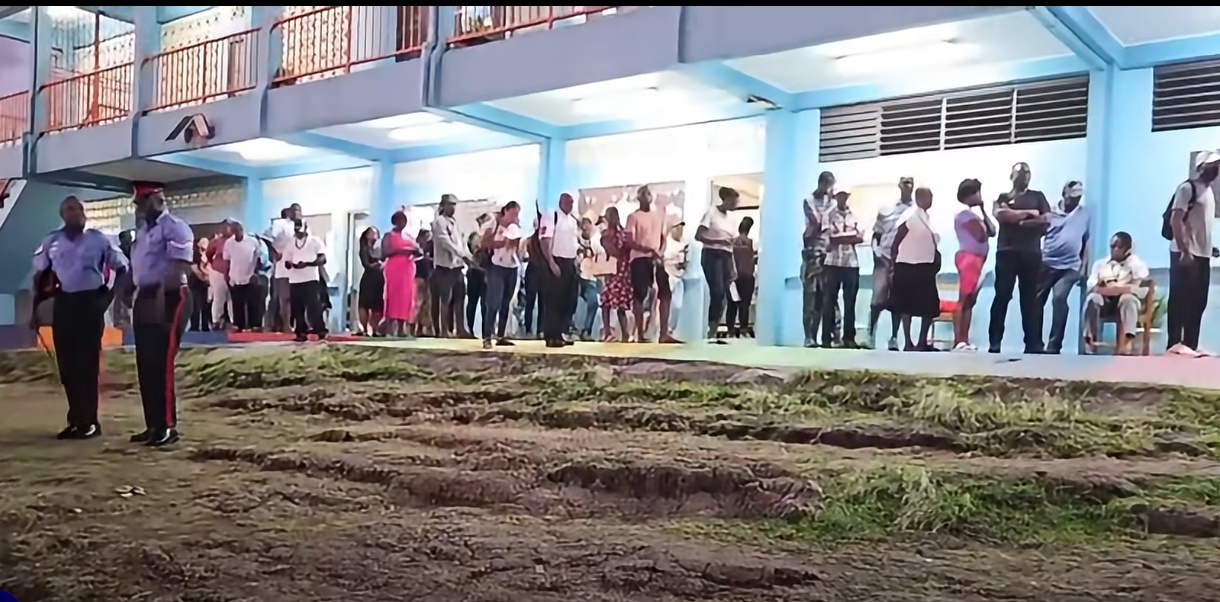
Polling stations across Grenada, Carriacou and Petite Martinique flung open their doors at 6 a.m. local time on election day, as tens of thousands of registered citizens cast ballots in a high-stakes general election that leading regional pollsters warn could end in a virtual dead heat. The Parliamentary Elections Office (PEO) confirmed it had completed all logistical preparations for the vote, with a total of 97,020 eligible electors on the official roll – a nearly 11% surge of 9,454 registered voters compared to the 87,566 who cast ballots in the 23 June 2022 general election. A total of 46 candidates from three major parties and independent aspirants are competing for the 15 seats in the national parliament, with polling stations scheduled to close at 5 p.m. and preliminary unofficial results projected to be announced within two hours of the final ballot box being sealed. The snap election was called a full 12 months ahead of the constitutional deadline by incumbent Prime Minister Dickon Mitchell, who is leading his centre-left National Democratic Congress (NDC) to the polls seeking a fresh mandate after securing a narrow 9-6 parliamentary majority in the 2023 general election. In a nationwide pre-election address delivered the night before voting began, Mitchell, a practicing attorney, reminded constituents of the weight of the public office they granted him four years prior. “Four years ago, you entrusted me with the responsibility of serving as your Prime Minister. It was an honour then, it is an honour now, and it is a responsibility I have never taken lightly,” he stated, framing his re-election campaign around a vision of steady, principled governance that prioritizes tough, transparent decision-making over performative public gestures. “Leadership is not what we say when the camera is on. It is what we are prepared to do when difficult decisions must be made,” Mitchell emphasized. “It means having the courage to engage in difficult national conversations, particularly when those conversations are uncomfortable. It means being consistent in principle, whether speaking in public or behind closed doors.” Facing off against the incumbent is Emmalin Pierre, the historic first female leader of the main opposition New National Party (NNP), who took the reins of the long-ruling party after its iconic founder and former long-serving prime minister Dr Keith Mitchell formally retired from active political life earlier this year. Pierre has centered her campaign on a sweeping 100-day action plan designed to deliver immediate financial relief to working and middle-class Grenadians, including full elimination of taxes on electricity and sugar, the scrapping of the existing water levy, a full income tax exemption for all monthly earnings of EC$6,000 or less, tax-free Christmas bonuses for all workers this year, a new rent-to-own public housing scheme, and the full rollout of a universal National Health Insurance program. “Our plan will put money back in your pocket and put Grenada back on track,” Pierre pledged to supporters, outlining that the ambitious social and economic agenda would be funded by targeted measures to boost national revenue collection, eliminate government waste, and unlock new inclusive economic growth. Pierre is also fighting to hold her own constituency seat against a stiff challenge from incumbent Education Minister David Andrew, who she defeated by a razor-thin margin of just over 200 votes in the 2023 general election. Adding an unexpected wild card to the race is veteran politician Peter David, a former foreign affairs minister who has previously run for office and won seats representing both the NDC and NNP, and now leads his newly launched Democratic People’s Movement (DPM). David is contesting the Town of St George’s parliamentary seat, a constituency he has won four consecutive times dating back to November 2003 without a single election loss. He told supporters that his cross-partisan appeal in the district makes it a model for collaborative, people-first governance that transcends traditional party divides. Political analysts note that David’s unbroken electoral track record in the seat makes him a likely kingmaker in the event of a hung parliament, if the widely cited North American Caribbean Teachers (NACTA) poll prediction of a dead heat between the two major parties holds true. The NACTA survey confirms that final voter turnout rates and the voting choices of undecided, politically unaffiliated electors will be the decisive factors that determine which party secures enough seats to form the next national government. To ensure full transparency and adherence to international democratic standards, independent observer missions from both the Organisation of American States (OAS) and the Caribbean Community (CARICOM) are deployed across the island to monitor polling, vote counting and result tabulation processes from opening to close.