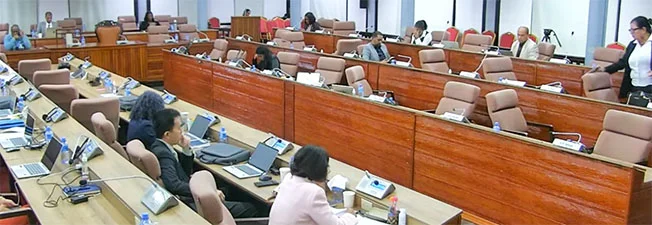
On November 5, the National Assembly (DNA) of Suriname launched a second day of public deliberations on the landmark Tax Administration Justice Act, following a heated first session that laid bare systemic flaws plaguing the country’s current fiscal dispute resolution framework. For decades, the existing system of specialized appeal boards has failed to deliver timely, independent redress for taxpayers: the tax authority currently holds a backlog of objection submissions dating as far back as 35 years, the judiciary lacks dedicated tax law specialists, and there are almost no enforceable safeguards to shield households and small businesses from aggressive, often disproportionate, tax collection actions. The draft legislation, jointly tabled by members of parliament Asis Gajadien of the ruling VHP party and Rossellie Cotino of the NDP, is designed to fully replace the defunct old appeal boards. Under the proposed framework, lower-level canton court judges will preside over first-instance tax dispute cases, with appeals routed directly to the national Court of Justice, a structural overhaul intended to end the long-standing gap in independent legal protection for parties locked in disputes with the tax agency. Leading the parliamentary Rapporteur’s Committee review of the bill, NDP committee chair Rabin Parmessar opened proceedings by emphasizing that two non-negotiable pillars of the final law must be full judicial independence for tax cases and a robust cohort of judges with specialized fiscal law training. Fellow committee members across political parties focused their interventions largely on practical implementation gaps and stronger protections for ordinary taxpayers. Krishna Mathoera (VHP) raised targeted questions about the independence of tax inspectors, standardized competency requirements for specialized judges, and the structural design of new procedures, pushing for explicit clarity on whether taxpayers will be forced to file an internal administrative objection with the tax agency before they can bring a case to court. She also called for provisions to allow tax cases to be heard in regional districts outside the capital, and clear rules for submitting digital case files to judges, noting that the new system must remain simple and accessible rather than creating convoluted processes that deter low-income citizens from exercising their legal rights. Ronny Asabina of the BEP party warned that the tax justice reform cannot be decoupled from the government’s broader ongoing fiscal overhaul agenda, pointing to ongoing unrest among customs officers who have raised fierce objections to their proposed employment status under the new unified national tax authority. He urged the cabinet to enter immediate, constructive negotiations with all relevant stakeholders to prevent the entire reform package from grinding to a halt, and challenged the tax agency’s published data on backlog reductions, asking whether revised re-submitted objection filings had been excluded from the official statistics. Asabina also proposed mandatory legal quality standards for professional tax consultants, standardized case file management protocols, and a scheduled multi-year evaluation of the entire modernization program, stressing that draft laws must be not just legally sound on paper, but practically enforceable in real-world contexts. NDP representative Jennifer Vreedzaam highlighted gaps in judicial system capacity and risks associated with the transition from the old appeal boards to the new tax court structure. While the bill explicitly allows taxpayers to represent themselves without hiring a lawyer, she noted that most small business owners and citizens with no formal legal training will struggle to navigate complex procedural rules unassisted, and proposed introducing free or low-cost guidance from certified tax experts to help members of the public file their cases correctly, alongside clear transitional rules for processing the decades-old backlog of pending objection submissions. VHP committee member Hakiem Lalmahomed pushed to slash the maximum allowed window for a tax inspector to rule on an administrative objection from the proposed two years down to a strict six months, arguing that a two-year timeline is deeply unfair to taxpayers who may face immediate frozen assets or collection penalties while waiting for a decision. He added that any extension beyond the six-month limit should only be permitted in exceptional, objectively verifiable circumstances, with a full written public justification. Lalmahomed also raised serious constitutional concerns about Article 22 of the draft bill, which would allow tax court judges to order warrantless entry to private residential properties under certain conditions, demanding stricter safeguards including a pre-approved written judicial order, mandatory proportionality checks, and clear limits on the definition of “manifestly unreasonable procedural conduct” to prevent citizens from abandoning valid legal challenges for fear of being ordered to pay crippling court costs. NPS representative Jerrel Pawiroredjo questioned a recent proposal from the tax agency to restaff and reactivate the defunct old Board of Appeal, noting that the body failed to function properly for decades and running it in parallel with the new dedicated tax court would create widespread public confusion. He emphasized that the new tax judiciary must be mandated to review not just whether tax laws were applied correctly, but also whether the tax authority acted in line with fair administrative practice standards. Pawiroredjo also called for robust interim legal protection for taxpayers, noting that small business owners contesting an unfair tax assessment should not be left powerless while aggressive collection measures threaten to shut down their operations entirely, and that clear expedited redress rules must be established for customs disputes where perishable or high-value cargo is seized at ports. He added that the new court must be allocated sufficient trained staff to ensure the 35-year backlog is fully cleared and similar multi-decade delays never occur again. Ebu Jones of the NDP targeted multiple clauses in the draft bill that he argued would erode taxpayer legal protections, proposing a formal scheme of reduced, deferred, or fully waived court filing fees for low-income taxpayers who can prove they lack sufficient financial resources. He also pushed back against proposed rules that would shift and increase the burden of proof onto taxpayers, arguing that minor administrative errors should never trigger disproportionate legal sanctions. Jones further criticized Article 42 paragraph 4, which currently grants automatic suspensive effect to appeals filed by the tax agency, meaning that a court ruling in favor of a taxpayer can be put on hold indefinitely while the government pursues an appeal; he proposed replacing the automatic suspension rule with a case-by-case judicial assessment to decide if a pause on enforcement is justified. He also rejected the transitional provisions in Article 50, which would bar citizens who filed old pending objections from accessing the new legal redress system, leaving the people who have waited decades for resolution with no path to justice. At the close of the first session, committee members confirmed that the government and the bill’s original sponsors will present formal responses to all proposed amendments during the continuation of the public plenary later the same day, with the stated goal of finalizing a revised bill that is fully independent, accessible, and practically workable for all stakeholders.
Commissieleden vrezen dat nieuwe belastingrechtspraak burgers onvoldoende beschermt