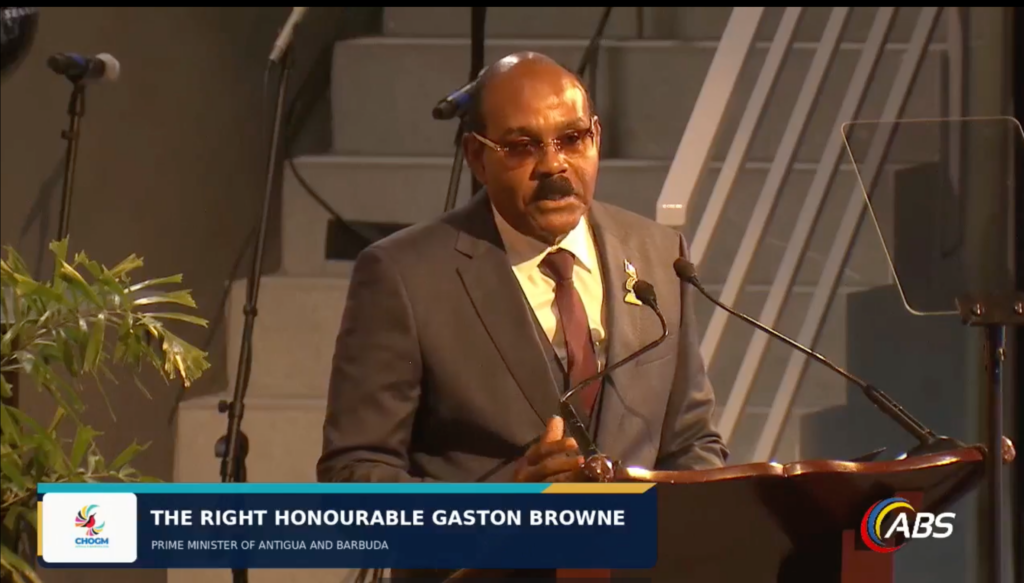
Delivering a landmark address at the official opening of the 28th Commonwealth Heads of Government Meeting (CHOGM) hosted in Antigua and Barbuda, Prime Minister Gaston Browne has formally called on the 56-nation intergovernmental bloc to translate its 2024 Samoa summit commitments into actionable, structured, inclusive dialogue on reparatory justice for the enduring harms of chattel slavery and colonialism. Flanked by Commonwealth Head King Charles III, Queen Camilla, and dozens of global leaders, Browne framed the push for reparatory accountability as a core pillar of building a fairer, more equitable global order rather than a confrontational demand that undermines cross-member cooperation.
Browne emphasized that the historic consensus reached at the October 2024 Apia, Samoa summit — where Commonwealth leaders formally acknowledged the shared traumatic histories of transatlantic enslavement, Indigenous dispossession, indentureship, and colonial exploitation, alongside their persistent intergenerational impacts — must not remain a symbolic gesture. The Samoa communiqué stopped short of establishing binding financial compensation mechanisms or assigning formal liability to former colonial powers, laying down only a loose framework for future inclusive discussion that centers the disproportionate harms experienced by women and girls.
The Antiguan prime minister’s intervention comes on the heels of a notable shift in UK policy, where newly installed British Prime Minister Andy Burnham’s administration has signaled openness to negotiating a formal public apology for the United Kingdom’s central role in the transatlantic slave trade, alongside structured consultations with affected nations and communities on the terms of that apology. However, London has explicitly maintained its opposition to direct financial reparations, leaving a major unresolved point of friction between the British government and Caribbean member states that have led the global reparatory justice campaign for decades.
Browne welcomed the UK’s willingness to discuss a formal apology in an October 31 pre-summit statement, describing the move as a critical step toward historical reconciliation that could heal long-standing rifts and strengthen bilateral ties between Britain and historically impacted nations. Even so, he clarified that the Caribbean’s long-held official position on full reparatory justice remains unchanged, stressing that impasses over financial compensation must not derail collaborative progress on shared areas of common ground. He further demanded that all forthcoming dialogue with the UK operate on a clear, defined timetable, producing tangible, measurable outcomes rather than devolving into open-ended, unproductive diplomatic proceduralism.
The coordinated regional push for reparatory justice has been led by the Caribbean Community (CARICOM) since the 2013 launch of the CARICOM Reparations Commission, a body whose mandate extends far beyond monetary compensation to include formal public apologies, targeted public health interventions, expanded historical education curricula, cultural heritage restoration, dedicated historical research funding, and targeted development initiatives designed to redress centuries of systemic disadvantage. Ahead of CHOGM 2024, Commission Chair and University of the West Indies Vice Chancellor Sir Hilary Beckles reaffirmed the region’s commitment to constructive, non-confrontational engagement with the UK and other former European colonial powers to advance full historical accountability.
King Charles III, in his own opening address to the summit, expressed profound sorrow over the atrocities of the transatlantic slave trade and acknowledged its persistent, painful intergenerational legacy, but notably declined to issue a formal state apology, a move that fell short of longstanding demands from Caribbean reparations advocates.
Browne intentionally situated the reparatory justice campaign within a broader, sweeping agenda to reform the global political and economic systems that perpetuate structural disadvantage for small, developing Commonwealth nations. He highlighted that smaller member states face systemic barriers in global development financing, unsustainable sovereign debt burdens, and disproportionate exposure to catastrophic climate disasters, with little input into the global policy decisions made by wealthier, more powerful nations that directly shape their national outcomes. The prime minister called on the Commonwealth to advance global financial reform frameworks that allocate support based on national vulnerability rather than solely national income metrics, alongside tailored debt relief clauses that allow disaster-stricken small island states to rebuild without sacrificing long-term development goals. While he welcomed parallel UK proposals to expand development assistance and improve debt terms for vulnerable Commonwealth nations, Browne emphasized that current-day development support must never be framed as a replacement for formal reckoning with historical harms.
As the incoming Commonwealth Chair-in-Office, Browne pledged to collaborate closely with member governments, Commonwealth Secretary-General Shirley Ayorkor Botchwey, and the Commonwealth Secretariat to deliver measurable, practical results across all shared bloc priorities, framing the entire reparatory justice push as a test of the 75-year-old organization’s ongoing relevance for its two billion combined citizens. He argued that the diverse Commonwealth — which spans nations of wildly varying population sizes, wealth levels, and historical trajectories — is uniquely positioned to lead the formation of a more balanced, equitable global governance system, so long as it has the courage to confront uncomfortable shared histories rather than shying away from difficult conversations.
While the UK’s openness to negotiating a formal apology marks an unprecedented diplomatic opening, major unresolved questions remain over the scope of planned reparations dialogue, stakeholder participation parameters, the full range of remedies under consideration, and whether final outcomes will meet the core demands of nations and communities historically harmed by slavery and colonialism. For Caribbean governments, the Antigua-hosted CHOGM represents a pivotal moment to move past the symbolic acknowledgment secured in Samoa and lock in a formal, time-bound process to redress centuries of exploitation. Browne’s core message to assembled leaders was clear: confronting shared historical harms is not an obstacle to Commonwealth cooperation, but a necessary foundation for building far more equal, respectful, and mutually beneficial relationships across the bloc. As the summit proceedings unfold, the central lingering question for observers remains whether the collective commitment to dialogue will translate into tangible, actionable progress long after heads of government depart Antigua and Barbuda.