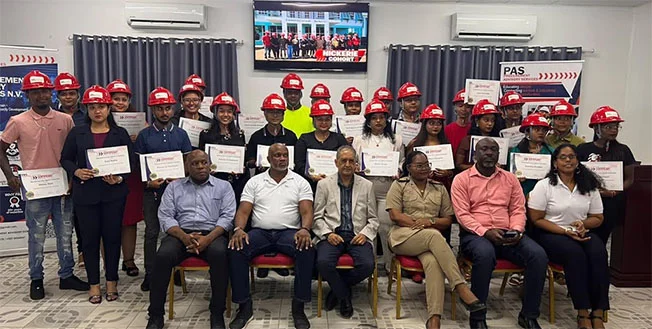
Suriname’s Ministry of Public Health, Welfare and Labour has unveiled a targeted workforce development roadmap to upskill roughly 3,000 local residents with industry-specific vocational training by the end of 2027, a proactive measure to capitalize on the projected surge in job openings driven by the rapid expansion of the nation’s oil and gas industry. Undersecretary Raj Jadnanansing laid out the government’s strategy on October 30 during a formal certification ceremony for 24 graduates of a two-week Warehouse & Logistics Employee training program held in the Nickerie district, noting that the oil and gas sector alone is projected to generate between 6,000 and 7,000 new roles over the next two years, with additional indirect positions set to emerge in supporting adjacent industries. Jadnanansing emphasized that sustained, targeted vocational training for unemployed job seekers and marginalized community groups must become a permanent core component of national labor market policy, to avoid a scenario where newly created high-value roles go unfilled by qualified local workers and force employers to bring in external labor. The undersecretary clarified that the 6,000 to 7,000 job projection remains a preliminary estimate, with the exact number of roles and their rollout timeline dependent on ongoing sector development milestones and incoming foreign and domestic investment flows. He further noted that the oil and gas boom will not only create direct operational positions in extraction and production, but also drive sharp demand for skilled staff across logistics, distribution, and a wide range of business support services, making targeted upskilling for these adjacent roles just as critical as training for core energy sector positions. The recently completed Nickerie warehouse training was delivered by local firm Procurement Advisory Services N.V. under a contract with the national Welfare and Labour Directorate, as part of the broader Leri Fu Feni Wroko project funded via the Inter-American Development Bank (IDB)’s Labour Market Alignment with New Industries program. Built on the industry-aligned Training for Employment (TFE) framework, the curriculum is designed to teach participants practical, employer-validated skills rather than abstract theory: over two weeks, trainees completed hands-on modules covering goods receiving, inventory management, storage protocols, shipment preparation, workplace safety standards, efficient warehouse administration, and end-to-end supply chain record keeping. To ground their learning in real-world operational contexts, the cohort also completed site visits to a local rice processing facility and a regional healthcare institution in Nickerie, where they observed day-to-day warehouse operations, inventory storage practices, and stock tracking systems in action. The national vocational training rollout is already expanding beyond Nickerie: an identical warehouse and logistics training cohort launched in the Wanica district on October 28, running through December 16 with 125 total participants drawn from districts across the country. Following the conclusion of the Wanica program, the 2026 TFE series will continue in 2027 with scheduled sessions in the Para and Commewijne districts. Undersecretary Jadnanansing confirmed that the parallel Leri Fu Feni Wroko and Wroko Fu Meki Moni programs are on track to hit the 3,000 total trainee target by the 2027 deadline. During the Nickerie certification event, program manager Oyeleye Adeniyi, Procurement Advisory Services director Guilliano Doest, and Nickerie district secretary Rita Eduards all echoed the undersecretary’s remarks on the transformative value of practical, industry-tailored skills training. While the newly awarded certifications will significantly boost the 24 graduates’ employability, officials stressed that the training does not come with a guaranteed job placement, and the core long-term challenge for the government will be to continuously refine training curricula to match evolving workforce demands from private sector employers, ensuring that Suriname’s coming economic expansion translates directly to shared, inclusive employment gains for local residents rather than missed opportunities for the domestic workforce.