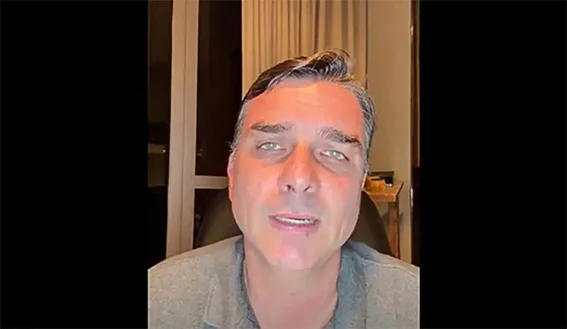
On November 1, details emerged surrounding the dramatic departure of prominent Brazilian opposition senator Flávio Bolsonaro, the eldest son of former far-right president Jair Bolsonaro, who fled Brazil for the United States shortly after losing the October 30, 2026 presidential runoff to incumbent Luiz Inácio Lula da Silva. In his first extensive public social media video statement, the defeated conservative candidate claimed he left his home country to escape targeted political persecution, a decision he said he made in secret alongside his wife after a visit to his father, who is currently under house arrest serving a 27-year sentence for his role in the 2022 attempted coup to block the peaceful transfer of power after that year’s election.
The sequence of events unfolded rapidly after Supreme Court Justice Alexandre de Moraes issued a formal court order mandating Flávio Bolsonaro surrender both his regular and diplomatic passports, and imposing a strict travel ban barring him from leaving Brazilian territory. The judicial measures were requested as part of two active federal investigations: one into alleged money laundering linked to suspicious financial transactions through unregulated online gambling platforms, and a separate probe into unreported funding for a partisan documentary chronicling Jair Bolsonaro’s political career. Flávio Bolsonaro has repeatedly rejected all allegations of wrongdoing, and no formal convictions have been handed down in either ongoing case to date. Federal authorities confirmed that Bolsonaro never complied with the order to submit his travel documents, leading Brazilian immigration systems to flag his passports as invalid and issue a nationwide travel alert.
Despite the official travel ban, Bolsonaro, his wife, and their two daughters departed Brazil on October 27, traveling through Argentina’s Misiones border province before boarding a private aircraft bound for Guayaquil, Ecuador, and finally landing at Opa Locka Executive Airport in Miami, Florida the following day. No record of his exit appears in Brazil’s official border control logs, prompting the Federal Police to launch a formal investigation into how the senator evaded standard immigration checks. Federal Police officials clarified that while Bolsonaro violated the court-ordered travel ban, the revocation of his passports does not automatically classify him as a fugitive or justify an immediate arrest warrant, as authorities work to trace the full circumstances of his unauthorized exit.
The United States government confirmed it has granted valid U.S. visas to Bolsonaro and his entire family, allowing them to legally reside on American soil. Former U.S. President Donald Trump previously made public critical remarks about Brazil’s 2026 electoral process, though U.S. officials have explicitly declined to endorse Bolsonaro’s unsubstantiated claims of election fraud. In his viral Instagram live broadcast, the senator offered no concrete evidence to back up his accusations of electoral irregularities, analogizing alleged unchallenged fraudulent votes to illegitimate soccer goals approved even after video assistant referee review. He refused to unconditionally concede his election loss to Lula, and teased plans to relaunch his presidential ambitions far earlier than the next scheduled 2030 Brazilian general election, without elaborating on what that timeline would entail. He also predicted Lula’s second term would trigger a catastrophic collapse of the Brazilian national economy, and confirmed he intends to lead the national conservative opposition movement remotely from his new base in Florida. Notably, his own Partido Liberal (PL) party, the official political home of the Bolsonaro political movement, has already formally recognized Lula’s 2026 election victory.
Bolsonaro’s unapproved cross-border transit through Argentina has ignited a sharp diplomatic rift between the two South American neighbors. Brazil’s Ministry of Foreign Affairs summoned Argentina’s chargé d’affaires María Emilia Cortés on Thursday to demand a full official explanation of how the banned senator was permitted to pass through Argentine territory, in direct violation of an active Brazilian Supreme Court judicial order. Long-simmering tensions between Lula and Argentine President Javier Milei, a vocal ideological ally of the Bolsonaro family, have been amplified by the incident: Milei publicly endorsed Flávio Bolsonaro during the 2026 campaign and has refused to formally recognize Lula’s latest election win. A senior Milei administration spokesperson posted on social media framing Bolsonaro’s escape as a rescue from what they described as a communist plot to imprison leading opposition figures. Argentine officials have pushed back against Brazil’s account of the diplomatic meeting, claiming Cortés was never formally summoned for a reprimand. The two nations had already recalled their respective ambassadors earlier in 2026 following a series of public spats between Lula and Milei, leaving bilateral relations at their lowest point in decades.
As of press time, Brazilian Federal Police investigators have not uncovered conclusive evidence linking Bolsonaro’s unauthorized exit to any third-party accomplices, and the senator has publicly urged authorities not to target or punish any other individuals for facilitating his departure. Legal experts note that Bolsonaro’s decision to operate his national opposition campaign from U.S. territory creates unprecedented cross-border legal and political complications, as Brazilian judicial authorities navigate the process of serving new legal summonses and advancing ongoing financial crime investigations against a leading political figure residing overseas.