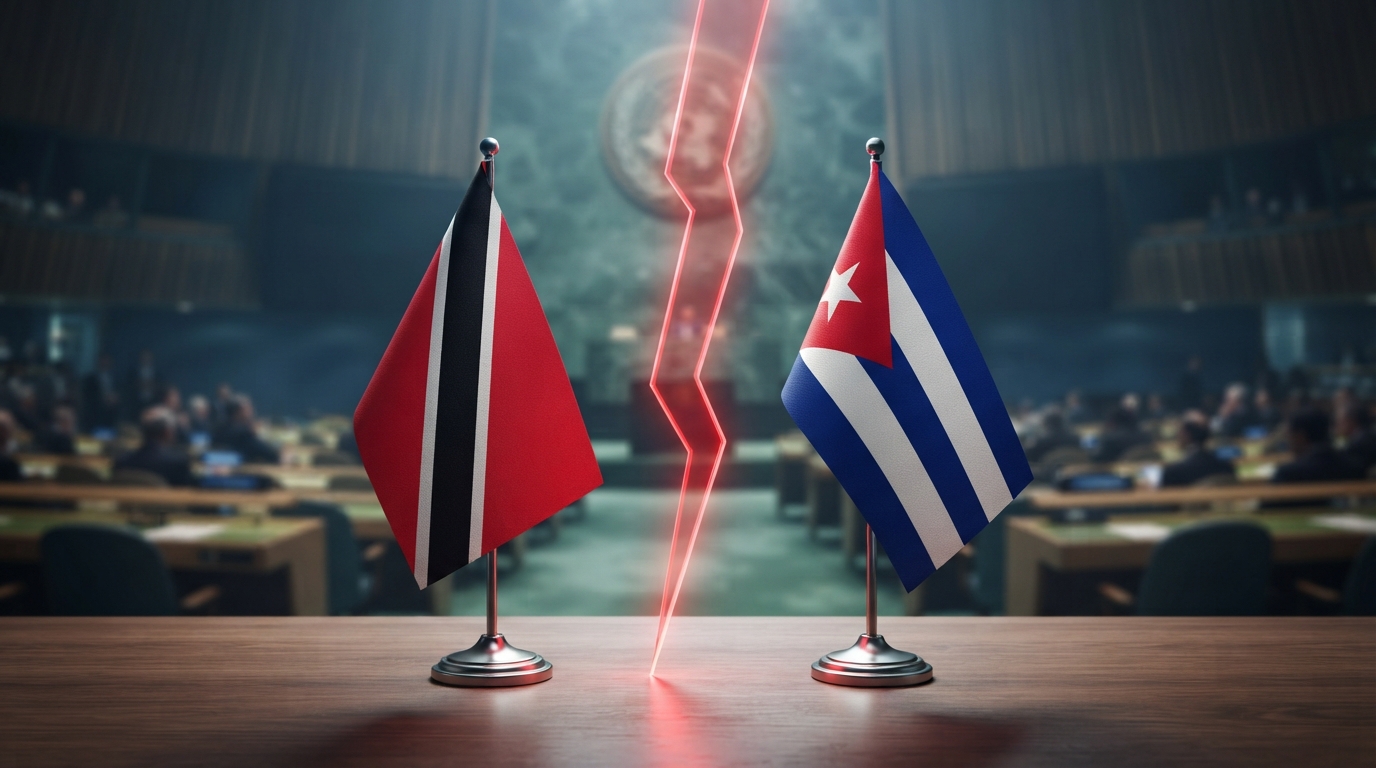
On October 28, 2026, during the annual United Nations General Assembly plenary session on Cuba-related policy, the twin-island Caribbean nation of Trinidad and Tobago made an unprecedented diplomatic choice that shattered 34 years of established foreign policy convention: it cast a vote against the long-standing non-binding resolution demanding an immediate end to the United States’ decades-old economic embargo on Cuba. This marks the first time since the country’s initial abstention on the equivalent resolution in 1992 that Port of Spain has taken an active opposing stance, placing it in a tiny cohort of just 17 nations that voted against the measure, alongside the U.S. and Israel.
Even though the resolution passed for the 34th straight year with 130 affirmative votes and 25 abstentions, global support for ending the U.S. embargo dipped to its lowest recorded level in decades, a shift widely attributed to a high-pressure, targeted lobbying push deployed by the U.S. administration in the lead-up to the ballot.
In the immediate aftermath of the vote, Trinidad and Tobago’s sitting Prime Minister Kamla Persad-Bissessar and Minister of Foreign and CARICOM Affairs Sean Sobers moved aggressively to defend the abrupt policy pivot, releasing public statements and delivering formal addresses to the House of Representatives framing the new alignment as a principled stand rooted in unwavering commitments to democratic governance, political pluralism, and universal human rights. Persad-Bissessar, leader of the ruling United National Congress, emphasized that the administration’s position was targeted exclusively at Cuba’s ruling political leadership rather than its civilian population, claiming that Havana’s governing elite exploits ordinary Cubans to fund excessive, lavish lifestyles while everyday citizens grapple with crippling economic deprivation.
The unanticipated policy shift has sparked a firestorm of cross-sector condemnation across the Caribbean region, drawing fierce pushback from regional diplomatic representatives, independent political analysts, and former national leaders who accuse the Persad-Bissessar administration of discarding generations of long-held, bipartisan foreign policy principles. Most notably, Trinidad and Tobago stands as the sole member of the 15-nation CARICOM bloc to cast a negative vote on the resolution: seven other Caribbean member states voted in favor of lifting the embargo, while regional neighbors including Jamaica, Guyana, and Haiti chose to abstain, leaving Port of Spain completely isolated within its traditional regional diplomatic alliance.
Former Trinidad and Tobago Prime Minister Dr. Keith Rowley issued a scathing rebuke of the current administration via public social media channels, dismissing the vote as “shameful” and arguing that the governing party has become “decisively disconnected from the people they are supposed to represent.” His successor as former Minister of Foreign and CARICOM Affairs, Dr. Amery Browne, went further to label the vote “disgraceful,” noting that the decision directly undermines Trinidad and Tobago’s decades-long, publicly stated commitment to core UN Charter principles of non-intervention and non-interference in the domestic governance of all sovereign nations.
Critics have also zeroed in on the deeply problematic timing of the vote, which landed as Cuba grapples with a catastrophic nationwide humanitarian and energy crisis marked by crippling fuel shortages, cascading electrical grid failures that leave communities without power for days at a time, and widespread shortages of essential food and medical supplies. Opponents of the new policy argue that by voting against the resolution to end the embargo, Trinidad and Tobago has effectively positioned itself as a complicit party in the ongoing economic strangulation of ordinary, vulnerable Cuban civilians.
While the U.S. Embassy based in Port of Spain released an official statement thanking the Trinidadian government for “standing with the Cuban people and their hope for freedom,” local critics and regional diplomatic figures broadly allege that the Persad-Bissessar administration has surrendered its long-guarded independent diplomatic judgment and abandoned decades of cross-Caribbean solidarity purely to curry political favor with Washington.