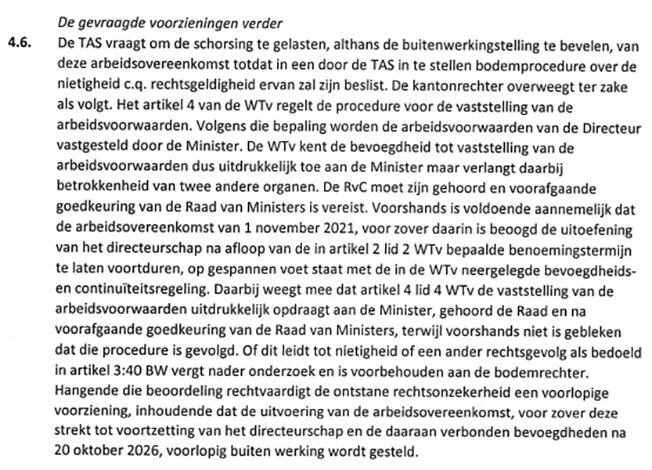
A newly reviewed 1 November 2021 employment contract signed by then-chair of Suriname’s Telecommunications Authority (TAS) Harish Monorath for agency director Wendy Jap-A-Joe has sparked widespread scrutiny over potential breaches of national labor law and statutory governance protocols, raising critical questions about whether Monorath prioritized the public institution’s interests over unorthodox, financially burdensome terms for its top executive. As a public sector body established by legislation to deliver critical telecommunications regulatory duties, TAS is bound by strict legal guardrails for all employment decisions, yet the signed agreement deviates sharply from both 2021 civil code rules and the dedicated Telecommunications Provisions Act. The contract’s termination clauses stand out as particularly anomalous: for Jap-A-Joe, a 12-month notice period is required if she voluntarily departs after three years of continuous service, double the 6-month maximum permitted for employees under the 2021 Civil Code Article 1615i paragraph 5. For TAS, the required notice period stretches to a minimum of 24 months, alongside provisions that could mandate up to 36 months of full salary and benefit payouts to the director in specific scenarios — far exceeding the legal requirement that employer notice periods be at least double the employee’s maximum 6-month allowance. Beyond the labor law violations, the contract entirely bypasses mandatory statutory procedure laid out in Telecommunications Provisions Act Article 4 paragraph 4, which explicitly requires that the director’s employment terms be formally set by the relevant minister, following consultation with TAS’s supervisory board and formal approval from the Council of Ministers. No such ministerial determination or Council of Ministers sign-off was ever obtained for Jap-A-Joe’s compensation package; the contract only references a 16 June 2021 Council of Ministers decision that approved her initial appointment, a separate administrative step that does not satisfy the legal mandate for employment term oversight. The full compensation package outlined in the agreement compounds these concerns: Jap-A-Joe receives a gross monthly salary of $4,000, plus a 15% representation allowance, miscellaneous expense reimbursements, performance bonuses, paid vacation benefits, and premium pay for irregular working hours, alongside comprehensive private medical coverage, a €125,000 life insurance policy, and a company car that would transfer to her ownership for no cost upon contract termination. While individual executive benefit provisions are not inherently unreasonable, the cumulative weight of the generous compensation paired with the multi-year notice and payout obligations creates long-term unplanned financial liabilities for the publicly funded TAS, threatening its operational flexibility for future leadership transitions. The scrutiny carries extra weight due to Monorath’s professional background: at the time of signing, he was not only the TAS supervisory board chair but also a licensed attorney and former dean of Suriname’s Bar Association, a senior legal role that demands exceptional rigor in upholding statutory compliance for public entities. In a 26 October summary ruling, a lower district court confirmed that Jap-A-Joe’s statutory appointment term had expired and she was no longer legally permitted to serve as TAS director, issuing a provisional judgment that the 2021 employment contract fails to meet the authority requirements laid out in the Telecommunications Provisions Act. The court temporarily suspended enforcement of the entire agreement, noting that a full formal civil trial will be required to issue a final ruling on whether the contract is fully voided under law. Even with the provisional ruling, significant unanswered questions remain about Monorath’s conduct, particularly as he currently serves as Suriname’s Minister of Justice and Security. No public explanation has been provided for why the senior legal official signed an agreement that deviates so sharply from established legal protocols, leaving outstanding concerns over his governance accountability, professional credibility, and personal integrity in public office.